Small-batch lunchbox bakers
If you usually make one batch at a time, look for a stated dough limit that suits your recipe and a machine you have room to store.


Choose a food processor that explicitly lists a dough blade or kneading capability, then compare your usual biscuit recipe with its stated dough limit where one is available. A compact model may suit occasional small batches, while a larger machine makes more sense for repeated baking or wider food preparation; bowl volume alone does not establish how much dough it can handle.
If you usually make one batch at a time, look for a stated dough limit that suits your recipe and a machine you have room to store.
If you prepare several lunchbox portions or bake for a household, a published dough limit helps you judge whether you will need to split a recipe.
If the processor will also chop, slice or grate food for other meals, check which attachments come with the exact model and where they will be stored.
For consumers choosing a processor for lunchbox biscuit dough, start with dough handling, then consider how often you bake and what else the machine needs to do.
| Concern | What to check | Who this matters to |
|---|---|---|
| Dough handling | Check for an included dough blade or stated kneading capability. Compare your recipe weight with a model-specific dough limit where published. | I want to make my usual biscuit dough without assuming a chopping blade is suitable; around 36% of consumers would put dependable dough handling first. |
| Batch capacity | Compare the stated maximum dough quantity with your recipe; keep it distinct from bowl volume or working capacity. | When I bake for several lunchboxes, I want to avoid splitting one recipe into repeated loads; roughly 29% of consumers would make batch capacity their main concern. |
| Storage and versatility | Check external dimensions, included attachments and how they are stored. | For an occasional batch, I need the machine to fit my cupboard and earn its space on other food-preparation tasks; around 21% of consumers would put this first. |
| Allergen-aware preparation | Check the school's policy and any child-specific arrangements, then follow the manufacturer's cleaning instructions for the parts used. | If a known allergy affects the lunchbox, I need to plan ingredients and avoid cross-contact rather than rely on the appliance alone; roughly 14% of consumers would prioritise this need. |
A roomy bowl does not, by itself, tell you the maximum quantity of dough the processor can handle. Bosch GB publishes separate bowl-volume and dough-content figures for its MCM3501MGB and MC812S734G.
Use the exact model's stated dough limit where available. Otherwise, check its manual or ask the manufacturer before planning a large recipe.
A larger machine may be useful for frequent batch baking, but extra bowl space offers little help if you normally make one modest batch.
Note your usual recipe's dough weight and how often you bake, then compare those needs with the processor's dough limit and dimensions.
Cleaning removable parts is only one part of preparing food where a known allergy or school food policy matters. Ingredient choices and avoiding cross-contact also need attention.
Check the school's policy and any arrangements for the child, then follow the processor manufacturer's cleaning instructions for the parts you use.
Bosch GB publishes dough-content limits for both the compact MultiTalent 3 MCM3501MGB and the larger MultiTalent 8 MC812S734G.
KitchenAid UK lists a 3.1 L bowl and an included dough blade for the 5KFP1319, alongside attachments for other food-preparation tasks.
Magimix presents the 4200XL as an option for cooks interested in stated kneading capability and long-term parts support.
This food processor is a multi-use choice for consumers who want to prepare dough alongside other foods. Check the model guidance against your biscuit recipe before relying on it for a particular batch size.
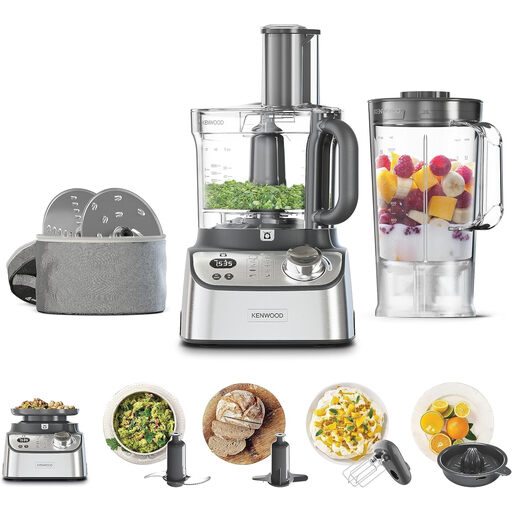 Image unavailable
A multi-use option if you want one appliance for dough and other food preparation; check the model manual for guidance on your biscuit recipe and dough quantity.
3 L capacity, 1000 W, eight accessories and an integrated digital scale.
Not necessarily: bowl volume and maximum dough quantity are different specifications. Bosch GB lists a 2.3 L usable bowl volume and 0.8 kg maximum dough content for the MCM3501MGB, versus a 3.9 L bowl and 1.5 kg maximum dough content for the MC812S734G; use the figures for the exact model you are considering.
Choose a model that explicitly lists a dough blade or kneading capability rather than assuming its chopping blade is intended for dough. KitchenAid UK lists a dough blade with the 5KFP1319; check what comes with the exact model and follow its recipe guidance.
Check the school's allergy policy and any arrangements that apply to your child before packing homemade biscuits. In England, the Department for Education says schools must publish an allergy safety policy; ask your school how its arrangements apply to food brought from home.
It is worth weighing up if you expect to use the processor frequently over many years, alongside its fit for your usual dough batches. Magimix lists a 30-year motor guarantee and 30-year spare-parts availability for the 4200XL; check the applicable terms before choosing it on that basis.