Shared-kitchen biscuit bakers
When several people use the same bowl, blade and worktop, you need a practical way to clean the equipment and hand it over, as well as a processor suited to your dough.


Choose a compact food processor if you usually make modest biscuit-dough batches and need to put it away after use; for larger or repeated batches, look for a model with a stated pastry or dough-processing limit. In a shared kitchen, removable parts and convenient storage also matter, but dishwasher-safe parts do not replace a cleaning routine, particularly when food is prepared for sale or catering.
When several people use the same bowl, blade and worktop, you need a practical way to clean the equipment and hand it over, as well as a processor suited to your dough.
If you regularly make several trays, compare your recipe quantity with the exact model’s stated pastry or dough limit rather than its bowl volume alone.
For modest batches in a kitchen where equipment must be put away, storage fit and the model’s dough instructions may matter more than a large bowl.
Choose when: Batches are modest and the appliance must be stored between users.
Trade-off: Larger recipes may need splitting; follow the exact model’s dough-processing limit.
Choose when: Larger quantities or repeated batches are routine and the stated limit fits your recipe.
Trade-off: Allow for the machine’s weight, storage space and cleaning access.
| Concern | Buying checks | Who this matters to |
|---|---|---|
| Cleaning and allergen control | Check which food-contact parts can be removed and how the manufacturer says to clean them. Plan for cleaning the appliance and work area between users. | When different people use the processor, I need to clean the parts that touched the previous dough before starting mine; around 42% of consumers would put this shared-use routine first. |
| Dough batch capacity | Compare your recipe with the exact model’s stated pastry or dough limit and processing instructions, not just its total bowl volume. | If I make several trays, I want a batch size that avoids unnecessary repeat runs without exceeding the machine’s instructions; about 33% of consumers would prioritise dough capacity. |
| Storage and modest batches | Measure the cupboard space and check the machine’s dimensions, weight and accessory storage. | For occasional baking, I need to clear the shared worktop after making a small batch; roughly 25% of consumers would put easy storage first. |
A bowl’s total volume is not the quantity of pastry or biscuit dough the processor is intended to handle. Magimix, for example, publishes separate short-crust-pastry limits for its models.
Compare the exact model’s pastry or dough instructions with your recipe, and split the mixture if the stated limit requires it.
Dishwasher-safe attachments can simplify cleaning, but the label alone does not establish that food-contact parts and the work area have been cleaned effectively. GOV.UK says food businesses must be able to demonstrate effective cleaning.
Set a handover routine for the bowl, lid, blades and work area. If food is prepared by a food business, include the cleaning and allergen procedures appropriate to that operation.
Processing times can be model-specific: Kenwood warns against running its MultiPro Go for longer than 30 seconds when following its dough instructions, to prevent motor overheating.
Follow the instructions for your exact machine and quantity rather than extending a cycle to make up for a small batch limit.
A higher-capacity processor can be awkward to move and put away in a shared kitchen. Magimix lists its 3160 at 6.7kg, making handling worth considering alongside capacity.
Measure the intended storage space, check the exact model’s weight and dimensions, and decide where its accessories will go after cleaning.
Relevant if a model-specific pastry limit is central to choosing a processor for repeated batches.
Its MultiPro Go range is relevant to modest dough batches where putting the processor away matters.
Selected BN-series accessories and cleaning instructions are worth checking for a shared-use setup.
These processors are relevant to making dough where cleaning between users also matters. Compare each model’s dough instructions and storage fit before choosing; the Ninja model is listed for household use only.
 No image available
For shared-kitchen dough making, compare your recipe with this model’s dough-processing instructions and plan how its parts will be cleaned between users.
The named variant has a 3L bowl, 1000W rating, eight accessories and an integrated digital scale. Check its dimensions against the intended storage space.
 No image available
Consider this model where dough preparation and cleaning attachments between users are priorities; check its instructions against your usual biscuit batch.
The named variant has a 3L bowl, 1000W rating, six accessories, a pulse function and dishwasher-safe attachments. Measure the storage space before buying.
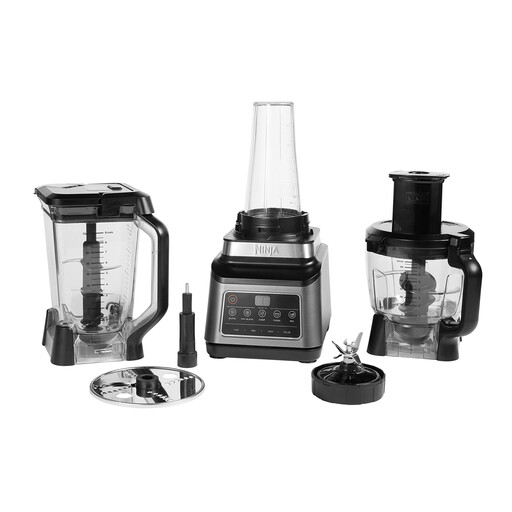 No image available
For dough making in a non-commercial shared kitchen, check the model’s dough quantity and cleaning instructions before settling on a batch size.
The named variant has a 1.8L processing bowl, 2.1L jug, 700ml cup, 1200W rating and dishwasher-safe parts. It is listed for household use, not commercial purposes; check its dimensions if it must be stored after each use.
Start with the exact processor’s stated pastry or dough limit and compare it with your recipe, rather than relying on total bowl volume. For reference, Magimix lists maximum short-crust-pastry quantities of 1kg for the 3200XL, 1.2kg for the 4200XL and 1.5kg for the 5200XL; check the instructions for the dough you intend to make.
Do not extend a processing cycle beyond the instructions for your exact model and quantity. Kenwood’s MultiPro Go dough guidance warns against processing for longer than 30 seconds to prevent motor overheating; that limit should not be assumed to apply to other processors.
No: dishwasher-safe parts are a cleaning convenience, not proof of allergen control. Clean the food-contact parts and work area between uses; where the kitchen is used by a food business, GOV.UK says effective cleaning must be demonstrable and allergen handling must be managed during food preparation.
A food business preparing biscuits for sale or catering needs to account for food-business allergen and cleaning duties, rather than treating the kitchen as purely private use. GOV.UK says retail and catering food business operators must provide required allergen information and follow applicable labelling rules; check the requirements for the particular operation with the relevant local authority.