
24/7 Customer Support

Free returns

Same-day & Next-day Delivery

Quality Guaranteed

Unlock Your Welcome Offers: FREE Delivery | Up to 80% OFF | Free 30-day JoyPlus trial
Download the APP
A food processor and blender can simplify weekday cooking, batch preparation and family meals, but choosing the wrong model often creates more work rather than less. UK kitchens vary widely in size, and an appliance that suits a large household may be excessive for a flat with limited cupboard space.
The most common buying mistakes are not always obvious from a product listing. Here are the practical details to check before choosing a multi-functional food processor, electric food chopper or food processor with blender.
A higher wattage can indicate greater motor input, but it does not automatically mean better results for every task. Blade design, bowl shape, speed control and operating limits also matter. A 750W model may be suitable for chopping and blending, while a compact 300W chopper may be more appropriate for shorter, smaller batches.
Check the appliance’s intended uses rather than relying on wattage alone. Some models are designed for vegetables and meat but should not be used for ice, bones, frozen food or dry grains.
A bowl marked “2 litres” does not necessarily mean you can fill it with 2 litres of food. Ingredients need room to move, and liquids may have separate maximum levels. Overfilling can lead to uneven processing, spillage or unnecessary strain on the motor.
For family cooking, compare both the processor bowl and blender jug capacities. A food processor with bowl and separate jug can be more flexible than a single-container appliance, while a smaller bowl may be easier to store and clean.
Multiple discs and attachments can expand the functions of a kitchen food processor, but they also create more parts to wash and store. Look for detachable blades, dishwasher-safe components where stated, nesting bowls and a compact base.
Always check whether the motor unit can be immersed. It should generally be wiped with a damp cloth rather than placed under running water. Blades are sharp and require careful handling, even when the appliance is switched off.
Consider the tasks you regularly prepare:
Speed settings and pulse control are also important. Pulse operation helps you stop before ingredients become too smooth, which is useful for salsa, chopped vegetables and fillings. Short operating cycles may be required on some electric food choppers, so read the instructions before buying.
A large-capacity food processor can save time when preparing family meals, but measure your available worktop and cupboard space first. For reference, the Daewoo 2-in-1 model measures 230mm × 200mm × 320mm, while compact models may suit smaller UK kitchens more easily.
Remember to allow extra height for lids, feed tubes and blender jugs. If you intend to leave the appliance on the worktop, consider its appearance, cord storage and non-slip feet as well as its dimensions.
The right attachment depends on your cooking habits. Chopping blades support vegetables, meat and purées; slicing and shredding discs help with salads, cheese and batch preparation; blender jugs are useful for soups, smoothies and drinks.
For durability and easier maintenance, check for stainless steel blades, food-contact bowl materials and detachable parts. Stainless steel does not mean the appliance is maintenance-free: dry components thoroughly and follow the product’s cleaning instructions.
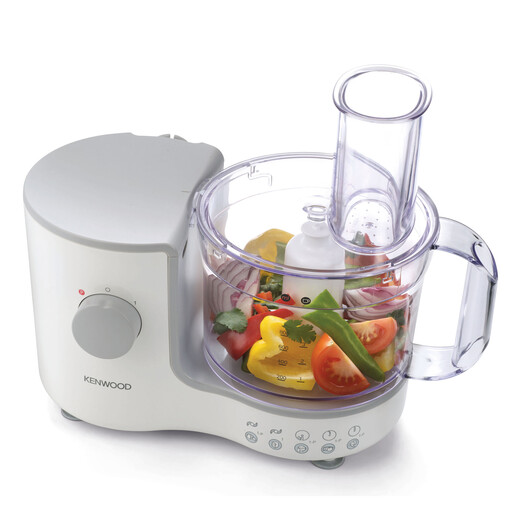
Why This Fits Their Persona: Its 1.4L bowl, compact dimensions and cord storage suit first-time buyers, couples and smaller UK kitchens.
It offers a defined one-speed plus pulse layout and a stated 0.8L liquid capacity, helping buyers set realistic expectations.
400W motor, stainless steel chopping blade, shredding disc and dishwasher-safe parts.

Why This Fits Their Persona: Designed for frequent cooks who value measured recipes, broad functionality and organised storage.
The 3L bowl and integrated scale make capacity and weighing functions clear, rather than relying on vague multifunction claims.
1,000W motor, 8 accessories, 3kg scale with 1g increments and dishwasher-safe removable parts.

Why This Fits Their Persona: Separate 2L processor and 1.8L blender capacities support family meals, soups, sauces and drinks.
The two-container design avoids forcing chopping, blending and pouring into one vessel, while detachable parts simplify cleaning.
750W motor, 2 speeds plus pulse, stainless steel blades and non-slip feet.
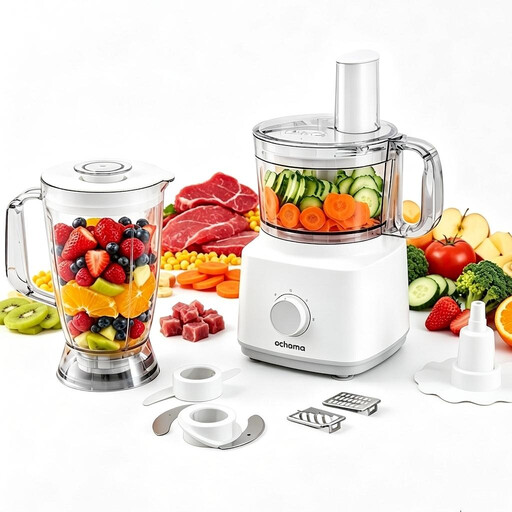
Why This Fits Their Persona: Meal-prep enthusiasts wanting chopping, slicing, grating, puréeing and blending functions in one worktop appliance.
Its listed functions and 1.8L capacity make the intended workload clearer than a generic “all-in-one” label.
750W motor, large bowl, blender function, meat grinder and detachable parts designed for cleaning.
We have compiled a complete, real-time list of products that fully satisfy these strict selection criteria and UK safety regulations.
It can be practical if you regularly prepare both solid and liquid foods. A 2-in-1 food processor may reduce the need for separate appliances, but check whether the included attachments cover your actual recipes. For occasional smoothies only, a compact smoothie maker may be sufficient.
Some models can chop or purée cooked ingredients, while dedicated baby food processors are designed around smaller portions and simpler controls. Always follow age-appropriate feeding guidance, allow food to cool safely and check the texture before serving. Do not treat an appliance description as medical or nutritional advice.
The answer depends on the model. Some choppers specify cycles such as up to 30 or 40 seconds followed by a rest period. Follow the supplied instructions, avoid exceeding the stated capacity and unplug the appliance before changing blades or attachments. These habits can help reduce avoidable motor strain and support safer everyday use.