
24/7 Customer Support

Free returns

Same-day & Next-day Delivery

Quality Guaranteed

Unlock Your Welcome Offers: FREE Delivery | Up to 80% OFF | Free 30-day JoyPlus trial
Download the APP
A food processor and blender can replace several appliances, but the wrong model may quickly become an expensive cupboard resident. Marketing often focuses on motor wattage or a long accessory list, while overlooking bowl capacity, cleaning requirements and realistic operating limits.
Before buying, watch for three common pitfalls:
The right appliance should match how you cook, how much food you prepare and how often you are willing to wash removable parts.
For everyday chopping, slicing and blending, look beyond the headline wattage. A 600W to 750W motor may suit smoothies, sauces, vegetables and smaller food-preparation tasks. Models around 1,000W or above may be more appropriate for larger batches, dough mixing or tougher ingredients, provided the manufacturer permits those uses.
Control options matter just as much. Two speeds and pulse control can be sufficient for a straightforward kitchen food processor, while variable speed or automatic programmes offer more control for mixtures with different textures.
If you plan to crush ice, process nuts or prepare thick dips, check the product instructions rather than assuming the appliance can handle every hard ingredient. Some electric food choppers are intended only for short processing cycles.
Capacity should reflect the number of people you regularly cook for:
A food processor with blender may quote separate capacities for its processing bowl and jug. For example, a 3L bowl and 1.5L blender jug serve different purposes; the bowl is more suitable for chopping and mixing, while the jug is designed for liquids such as soups and smoothies.
Always follow the maximum-fill markings. Liquids can expand or splash during blending, and dense mixtures may require pauses to prevent overheating.
A dishwasher-safe food processor can reduce daily cleaning time, but check which components are actually dishwasher safe. The motor base should never be immersed in water. Sharp blades and grating discs require careful handling, whether washed by hand or placed in a dishwasher.
Useful safety features include:
For UK homes, confirm that the appliance is supplied with a suitable UK plug or approved adaptation, and review the manufacturer’s safety and compliance information before purchase. Keep hands and utensils away from moving blades, unplug the unit before changing attachments, and wait until all parts have stopped before opening it.
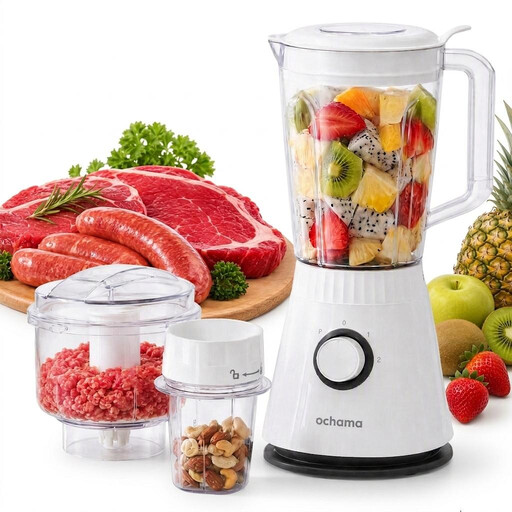
Why This Fits Their Persona: Its 1.5L jug and compact format suit smaller kitchens, smoothie preparation and straightforward everyday blending.
The three speed settings provide more control than a basic single-button chopper, while the detachable construction supports simpler cleaning.
600W motor; 1.5L jug; listed functions include blending, ice crushing, meat chopping and spice grinding.

Why This Fits Their Persona: This model suits cooks who want one worktop appliance for measured recipes, batch preparation and blended drinks.
The integrated EasyWeigh scale reduces the need for separate weighing equipment, while dishwasher-safe components address the cleaning burden of multi-attachment appliances.
1000W motor; 3L processor bowl; 1.5L blender jug; variable speed, pulse and 13 listed accessories.

Why This Fits Their Persona: Separate 2L and 1.8L vessels provide practical room for family portions, batch sauces and drinks without buying two separate machines.
The clearly stated bowl and jug capacities make comparison easier, while two speeds plus pulse avoid relying on a single preset for every texture.
750W motor; 2L processor bowl; 1.8L blender jug; detachable jugs and blades; non-slip feet.
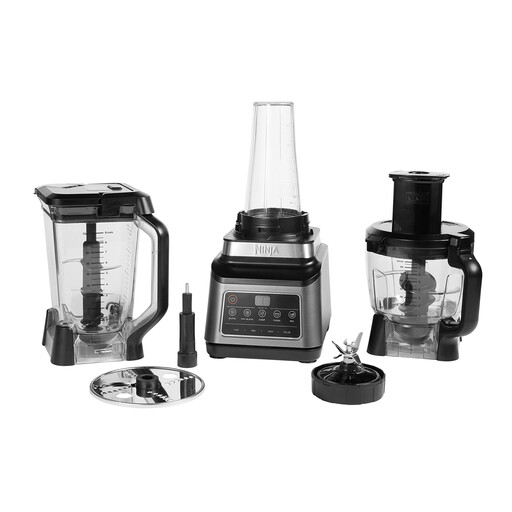
Why This Fits Their Persona: Meal-prep households can switch between a 1.8L processor bowl, 2.1L jug and 700ml cup for shared or individual servings.
The multiple vessels have stated capacities, and the five automatic programmes can reduce guesswork while manual controls remain available.
1200W motor; 1.8L processor bowl; 2.1L jug; 700ml cup; dishwasher-safe parts and five automatic programmes.
We have compiled a complete, real-time list of products that fully satisfy these strict selection criteria and UK safety regulations.
It can be useful when you regularly chop vegetables, grate cheese, prepare dips and make smoothies. One base unit may save cupboard space, but check the attachment storage and cleaning process before buying. If you only make occasional smoothies, a smaller smoothie maker may be more practical.
Operating limits vary by model and ingredient. Dense mixtures, meat and hard vegetables can place more load on the motor than soft fruit. Follow the supplied manual, use the pulse function where appropriate and allow the appliance to cool if it becomes warm or stops unexpectedly.