
24/7 Customer Support

Free returns

Same-day & Next-day Delivery

Quality Guaranteed

Unlock Your Welcome Offers: FREE Delivery | Up to 80% OFF | Free 30-day JoyPlus trial
Download the APP
A food processor promises to be the ultimate kitchen shortcut, saving you from the tedious chopping, slicing and mixing that stands between you and a home-cooked meal. Yet, many of us have been let down by a gadget that was more hassle than it was worth. It ends up gathering dust in a cupboard after a few frustrating uses. As a Joybuy Product Recommendation Officer, my role is to help you sidestep the common purchasing pitfalls and find an appliance that genuinely makes your life easier.
Before you add another appliance to your counter, let's look at the three most common traps that lead to buyer's remorse:
To avoid these traps, focus on a few core parameters that determine a food processor's real-world performance and longevity.
The right motor power is directly linked to what you plan to make.
The bowl capacity should match your household size and cooking style. A 1.8L to 2L bowl is a good starting point for couples or small families, while batch cookers will appreciate a 3L+ capacity.
Instead of being swayed by a box filled with a dozen attachments, check for the essential, high-quality tools. A solid food processor should include:
For those wanting a blender and food processor combo, ensure it comes with a separate blending jug and blade system. A dedicated smoothie maker attachment or a tall, narrow blending jug will always produce better results than trying to blend in a wide, shallow processor bowl.
Here are a few options that align with specific needs, helping you find a machine that fits your kitchen routine.
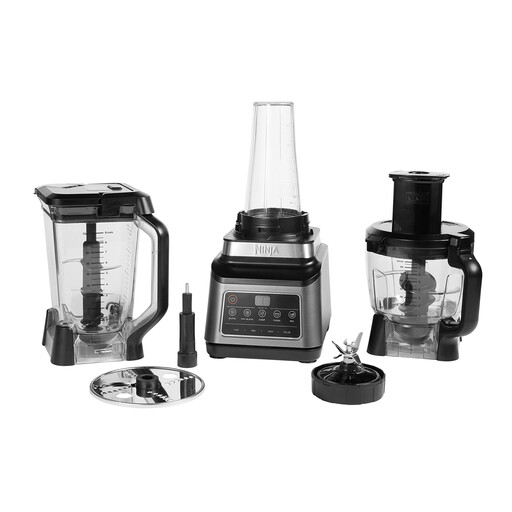
Why This Fits Their Persona: This is a true blender and food processor combo for busy households. It handles meal prep with the 1.8L processor bowl, blends family-sized soups or smoothies in the 2.1L jug and makes single-serving drinks in the 700ml cup. It's a versatile workhorse for everything from a quick baby food puree to chopping veg for a casserole.
It sidesteps the "all-in-one" disappointment by using a powerful 1200W motor and dedicated blade systems for each function. The Auto-iQ presets also take the guesswork out of getting the right results and the parts are dishwasher safe.
True 3-in-1 functionality with a powerful motor and intelligent programs. Includes a personal blending cup for on-the-go smoothies.

Why This Fits Their Persona: This is a large food processor built for serious kitchen tasks. The 1000W motor and 3L bowl are ideal for kneading dough, mixing large cake batters or processing big batches of vegetables. The integrated digital scale is a genuinely useful feature for bakers who value precision.
It avoids the wattage myth by pairing a powerful 1000W motor with a robust build designed for heavy loads. It focuses on being an excellent food processor first, rather than a mediocre jack-of-all-trades. The scale adds real utility, not just a gimmick.
Integrated digital scale for precise baking. Powerful motor and large 3L capacity for batch cooking and dough making.

Why This Fits Their Persona: Perfect for those who don't need a full-sized processor. This compact electric food chopper is ideal for daily tasks like dicing onions, mincing garlic, making breadcrumbs or chopping nuts. The simple two-speed operation and glass bowl make it straightforward and practical for quick jobs.
It doesn't pretend to be more than it is. It's a dedicated chopper, not an over-promising multi-system. Its simple construction with a glass bowl and removable blade makes it very easy to clean, avoiding the cleaning nightmare trap entirely.
Simple, effective and compact. The glass bowl is durable, easy to clean and won't absorb odours or stains.
We have compiled a complete, real-time list of products that fully satisfy these strict selection criteria and UK safety regulations.
1. Can a food processor be used as a smoothie maker? While many blender and food processor combo models can make good smoothies, a standard food processor is not ideal for this task. The wide, flat bowl and S-shaped chopping blade are designed to process solids, not create a vortex to liquefy ingredients. For the smoothest texture, a dedicated blender or a combo unit with a proper blending jug is a better choice.
2. How much power (watts) do I really need for a food processor? Focus on your primary use case. For a mini chopper handling soft ingredients, 300-500W is sufficient. For an all-purpose machine that will regularly chop hard vegetables like carrots or nuts, aim for 750W or higher. If you plan to make bread dough, a powerful motor of 1000W or more, combined with a sturdy build, is recommended to prevent it from burning out.
3. Are glass or plastic food processor bowls better? Each has its advantages. A glass bowl is heavier, more stable and completely non-porous, meaning it won't stain or retain odours from garlic or spices. However, it can break if dropped. A plastic bowl is lightweight and durable, but can become scratched or stained over time. If you choose plastic, ensure it is certified BPA-free for food safety.