
24/7 Customer Support

Free returns

Same-day & Next-day Delivery

Quality Guaranteed

Unlock Your Welcome Offers: FREE Delivery | Up to 80% OFF | Free 30-day JoyPlus trial
Download the APP
A good food processor can be a game-changer in the kitchen, saving you precious time on chopping, slicing and mixing. But with so many models on the market, it's easy to end up with a gadget that gathers dust in a cupboard. Many shoppers fall into common traps, buying appliances that are either too weak for their needs, a nightmare to clean or loaded with features they'll never use.
As a Joybuy Product Recommendation Officer, my role is to help you see past the marketing clutter. This guide will walk you through the essential factors to consider, helping you avoid buyer's remorse and find a machine that genuinely makes your life easier. We'll focus on three common pitfalls and how to sidestep them.
The "All-in-One" Overpromise: Many models are marketed as a complete all-in-one kitchen appliance, promising to replace everything on your worktop. The reality is often disappointing. A motor powerful enough for a smoothie maker might struggle with dense bread dough and flimsy attachments can render half the functions useless. The result is a jack-of-all-trades that is a master of none.
Paying for Power You Don't Need: A 1000W motor sounds impressive, but is it necessary for your daily routine? If your main goal is to use a vegetable chopper for salads or a mini food processor for pesto, a less powerful and more energy-efficient model around 600-800W is often more than sufficient. Don't let high wattage numbers sway you into overspending.
The Cleaning Nightmare: The biggest hidden cost of a food processor is the time spent cleaning it. Models with awkward crevices, non-detachable blades or parts that aren't dishwasher-safe can turn a time-saving device into a dreaded chore. This is a critical consideration for busy families and anyone who values convenience.
To make a smart choice, focus on these non-negotiable parameters. They determine whether your new appliance will be a trusted kitchen partner or a source of frustration.
The motor is the heart of the machine. Its power, measured in watts, dictates what it can handle.
immersion blender or stick blender used for soups and sauces or for a mini food processor designed for chopping herbs and nuts.blender and food processor combo that can handle daily chopping, slicing, grating and blending without strain.Look for models with at least two speed settings plus a pulse function. This gives you the control needed to avoid over-processing ingredients.
Consider your household size and kitchen space before buying.
The right attachments add versatility, but only if they are well-made.
food mixer or processor may also come with a dough tool or a whisk attachment.Instead of a generic list, we've matched specific models to different user needs, helping you find the right fit for your lifestyle.

Why This Fits Their Persona: This is an excellent starting point for those who need basic processing without committing to a large, expensive machine. Its compact form is perfect for smaller UK kitchens, and it handles everyday tasks like blending soups, whipping cream, and chopping small amounts of vegetables or meat.
It sidesteps the "overkill" pitfall by offering focused functionality. The 600W motor is perfectly matched to its tasks as a hand blender and mini chopper, providing efficiency without excess cost or energy use.
Its 4-in-1 design provides great value and versatility in a very small footprint. The detachable parts are easy to clean, avoiding the cleaning nightmare.
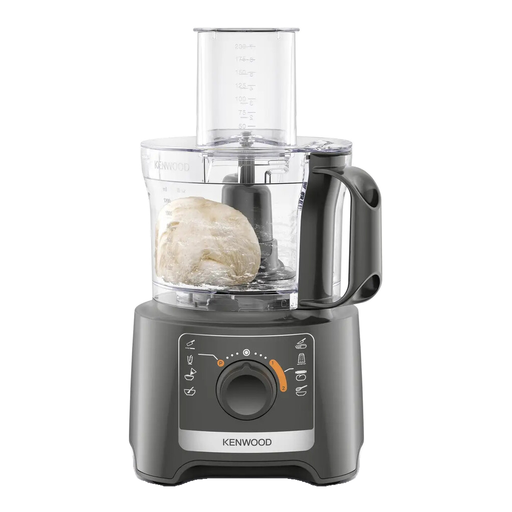
Why This Fits Their Persona: This is a practical workhorse for daily family meal prep. The 2.1L bowl and 1.2L blender jug are sized for family meals, and the 800W motor is robust enough for chopping, slicing and blending. It's a true blender and food processor combo that delivers on its core functions.
It avoids the "all-in-one overpromise" by focusing on the essentials and doing them well. Crucially, its dishwasher-safe parts directly address the "cleaning nightmare," making it a genuinely convenient tool for busy parents.
A balanced combination of power (800W), family-sized capacity and easy-to-clean, dishwasher-safe components. The in-bowl stackable storage is a thoughtful touch for keeping cupboards tidy.

Why This Fits Their Persona: For the serious home cook who values precision, power and convenience. The 1000W motor handles demanding tasks with ease, while the large 3L bowl is ideal for batch cooking. The integrated digital scale is a standout feature, saving time and reducing washing up.
While it is a feature-rich "all-in-one," it delivers on its promises with a powerful motor and genuinely useful innovations like the EasyWeigh scale. This isn't marketing fluff; it's a practical tool that enhances the cooking process.
The integrated digital scale allows you to weigh ingredients directly into the bowl, streamlining recipes. The powerful 1000W motor and 13 accessories provide true versatility for advanced cooking.
We have compiled a complete, real-time list of products that fully satisfy these strict selection criteria and UK safety regulations.
For most UK households, a motor between 600W and 800W is perfectly adequate for everyday tasks like chopping vegetables, making sauces and blending soups. If you are a keen baker and plan to knead heavy doughs frequently or if you want to crush ice regularly for drinks, investing in a model with 1000W or more will provide better performance and longevity.
Reputable manufacturers prioritise safety. Always look for a clear statement that the plastic parts that come into contact with your food—such as the main bowl, lid and any beakers—are BPA-free. This ensures that no harmful chemicals will leach into your food, which is especially important when preparing meals for children.
This is a key feature for convenience. Many modern food processors come with dishwasher-safe bowls, lids and blades. However, you must always check the manufacturer's instructions, as some parts may be top-rack only. The main motor unit should never be submerged in water or placed in a dishwasher; simply wipe it clean with a damp cloth.