
24/7 Customer Support

Free returns

Same-day & Next-day Delivery

Quality Guaranteed

Unlock Your Welcome Offers: FREE Delivery | Up to 80% OFF | Free 30-day JoyPlus trial
Download the APP
A food processor can save time when preparing vegetables, sauces, dough and batch meals. However, product listings often make similar appliances appear interchangeable. Motor wattage, bowl size and the phrase “multi-functional” do not always tell you how a machine will fit your cooking routine.
Before buying, look beyond promotional wording and check the operating limits, included attachments, cleaning instructions and realistic capacity. The right food processor should suit the quantities and textures you prepare most often, rather than simply having the longest feature list.
A higher wattage can indicate greater motor input, but it does not guarantee better results with every ingredient. Blade design, batch size, speed control and the manufacturer’s instructions also matter. A 300W electric food chopper may be entirely suitable for onions, herbs and meat in short cycles, while a larger food processor and blender may be more appropriate for dough, slicing and family-sized preparation.
Check whether the appliance is intended for continuous operation. For example, the BEAR QSJ-D03W5 specifies a maximum continuous operating time of 40 seconds, followed by a two-minute rest. Ignoring such limits can cause overheating or shorten the appliance’s service life.
A listed 2L or 3L capacity does not mean you can fill the bowl to the rim. Ingredients need room to move, and liquids may require a lower maximum level. Review the instruction manual or product specifications for separate liquid and dry capacities where available.
For a household cooking in batches, a 3L bowl can reduce the number of processing cycles. For one or two people, a mini food chopper may take up less space and create less washing-up.
A multi-functional food processor may include chopping blades, slicing discs, shredders, dough tools, blending jugs and personal cups. This can be useful, but only if you regularly prepare the foods those accessories are designed for.
Before choosing a 2-in-1 food processor or food processor with blender, confirm:
Power ratings should be considered alongside the intended workload. Two speeds and a pulse setting provide more control over texture than a single on/off button. Low speed is generally useful for softer ingredients, while higher speed can help with firmer vegetables or meat, subject to the manufacturer’s guidance.
A food processor for chopping vegetables should offer enough bowl movement and blade coverage to process ingredients evenly. If you want a food processor for meat, check that the product description specifically permits this use. Do not assume that an appliance suitable for vegetables is automatically designed for raw meat or dense mixtures.
Glass bowls allow you to see the mixture while processing and may resist odour retention. Stainless steel blades are commonly used for chopping and slicing, but they remain sharp and should be handled carefully during assembly and cleaning.
The BEAR QSJ-D03W5 includes a 2L glass bowl, a 300W motor, two speeds and 304 stainless steel blades. Its instructions state that it is designed for meat and vegetables, but not bones, ice cubes, frozen food, coffee beans or grains. These restrictions are important because misuse can damage the motor or blades.
A dishwasher-safe food processor can reduce cleaning time, but “dishwasher-safe parts” usually excludes the motor base. The base should be unplugged and wiped with a soft, damp cloth; it must not be immersed in water.
Look for:
Always disconnect the appliance before changing blades, removing stuck food or cleaning. Keep fingers and utensils away from moving blades, and allow all components to stop fully before disassembly.

Why This Fits Their Persona: A straightforward option for regular chopping of onions, garlic, vegetables and meat without investing in a larger attachment system.
Its listing clearly states the 40-second operating limit and ingredients it should not process, helping buyers set realistic expectations.
2L visible glass bowl, 300W motor, two speeds and 304 stainless steel blades.

Why This Fits Their Persona: Suitable for households wanting one worktop system for batch preparation, slicing, grating, baking and drinks.
The included tools are specified, and the bowl, lid and accessories can be washed in warm soapy water or the dishwasher.
3L bowl, 1000W motor, metal slicing and grating disc, baking tool and Blend-Xtract 2GO bottle.
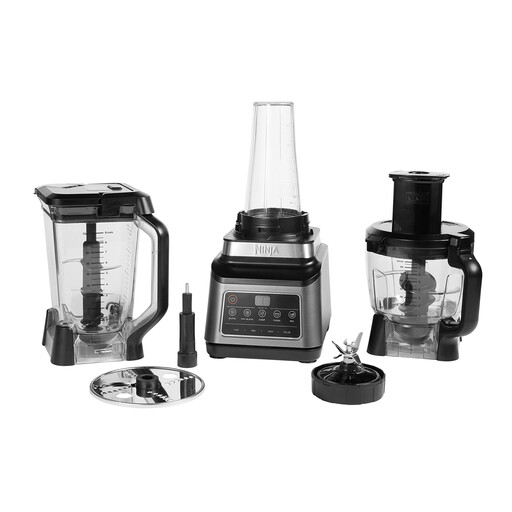
Why This Fits Their Persona: Designed for cooks who regularly switch between food processing, multi-serve blending and individual drinks.
Its capacities and five automatic programmes are listed separately, so the processor bowl, blender jug and cup are not confused with one another.
1200W motor, 1.8L processing bowl, 2.1L jug, 700ml cup and dishwasher-safe parts.

Why This Fits Their Persona: A compact choice for flat dwellers, students, couples and anyone preparing small portions of herbs, garlic, nuts, sauces or breadcrumbs.
The 350ml bowl makes its intended small-batch use clear, while the 30-second operating warning helps prevent prolonged running.
300W motor, two speeds plus pulse, compact dimensions and dishwasher-safe bowl and blade.
We have compiled a complete, real-time list of products that fully satisfy these strict selection criteria and UK safety regulations.
It can be, provided the capacity matches your portions. A mini food chopper is suitable for herbs, onions, garlic, dips and small quantities. A 1.4L or 2L model offers more flexibility for batch sauces, vegetables and meal preparation, but will need more storage space.
Some models combine both functions, but the results and capacities may differ. A food processor is generally shaped for chopping, slicing, shredding and mixing, while a blender jug is designed for liquid-based recipes. A food processor and blender combination is practical when you regularly make both solid preparations and smoothies or sauces.
There is no universal operating period. Follow the model’s manual and product listing. Some compact choppers specify 30-second cycles, while the BEAR QSJ-D03W5 specifies up to 40 seconds followed by a rest. Short pulses, correct filling levels and regular cooling breaks can help reduce unnecessary motor strain.