
24/7 Customer Support

Free returns

Same-day & Next-day Delivery

Quality Guaranteed

Unlock Your Welcome Offers: FREE Delivery | Up to 80% OFF | Free 30-day JoyPlus trial
Download the APP
A food processor can simplify chopping, slicing, shredding, blending and meal preparation, but the wrong model may quickly become an expensive cupboard ornament. UK kitchens vary from compact flats to busy family homes, so capacity, attachments and cleaning requirements matter as much as motor power.
Before buying, watch out for three common pitfalls:
Choose capacity according to the quantity you usually prepare rather than the largest number in the product title.
Also check the appliance’s dimensions, cable storage and the space needed to remove the lid or feed ingredients. A wide base may be stable but difficult to position beneath low cupboards.
A multifunction food processor should match your actual recipes. Useful accessories may include:
Some appliances are marketed as a food processor with blender, but the containers and attachments may have different limits. Check whether the model supports wet blending, dry grinding or meat preparation before assuming it replaces several appliances.
Motor power is best used as a comparison point within a similar product type. For example, a 300W electric food chopper may be designed for short chopping cycles, while a 750W or 1,200W multifunction appliance may offer more attachments and broader preparation options.
Look for:
Always unplug the appliance before changing blades, removing attachments or cleaning. Sharp accessories should be handled by their non-cutting edges and stored securely.
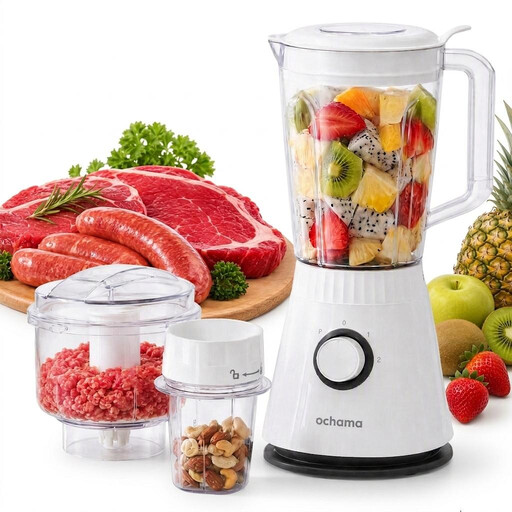
Why This Fits Their Persona: A practical starting point for flats, couples and shoppers wanting one compact appliance for smoothies, purées, spices and smaller chopping tasks.
Its 1.5-litre pitcher and three speed settings make the intended scale clearer than buying an oversized family appliance for occasional use.
600W motor, ice-crushing function, meat chopper and spice grinder; components are designed to come apart for cleaning.
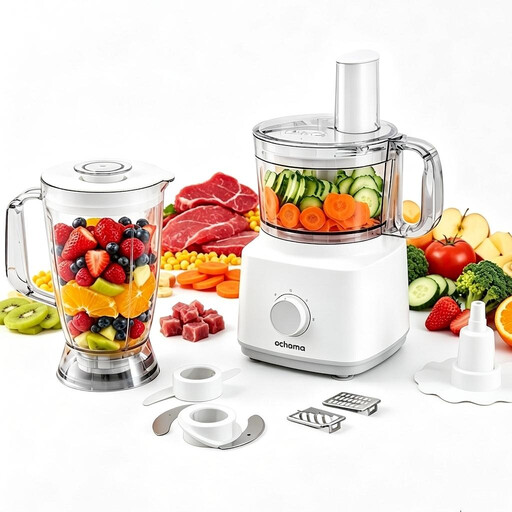
Why This Fits Their Persona: The 1.8-litre bowl provides more room for family meal preparation, while the combined design reduces the need for separate chopping and blending appliances.
Its listed functions and accessories are clearly specified, including chopping, slicing, grating and puréeing, so buyers can compare capability rather than rely on vague multifunction claims.
750W motor, 1.8-litre bowl and included slicing, shredding and grating discs; detachable parts support simpler cleaning.

Why This Fits Their Persona: Suitable for frequent cooks who value measured preparation, a larger bowl and a broad set of accessories in a single kitchen food processor.
The 3-litre bowl capacity, eight accessories and integrated scale are stated as separate features, making it easier to judge whether the added functionality suits your routine.
1000W motor, integrated 3kg scale with 1g increments and dishwasher-safe removable parts.
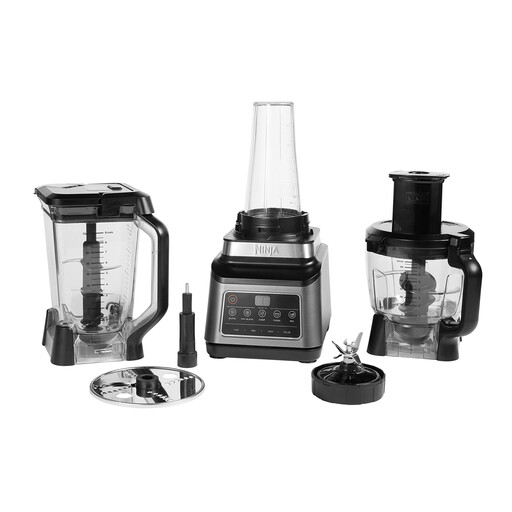
Why This Fits Their Persona: A flexible choice for households that regularly prepare doughs, dips, sauces, smoothies and individual drinks using different container sizes.
The 3-in-1 format provides separately listed bowl, jug and cup capacities, helping users select the appropriate container instead of overfilling one vessel.
1200W motor, 1.8-litre processing bowl, 2.1-litre jug, 700ml cup and five automatic programmes; listed parts are dishwasher safe.
We have compiled a complete, real-time list of products that fully satisfy these strict selection criteria and UK safety regulations.
A food processor is more likely to remain useful when it is operated within its stated limits.
For baby food, use clean ingredients and separate preparation equipment where appropriate. A baby food maker or purée function can assist with texture preparation, but it does not replace safe food handling, cooling and storage practices.
It can be useful if you regularly chop, grate, slice, mix dough or shred vegetables. Blenders are generally designed around liquid or semi-liquid mixtures, while a food processor bowl and discs are better suited to dry chopping and ingredient preparation. A blender and food processor combination may save space, provided its attachments match your recipes.
A 1.8-litre bowl can suit many everyday family preparations, while a 3-litre model provides more room for batch cooking. Do not assume the full bowl volume is the safe working capacity. Check the manufacturer’s liquid and dry limits and avoid filling beyond the marked line.
Running cost depends on the appliance’s wattage, usage time and your electricity tariff. A 300W chopper may draw less power while operating, but a 1,000W model may complete a larger task more quickly. Compare the motor rating with your real usage rather than choosing solely by the lowest wattage.