Weekly meal-prep cooks
If you prepare several portions of cooked chicken regularly, compare usable bowl capacity with the number of loads you are willing to process. Also consider how many parts you will wash after each session.


Choose a food processor with a chopping blade, pulse control and enough working capacity for the amount of cooked chicken you prepare at once. A compact bowl can suit smaller portions and limited storage, while a 3L-class processor gives you a larger format for recurring multi-portion prep; check its usable capacity rather than assuming the full bowl volume is available for chicken.
If you prepare several portions of cooked chicken regularly, compare usable bowl capacity with the number of loads you are willing to process. Also consider how many parts you will wash after each session.
If your recipe calls for distinct chopped pieces rather than a fine mixture, look for a chopping blade and pulse control so you can stop and inspect the chicken between bursts.
If your usual portions are modest, a smaller bowl may be easier to store and clean. Cuisinart UK positions its 1.1L FlexPrep for small-batch recipes; a larger session may require more than one load.
Start with the amount of chicken you process in one load, then decide how much texture control, cleaning effort and storage space matter to you.
| Concern | What to check | Who this matters to |
|---|---|---|
| Usable capacity | Compare bowl volume with stated working capacity and the manual’s ingredient limits. | If I prepare several portions together, repeated small loads could slow down meal prep; around 33% of consumers put usable capacity first. |
| Chopped texture | Confirm that the exact model has a chopping blade and pulse control. | For chicken going into wraps or salads, I want to stop before the pieces become too fine; around 27% of consumers make texture control their primary concern. |
| Cleaning | Check which removable parts are dishwasher-safe and how the blade is removed. | When I prep meals regularly, a complicated wash-up could make the machine less convenient to use; around 20% of consumers prioritise manageable cleaning. |
| Storage | Measure the intended storage space and consider where the accessories will go. | With limited cupboard or worktop space, I would accept extra loads to keep the appliance manageable; around 20% of consumers put storage first. |
Total volume is not the same as usable capacity. Magimix UK lists a 3L total bowl capacity but a 1.3L working capacity for its 4200XL.
Check the exact model’s working capacity and manual before planning to chop your usual chicken portion in one load.
Neither figure tells you when chopped chicken will reach the consistency you want. Which? assesses chopping separately from other food-processor tasks and ease of use.
Choose a model with a suitable chopping blade and pulse control, then stop to inspect the chicken between short bursts.
Extra attachments add parts to wash and store. Preparing chicken for later meals also means planning how the food will be cooled and stored after chopping.
Check cleaning instructions for the exact model and use only the attachments you need. For meals prepared for children, NHS guidance advises cooling food as quickly as possible, ideally within 1 to 2 hours, before refrigerating or freezing it.
Preparing food through a business brings different hygiene and registration obligations from cooking meals for your own household.
If you plan to operate a food business from home, the Food Standards Agency says to register with your local authority at least 28 days before trading and follow applicable food-business hygiene requirements.
Its UK range includes the full-size 4200XL, a 3L model.
Its UK food-processor range includes 1.1L, 1.9L and 3L formats.
Its MultiPro range includes full-size food processors such as the 3L MultiPro Express FDP65.180SI.
These food processors and choppers offer different bowl sizes and approaches to meal prep. Match the appliance to your usual chicken portion, then check its chopping attachment and operating instructions before buying.
 No image available
Consider this model for recurring multi-portion prep if you want a full-size bowl and pulse-controlled chopping.
Kenwood GB specifies a knife blade, pulse function and 1.5L dry and liquid working capacities. Check the manual for the appropriate cooked-chicken load rather than treating either capacity figure as a chicken limit.
 No image available
This processor-and-blender combination may suit batch cooks who will use its additional functions as well as its processor bowl.
The listed variant has a 3L bowl, integrated weighing, variable speed, pulse control and 13 accessories. Check its practical chicken load and storage dimensions against your routine.
 No image available
The 2L processor bowl offers a size to consider when your usual portions fall between small-bowl prep and a full-size session.
The product name also identifies a separate 1.8L blender jug and a 750W motor. Check the manual for the processor bowl’s usable chicken load and the cleaning instructions for its removable parts.
 No image available
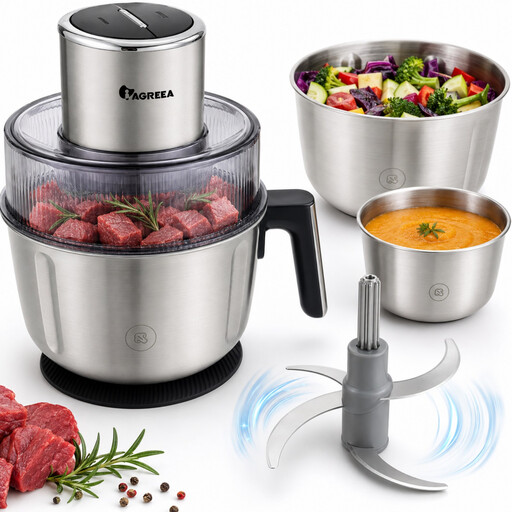
Consider this food chopper if you want a choice of bowl sizes for varying prep sessions rather than a conventional processor with broader attachments.
The listed variant has three nesting 304 stainless-steel bowls, two speeds and triple-curved blades. Check the suitable cooked-chicken load and follow its stated limit of up to 30 seconds per operating cycle.
 No image available
This 3L processor may suit recurring prep if you also want integrated weighing; the scale does not determine how well it chops chicken.
The listed variant has a 1000W motor and eight accessories. Before choosing it for chicken, confirm which included blade is intended for chopping, its appropriate load and the space needed to store the appliance.
Choose by the portion you will process at one time, not bowl volume alone. A 1.1L–1.9L model can suit modest portions, while a 3L-class model gives you a larger format for recurring multi-portion prep. Magimix UK lists 3L total and 1.3L working capacities for its 4200XL; check the manual’s limits for your intended ingredient.
Use a chopping blade and short pulses, stopping to inspect the chicken between bursts. Portion size, moisture and processing time can affect the result, so pulse control is a way to make adjustments rather than a guarantee of a particular texture.
Check the exact model’s instructions for the bowl, lid, blade and any discs you expect to use. Confirm which parts are dishwasher-safe and how to remove and handle the blade safely; do not assume every attachment follows the same cleaning instructions.
Plan how you will cool and store it promptly after preparation. For food prepared for children, NHS guidance advises cooling it as quickly as possible, ideally within 1 to 2 hours, then putting it in the fridge or freezer; follow guidance appropriate to the meals you are making.
Yes: operating a food business is different from preparing meals for your own household. The Food Standards Agency says a food business must register with its local authority at least 28 days before trading, including when it operates from a home address; applicable food-business hygiene requirements also need to be followed.