
24/7 Customer Support

Free returns

Same-day & Next-day Delivery

Quality Guaranteed

Unlock Your Welcome Offers: FREE Delivery | Up to 80% OFF | Free 30-day JoyPlus trial
Download the APP
A food processor and meat mincer can reduce preparation time for family meals, batch cooking and homemade fillings. However, many buyers focus on wattage or the number of attachments while overlooking practical limitations such as bowl capacity, cleaning requirements and safe operating times.
Before choosing a multifunctional food processor, watch for these common buying pitfalls.
A higher wattage figure does not automatically mean an appliance is suitable for every task. Motor power should be considered alongside the recommended operating time, blade design, feed tube size and the type of ingredients you plan to process.
A compact electric meat mincer may handle small portions well but require cooling breaks during larger batches. Similarly, a food chopper designed for short pulses may not be suitable for continuous blending or heavy dough work.
Product images can show several accessories, while the selected configuration may contain fewer parts. Check the written specification for:
This is particularly important when comparing a vegetable chopper with a full kitchen food processor.
Sharp blades, metal mincing parts and motor housings require different cleaning methods. Some bowls and blades are dishwasher-safe, while certain metal mincer components must be washed by hand and dried immediately.
Also check the stated duty cycle. For example, one appliance may allow operation for 40 seconds followed by a two-minute rest, while another may permit longer sessions. Ignoring these instructions can increase heat build-up and place unnecessary strain on the motor.
A 1.8 to 2-litre bowl is useful for family portions of chopped vegetables, sauces, fillings and purées. Larger capacity does not mean you should fill the bowl to the rim. Leave room for ingredients to circulate and follow the manufacturer’s maximum line.
For small portions, such as herbs, garlic or a baby food serving, a smaller chopper cup may provide better control and reduce unnecessary washing.
Rated power gives an indication of the electrical input, but it should not be used alone to compare appliances. A 750W food processor, for instance, may be suitable for chopping, slicing, grating and puréeing, while a dedicated electric mincer may use a different motor design and grinding mechanism.
Look for clear instructions covering:
When using an electric meat mincer, remove bones, thick skin and tough sinew first. Cut meat into approximately 2–3cm pieces, and use the supplied pusher rather than fingers or utensils.
A food processor with slicing and shredding discs is more useful for coleslaw, grated cheese, sliced potatoes and meal preparation than a basic food chopper. If you regularly make mince, compare the number and size of grinding plates.
Bowl material also affects everyday use. Glass is resistant to odours and scratches, while stainless steel bowls are durable and do not retain food colour as readily. Check whether the parts are detachable and whether the manufacturer permits dishwasher cleaning.
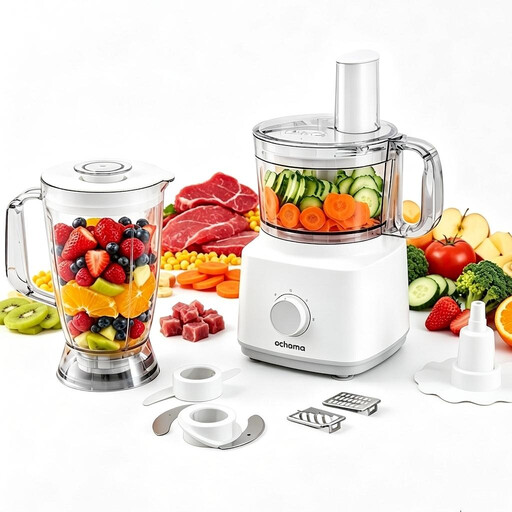
Why This Fits Their Persona: A practical option for UK households wanting one appliance for chopping, slicing, grating, blending and puréeing rather than buying several separate tools.
The listing specifies the 1.8-litre capacity, 750W motor and included functions, helping buyers compare stated features instead of relying on promotional images.
1.8-litre bowl; chopping, slicing, grating and puréeing functions; detachable parts designed for cleaning.
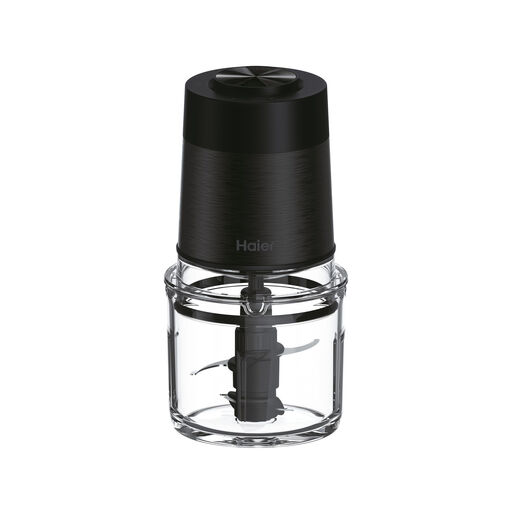
Why This Fits Their Persona: Suitable for cooks who prefer a glass bowl, two-speed control and simpler preparation for vegetables, nuts, herbs and purées.
The listing clearly identifies the two-speed control, 2-litre glass bowl and dishwasher-safe bowl and blades, reducing uncertainty around everyday cleaning.
550W motor; double-stacked blade arrangement; glass bowl and dishwasher-safe listed components.
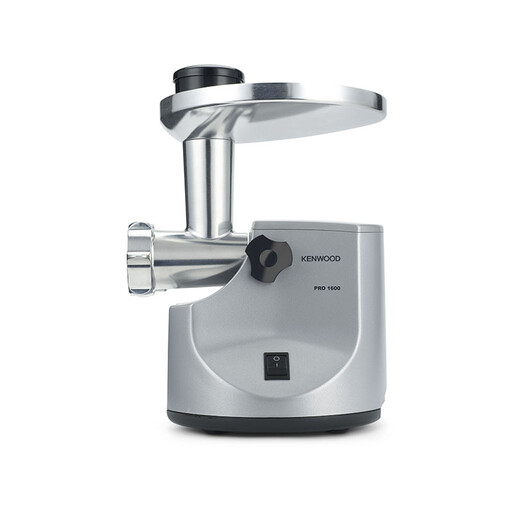
Why This Fits Their Persona: Designed for households that prepare mince regularly and want multiple textures, sausage-making accessories and a dedicated electric meat mincer.
Three grinding screens, overload protection, a reverse function and a stated 15-minute maximum continuous use provide more practical information than wattage alone.
Fine, medium and coarse screens; sausage and kebbe attachments; dishwasher-safe parts listed.
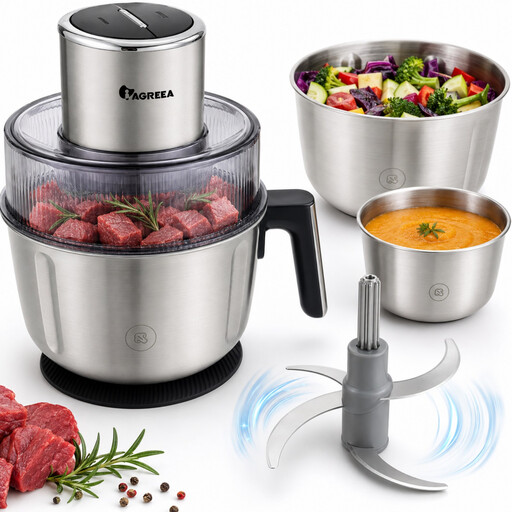
Why This Fits Their Persona: Useful for families preparing different quantities of meat, vegetables, purées or baby food, with three bowls that nest for storage.
The three bowl capacities and 30-second pulse limit are stated clearly, making it easier to plan portions and cooling breaks.
2.5L, 2.2L and 1.8L nesting stainless steel bowls; two-speed pulse control; detachable triple-curved blade.
We have compiled a complete, real-time list of products that fully satisfy these strict selection criteria and UK safety regulations.
It can be, provided the capacity and duty cycle match your portions. A multifunctional food processor is useful for chopping vegetables, slicing, shredding, blending and puréeing. For frequent mince preparation, a dedicated electric mincer with several grinding plates may be more convenient.
There is no single wattage suitable for every household. Compare the rated or maximum power with the recommended batch size, operating time and overload protection. For occasional small portions, a compact chopper may be sufficient; regular batch cooking may justify a dedicated meat mincer with coarse, medium and fine plates.
Not always. Some glass bowls and stainless steel blades are listed as dishwasher-safe, while certain aluminium or steel mincer components require hand washing. Always follow the individual product instructions and keep the motor housing dry.