Shared-kitchen batch makers
If you make several portions at once, a stated working capacity helps you plan batches. You also need enough time and space to clean the processor before another person uses it.


Choose a food processor by the amount of oat-bar mixture you need to make per batch, using its stated working or dough limit rather than its headline bowl size. In a shared kitchen, check that you can clean the food-contact parts and keep ingredients and equipment separated where needed; if you make bars for sale, food-business requirements also affect how you use the kitchen.
If you make several portions at once, a stated working capacity helps you plan batches. You also need enough time and space to clean the processor before another person uses it.
When ingredients, surfaces or equipment are shared, removable food-contact parts are useful only alongside a workable cleaning and separation routine. The Food Standards Agency's MyHACCP guidance identifies cross-contamination as a risk to control.
If you make oat bars often but have limited cupboard or worktop space, check where the appliance, lid and accessories will go between uses.
For oat-bar mixture in a shared kitchen, settle the batch size and cleaning routine before choosing between a larger bowl, compact storage and longer-term product support.
| Concern | What to check | Who this matters to |
|---|---|---|
| Cleaning and allergen control | Check which food-contact parts can be removed and cleaned, and agree how ingredients and equipment will be kept separate where needed. | When other people use the same equipment, I need a cleaning routine that deals with residues before my batch starts. Around 36% of consumers put cleaning and allergen control first. |
| Batch capacity | Compare your recipe with the model's stated usable, dry-working or maximum-dough limit, keeping the units and conditions distinct. | I want to make enough mixture per run without planning a batch around the bowl's headline volume. Batch capacity is the primary concern for around 29% of consumers. |
| Storage space | Measure the worktop and cupboard space, including room for the lid, blades and other accessories. | If my shared cupboard has little free space, I need somewhere practical to keep the processor and its cleaned parts. Around 21% of consumers prioritise compact storage. |
| Long-term support | Read model-specific guarantee terms and check parts availability separately from motor cover. | For regular use, I want to know what support is available if a part needs replacing, even if a smaller working capacity means more batches. Around 14% of consumers make long-term support their first concern. |
Total bowl capacity, usable volume, dry working capacity and maximum dough quantity describe different limits. For example, Kenwood lists a 3L bowl but a 1.5L dry working capacity for the FDP65.180SI.
Compare your recipe with the most relevant limit in the manufacturer's instructions, and do not plan to fill the bowl to its headline volume.
A lower working limit may mean making the mixture in extra batches.
A dishwasher-safe claim does not cover shared worktops, ingredient storage or the order in which people prepare food. Food Standards Agency MyHACCP guidance calls for cross-contamination risks to be identified and controlled.
Agree how food-contact parts will be cleaned and dried, and keep ingredients and equipment separated where appropriate. If you operate a food business, include shared-equipment hazards in its food-safety controls.
A processor may fit on a shelf while its lid, blades and discs still need separate clearance or storage. Accessory-storage arrangements differ between models.
Measure the allocated space before buying, then plan a safe place for sharp accessories after they have been cleaned and dried.
Published capacity and dishwasher-safe parts do not establish whether a shared-kitchen selling operation has appropriate registration or food-safety controls.
If you make oat bars as a food business, follow Food Standards Agency registration guidance and assess the process, ingredients and shared equipment under the applicable food-safety guidance.
These model-specific examples show why working limits and storage arrangements deserve attention alongside bowl size.
Kenwood's MultiPro Express FDP65.180SI is a compact 3L option with a dough tool and pulse control.
The Magimix 3200XL is an option for consumers weighing working capacity against published long-term support.
Bosch offers both the MultiTalent 3 MCM3501MGB and the larger-bowl MultiTalent 8 MC812S734G.
These food processors have bowl-based preparation features relevant to oat-bar mixture. Compare your recipe with each model's working limits, and plan how its food-contact parts will be cleaned between shared-kitchen users.
 No image available
For oat-bar preparation where an integrated scale would be useful, this model has a 3L bowl, a 1000W rating and eight accessories. Check the manual's working or dough limit against your recipe; bowl size alone does not establish how much dense mixture it can process.
 No image available
For regular batches where space is limited, this model includes a dough tool and dishwasher-safe attachments. Kenwood GB lists a 1.5L dry working capacity and dimensions of 24 × 22 × 40cm; check your recipe against the instructions, and keep a separate cleaning and allergen-control routine for shared use.
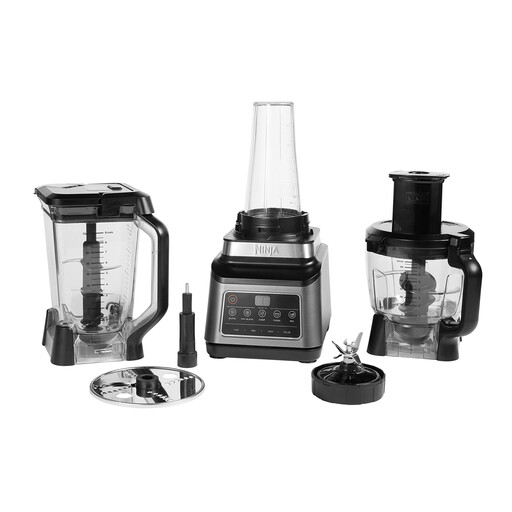 No image available
For consumers considering a processor with a separate jug and cup, this model lists a 1200W rating, a 1.8L bowl and dishwasher-safe parts. Check the manual before making a thick oat-bar mixture: its instructions warn that overly thick mixtures may jam the blades. The product description specifies household rather than commercial use.
No: use the model's stated working, dry-working or dough limit to plan a batch, and check its instructions for your recipe. Kenwood GB lists a 3L bowl but a 1.5L dry working capacity for the FDP65.180SI; Bosch GB lists a 3.9L bowl, 2.4L usable volume and 1.5kg maximum dough quantity for the MC812S734G. Litres and kilograms describe different measures and should not be treated as interchangeable.
Agree how food-contact parts, worktops and stored ingredients will be cleaned or separated between uses. Food Standards Agency MyHACCP guidance calls for cross-contamination risks to be identified and controlled; a dishwasher-safe accessory does not address every surface or handling step.
If you are starting or taking over a food business, the Food Standards Agency says to register with the local authority at least 28 days before trading or food operations start. Making bars in a shared kitchen does not, by itself, establish whether your activity is a food business; assess what you are doing before applying that requirement.
No. For a food business, cleanable processor parts are only one part of controlling hazards across ingredients, preparation and shared equipment. Food Standards Agency MyHACCP guidance describes a broader food-safety-management approach; the controls needed depend on the recipe and process.