Regular family-meal potato slicers
If you often prepare potatoes for gratins, tray bakes or similar family dishes, a supplied slicing disc and a workable batch size matter more than a list of unrelated functions.


Choose a food processor with a supplied slicing disc that gives you the slice thickness you need, then decide whether you want to collect potatoes in a bowl or slice directly into a dish or pan. A larger bowl may suit regular family-meal prep, while a compact direct-serve model takes less storage space; neither total bowl volume nor a general claim of cutting capability tells you how many potatoes you can slice in one batch.
If you often prepare potatoes for gratins, tray bakes or similar family dishes, a supplied slicing disc and a workable batch size matter more than a list of unrelated functions.
If cupboard space is limited, you may prefer a compact processor that sends slices into a suitable dish or pan rather than holding them all in its bowl. Kenwood describes this arrangement for the MultiPro Go FDP23.140GR.
If the processor will also handle chopping, grating or other meal prep, consider the supplied tools, cleaning instructions and accessory storage alongside its potato-slicing setup.
Start with the disc supplied for the exact model, then weigh batch handling against the space and washing-up involved in using it.
| Concern | What to check | Who this matters to |
|---|---|---|
| Slice thickness and disc | Confirm that the exact package includes a slicing disc and check its stated thickness options. | If I am making a layered potato dish, I want to choose a repeatable slice thickness rather than rely on a chopping blade. Around 46% of consumers put the supplied slicing setup first. |
| Family-meal batches | Distinguish total bowl volume from usable or working capacity; check the model’s guidance for your intended batch. | When preparing potatoes for several people, I want to know whether I will need to stop and empty the processor. For around 36% of consumers, batch handling is the primary concern. |
| Storage and cleaning | Check the space needed for the machine and accessories, and which named parts can go in the dishwasher. | In a small kitchen, I need the processor and its tools to fit away neatly and be manageable to clean after dinner. Storage and washing-up come first for around 18% of consumers. |
A chopping blade is not a substitute for a slicing disc, and a description of general cutting functions does not identify everything in the box.
Check the accessory list for the exact model and bundle, including the disc type and any stated slice thicknesses.
If the disc is not supplied, a compatible one may need to be obtained separately, if available.
Total, usable and working capacities describe different things; none alone guarantees how much sliced potato a processor will handle at once.
Compare capacity figures with the same labels and consult the model’s working-capacity guidance when planning family-meal batches.
A smaller bowl may mean more interruptions unless you can direct slices into a suitably positioned dish or pan.
Choose direct serving if that workflow suits your kitchen; otherwise, consider whether you need a larger bowl for collecting slices.
Care instructions can differ between a processor’s bowl, discs, blades and drive parts.
Check the exact model’s manual for the parts named as dishwasher-safe before making easy cleaning a deciding factor.
The 4200XL is a family-capacity option if you want a bowl-based processor with stated slicing capability and accessory storage.
Two Kenwood models illustrate the choice between a larger direct-serve processor and a compact one.
The MultiTalent 8 MC812S734G is worth considering if a large bowl and several food-preparation functions matter beyond potato slicing.
These food processors offer different bowl and multi-task setups for family-meal preparation. Check the exact slicing-disc specification and working-capacity guidance against the amount of potatoes you intend to prepare.
 No image available
For family-meal potato prep, check whether the supplied slicing disc gives you the thickness you want and consult the working-capacity guidance before planning a batch.
3L bowl; 1000W; six accessories; pulse function; dishwasher-safe attachments.
 No image available
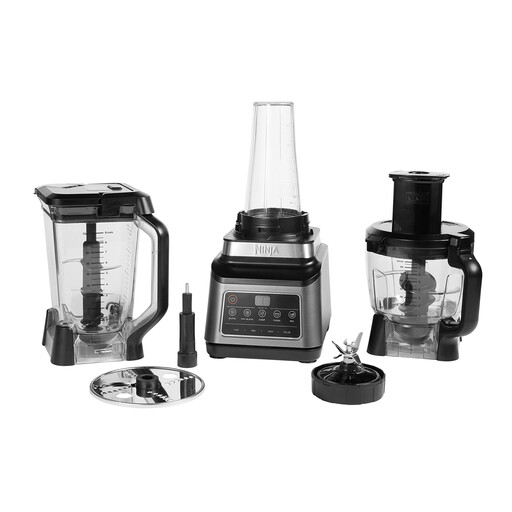
Consider this format if you also want a jug and cup for other food-preparation tasks; check the slicing disc’s thickness and the processor bowl’s working-capacity guidance for potatoes.
1200W; 1.8L processor bowl; 2.1L jug; 700ml cup. Five listed automatic programmes: Blend, Max Blend, Chop, Mix and Puree. Dishwasher-safe parts.
Look for a slicing disc supplied with the exact processor variant, rather than relying on a chopping blade or a general description of cutting functions. Kenwood lists reversible 2mm and 4mm slicing/grating discs for its MultiPro Express FDP65.860WH and MultiPro Go FDP23.140GR; check the box contents for the model you are buying.
Not necessarily: total bowl volume is not an ingredient-specific working limit. Magimix lists both 3L total and 1.3L working capacity for the 4200XL, while Bosch lists a 3.9L bowl and 2.4L usable volume for the MultiTalent 8 MC812S734G; compare the capacity labels and check the model’s guidance for your task.
It can be an option if you are comfortable working in batches or slicing directly into a suitably positioned dish or pan. Kenwood lists a 1.3L bowl, 0.75L working capacities and direct serving for the MultiPro Go FDP23.140GR, so consider whether that workflow suits the quantity you prepare.