Family dressing makers
You make avocado dressing for several servings and want a vessel and stated purée or emulsifying function suited to your usual batch.


Choose a food processor with a stated purée or emulsifying function and a vessel suited to the amount of avocado dressing you usually make. A bowl-based model can also handle chopping and slicing for the meal; a processor with a blender jug gives you a separate vessel for pourable recipes, but its liquid limit and the parts you will need to clean and store still matter.
You make avocado dressing for several servings and want a vessel and stated purée or emulsifying function suited to your usual batch.
You want to make dressing alongside chopped vegetables or sliced salad ingredients, so the included attachments and clean-up matter as much as the dressing function.
You make smaller batches less often and would rather check how the parts store and wash than choose a machine for its largest stated capacity.
Consider it when: Dressing is one of several occasional chopping, slicing or grating tasks, and you usually make modest batches.
Trade-off: Check that the exact bowl and blade are specified for puréeing; a bowl processor does not automatically include a separate blender jug.
Consider it when: You regularly make pourable dressing or other liquid recipes and also want processor tools for the rest of the meal.
Trade-off: The extra vessel and attachments need cleaning and storage; a jug’s stated capacity does not by itself establish its working liquid limit.
| Concern | What to check | Who this matters to |
|---|---|---|
| Dressing texture | Look for a stated purée, blending or emulsifying function and confirm which suitable tool is included. | If I want to adjust a dressing until it pours the way I like, the available processing function matters more to me than a headline power figure. Around 39% of consumers would put texture and control first. |
| Family-batch capacity | Compare working liquid limits or recipe maximums for the exact vessel, not just bowl size. | When I am preparing dressing alongside a family meal, I want enough usable capacity to avoid repeated batches. Roughly 38% of consumers would make batch capacity their primary concern. |
| Cleaning and storage | Check which removable parts are dishwasher-safe and where the included attachments will fit. | If I only make dressing occasionally, a cupboard full of discs and awkward washing could outweigh extra functions. About 23% of consumers would prioritise everyday convenience and space. |
A bowl’s headline capacity need not be its working limit for liquid recipes. Kenwood, for example, states a 3.0L bowl but a 1.5L working bowl liquid capacity for the FDP65.860WH.
Compare the exact model’s working liquid capacity or recipe maximum with the batches you plan to make.
Kenwood lists a blender and emulsifying tool with the FDP65.860WH, while Ninja describes the BN650UK-compatible processor bowl as capable of puréeing. Those descriptions do not establish the contents of other packages.
Check the exact box contents and look for a stated purée, blending or emulsifying function that suits your recipe.
If the supplied vessel does not suit your intended texture or batch size, you may need another compatible accessory or appliance.
Blades, discs, lids and vessels all need a place to go after the meal. Bosch says accessories for the MCM3201BGB can be stored in its bowl; Kenwood’s cited FDP65.860WH package includes multiple tools.
Identify the attachments you expect to use regularly, then check their cleaning instructions and the space available to store them.
These ranges offer different ways to combine dressing preparation with family meal prep; check features against the exact model and package you are considering.
Its MultiPro range includes processors with broader meal-prep attachments. Kenwood specifies a 3.0L bowl, 1.5L working bowl liquid capacity, 1.5L blender and emulsifying tool for the FDP65.860WH.
Ninja describes its 2.1L BN650UK-compatible processor bowl as suitable for chopping, slicing, grating, puréeing and mixing.
Bosch states that the MCM3201BGB has a 2.3L usable bowl volume, two speed stages and a moment function.
Magimix offers food processors sized for different household needs, from Mini Plus to 5200XL.
These processor and blender combinations, plus models listing puréeing or emulsifying tools, are choices to consider for dressing alongside family meal preparation. Check each model’s usable batch size and included parts against your recipe.
 No image available
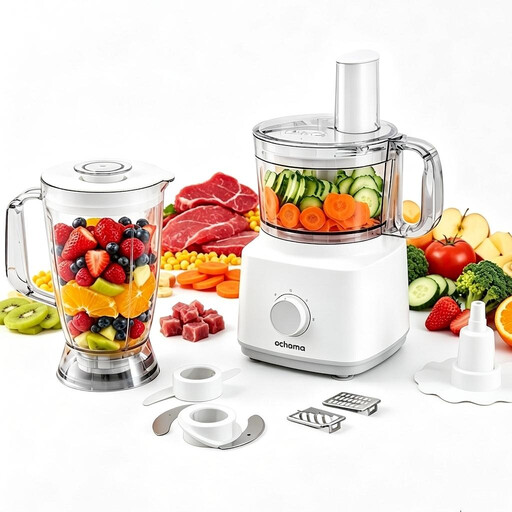
Consider this combination if you want a blender vessel for dressing and a processor bowl for other ingredients. Its stated vessel sizes do not establish how much liquid it can process or how small a batch will blend well; check both against your recipe.
 No image available
Its processor-and-blender configuration may suit meals that call for both dressing and other ingredient preparation. Check the working liquid limit and suitable minimum batch for the blender jug, and make sure you have room for the included accessories.
 No image available
Consider its listed emulsifying and preparation tools if you want to make dressing alongside other meal components. The 3L bowl size is not a working liquid limit; check that limit and the blending bottle’s suitable batch size before choosing it for your recipe.
 No image available
Its listed puréeing and vegetable-preparation functions make it worth considering for dressing and the rest of a family meal. The 1.8L bowl figure does not establish a working liquid limit; confirm the appropriate vessel, included parts and suitable batch size for your dressing.
Choose a food processor if you also want to chop, slice or grate ingredients for the meal; consider a processor with a blender jug if pourable dressings and other liquid recipes are frequent tasks. Check the exact model’s stated functions and included vessel rather than assuming either configuration will produce your preferred texture.
Compare your usual recipe amount with the exact model’s working liquid or recipe limit, not just its bowl size. Kenwood specifies a 3.0L bowl but a 1.5L working bowl liquid capacity for the FDP65.860WH; Magimix also publishes different recipe maximums for different models.
Follow the instructions for each attachment on the exact model. Bosch lists dishwasher-safe accessories for the MCM3201BGB, and Kenwood lists dishwasher-safe tools for the FDP65.860WH; those statements should not be extended to every part or model.
Clean removable food-contact parts according to the manufacturer’s instructions after use. GOV.UK guidance for food businesses calls for cleaning and disinfecting equipment after contact with raw food; if you use the same processor for different ingredients, take care to clean it between tasks.
Ask the seller or manufacturer for documentation concerning the exact model if a particular food-contact material matters to you. General GOV.UK guidance on food-contact materials does not establish whether an individual processor meets an applicable requirement.