Shared-kitchen scone bakers
You make savoury scones in a kitchen used by others and need to clean, dry and store the processor between uses, particularly when equipment may also touch raw foods or allergen-containing ingredients.


Choose a food processor with a documented dough allowance that covers your usual scone batch, then check whether its food-contact parts can be cleaned, dried and stored between users. A compact model may suit modest batches, while a higher stated dough limit matters more for regular batch baking. Dishwasher-safe parts do not replace cleaning and separation where cross-contamination is a concern.
You make savoury scones in a kitchen used by others and need to clean, dry and store the processor between uses, particularly when equipment may also touch raw foods or allergen-containing ingredients.
You make occasional modest batches and need a processor that fits your storage space without sacrificing the dough allowance your recipe requires.
You make larger or repeated batches and need to check the exact model’s dough limit and processing instructions, rather than relying on bowl volume or motor wattage alone.
Start with the dough quantity your usual batch requires. Then check how the processor’s parts will be cleaned and where the machine and attachments will go between users.
| Concern | What to check | Who this matters to |
|---|---|---|
| Dough capacity | Check the exact model’s maximum dough quantity and any processing-time or rest instructions. | If I make several batches, I need a stated dough allowance that covers each one without exceeding the maker’s instructions. Around 40% of consumers put batch capacity first. |
| Cleaning and separation | Check access to the bowl, blade, lid and pusher, and plan how food-contact parts and surfaces will be cleaned, dried and kept separate where needed. | When others use the equipment for raw foods or allergen-containing ingredients, I need a workable cleaning and separation routine before preparing my scones. For around 30% of consumers, that is the primary concern. |
| Shared-space storage | Check the machine’s dimensions, attachment storage and the space needed to wash and dry its parts. | With a shared cupboard and worktop, I want the processor and its attachments to have a practical place between batches. Storage and setup come first for around 30% of consumers. |
Neither figure tells you the maximum dough quantity intended for a particular model. Bosch, Kenwood and Magimix publish different dough limits for the named processors discussed here.
Compare your batch with the exact model’s dough limit and follow its processing instructions; do not transfer a limit from another machine in the same range.
Food residue can remain on equipment and work surfaces. Food Standards Agency guidance for food businesses identifies shared equipment as a route for cross-contamination; a dishwasher-safe label alone does not establish that an allergen-sensitive preparation area is suitable.
Agree who cleans the bowl, blade, lid, pusher and worktop. Where raw-food or allergen risks require it, follow an appropriate cleaning and separation procedure or use separate equipment.
A larger bowl and extra attachments also need room for washing, drying and storage in a kitchen other people use.
Measure the intended cupboard and worktop space, and check where each attachment will be stored before choosing a machine for bigger batches.
Bosch publishes dough limits for both a compact MultiTalent 3 model and a larger MultiTalent 8 model.
The MultiPro XL Weigh+ FDM72.990BK combines an integrated scale with a supplied dough tool.
The 4200XL is worth considering when published kneading quantity and stated long-term parts support matter to the choice.
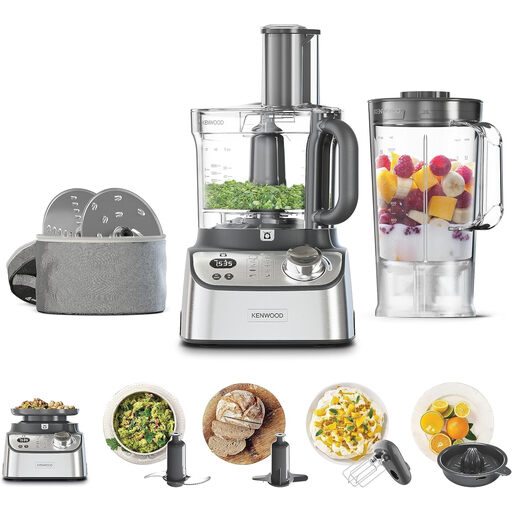
This integrated-weighing processor may suit a shared worktop where a separate scale would take up space. Check the FDM71.450SS’s own dough instructions before deciding whether it suits your usual scone batch.
 No image available
The integrated digital scale is useful if you want to weigh ingredients without placing a separate scale on a shared worktop.
The product name specifies a 3 L bowl, 1000 W motor rating and eight accessories.
Before using it for scones, check this exact model’s dough-tool instructions, maximum dough load and processing intervals. Check its dimensions and cleaning instructions against your shared kitchen’s storage and preparation routine.
Not if a smaller model’s documented dough limit covers your normal batch. Bosch specifies a 0.8 kg maximum dough content for the MCM3501MGB and 1.5 kg for the MC812S734G; check the limit and processing instructions for whichever exact model you choose.
No: dishwasher-safe parts can make routine washing more manageable, but that label does not establish that shared equipment is suitable for someone with an allergy. Consider what ingredients previous users handled, whether every food-contact area can be cleaned, and whether separate equipment or a defined preparation procedure is needed.
Clean and disinfect its food-contact components and the work area before using them for other preparation. Food Standards Agency guidance for food businesses identifies equipment as a possible route for cross-contamination and advises separate equipment for raw meat, fish or poultry and ready-to-eat food unless thorough washing and disinfection are possible.