
24/7 Customer Support

Free returns

Same-day & Next-day Delivery

Quality Guaranteed

Unlock Your Welcome Offers: FREE Delivery | Up to 80% OFF | Free 30-day JoyPlus trial
Download the APP
Food processors and blenders can save considerable preparation time, but choosing the wrong design may leave you with an appliance that is difficult to clean, too small for family meals or unable to handle your regular recipes.
Marketing often focuses on wattage and the number of attachments. These details matter, but they do not tell the whole story. A practical purchase also depends on usable capacity, operating limits, storage space, blade design and how easily the parts can be washed.
A higher wattage does not automatically mean better results for every task. A 300W electric food chopper may be suitable for onions, herbs and smaller batches, while a 750W multifunctional food processor is more appropriate for larger quantities and a wider range of ingredients.
Also check the recommended operating cycle. Some compact appliances are designed for short pulses followed by cooling periods. Ignoring these instructions can place unnecessary strain on the motor.
A bowl labelled “2 litres” may have a smaller maximum working capacity, particularly when processing liquids or ingredients that expand. Always check the fill markings and instructions.
For a family-size food processor, consider both the processor bowl and the blender jug. A 2-litre bowl may be useful for batch preparation, while a 1.5-litre smoothie maker can be easier to store and handle for everyday drinks.
Multiple attachments can appear attractive, but they also create more parts to wash and store. Look for detachable components, dishwasher-safe food processor parts and a compact base that fits your available cupboard or worktop space.
Sharp blades should always be handled carefully, and the motor base, plug and power cord should never be immersed in water.
Match the bowl to your routine rather than buying the largest appliance available. A 350ml mini food processor is useful for garlic, herbs, nuts, breadcrumbs, dips and small sauces. For family cooking, a 1.4-litre to 2-litre bowl is more practical for vegetables, fillings and batch preparation.
Measure the available space before ordering. For example, the DAEWOO 2-in-1 model measures approximately 230mm wide × 200mm high × 320mm deep, giving it a worktop format while providing a 2-litre processor bowl and 1.8-litre blender jug.
Power should be considered alongside blade configuration and controls. Two speeds plus pulse can give better control over coarse chopping and finer puréeing than a single basic setting.
A hand blender is convenient for soups and purées because ingredients can often be blended in a suitable container. A worktop food processor with blender is generally more suitable when you need slicing, shredding, grating, chopping and liquid blending from one base.
Check exactly what is included rather than relying on phrases such as “multi-functional”. Useful attachments may include:
Stainless steel blades are common for chopping and slicing. Glass bowls can resist odours and scratches, but they are heavier than plastic. For easier maintenance, confirm whether the bowl, blade and discs are dishwasher-safe and whether the manufacturer excludes any motor or connector parts.

Why This Fits Their Persona: Its small footprint suits renters, students and smaller UK kitchens where a full-size appliance may be unnecessary.
The 350ml bowl makes its intended small-batch use clear, avoiding the disappointment of expecting family-sized preparation from a mini chopper.
300W motor, two speeds plus pulse, and a dishwasher-safe bowl and blade.
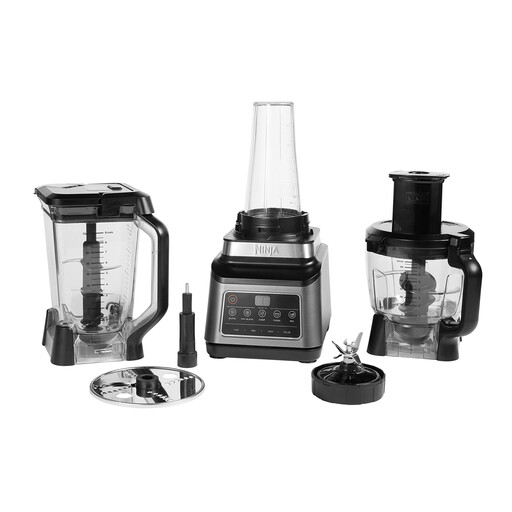
Why This Fits Their Persona: Suitable for households wanting one worktop system for drinks, meal preparation and smaller individual servings.
Its listed bowl, jug and cup capacities make it easier to select the right format for batch cooking, shared drinks or one-person smoothies.
1.8L processor bowl, 2.1L blender jug, 700ml cup, five automatic programmes and dishwasher-safe parts.

Why This Fits Their Persona: A practical option for families and meal-prep households that regularly switch between chopping, slicing and blending.
It states separate processor and blender capacities, rather than presenting one headline capacity for every task.
750W motor, 2L bowl, 1.8L jug, two speeds plus pulse, and detachable jugs and blades.
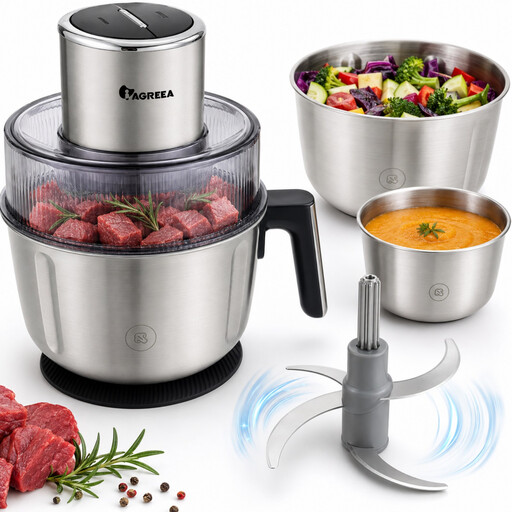
Why This Fits Their Persona: Three nesting bowls provide separate formats for vegetables, meat and small portions such as purées or prepared baby food.
The bowl sizes are clearly specified as 2.5L, 2.2L and 1.8L, helping users plan portions instead of guessing from the motor rating.
Three 304 stainless steel bowls, two-speed pulse control and a detachable triple-curved blade system.
We have compiled a complete, real-time list of products that fully meet these strict selection criteria and UK safety regulations.
No. A blender is generally designed for liquids, smoothies, soups and purées, while a food processor is more suited to chopping, slicing, grating, shredding and mixing. A 2-in-1 food processor and blender combines both functions, but attachments and capacities still vary between models.
A mini food processor, compact food processor or hand blender usually takes less storage space than a full-size worktop machine. For occasional chopping, a 350ml chopper may be sufficient. If you also make smoothies or soups, an immersion hand blender or compact blender may offer more flexibility.
They can reduce cleaning time, but they do not directly determine electricity use. Energy consumption depends on motor power and how long the appliance operates. Short pulse cycles and preparing several portions at once can help limit unnecessary use, while following the manufacturer’s operating intervals supports safe appliance care.