
24/7 Customer Support

Free returns

Same-day & Next-day Delivery

Quality Guaranteed

Unlock Your Welcome Offers: FREE Delivery | Up to 80% OFF | Free 30-day JoyPlus trial
Download the APP
The right food storage containers can make packed lunches, leftovers and meal preparation far easier. The wrong choice, however, may waste money through leaking lids, awkward shapes or materials that cannot handle your intended use.
For UK households, office workers, students, parents, caterers and food-service businesses, the main challenge is matching the container to the job. A lunch box for sandwiches does not necessarily suit soup. A takeaway container may be convenient for one service but unsuitable for repeated use. Before buying, look beyond capacity and attractive packaging.
A lid may reduce air exchange without being suitable for transporting liquids. Check whether the design includes a silicone seal, locking clips or a manufacturer’s specific leak-resistance information. For soups, sauces and stews, keep containers upright and test the seal at home before placing one in a work bag or school backpack.
Materials and lids can have different heat limits. Stainless steel food containers should not be placed in a microwave, and some plastic lids may need to be removed before heating. A product described as dishwasher-safe may still have separate instructions for its seals, clips or lids.
A multi-pack can appear economical, but several bulky boxes may not stack neatly in a cupboard or refrigerator. Compare the external dimensions, shape and lid design. Stackable storage boxes are particularly useful in smaller UK kitchens, but only when the lids fit securely and the sizes work together.
Common options include plastic, stainless steel, bamboo fibre and insulated constructions.
For UK use, food-contact products should be supplied with appropriate safety information. When a listing does not clearly explain food-contact suitability, heating limits or care instructions, contact the seller before purchasing.
Capacity should match the food you normally carry. A compact lunch box may suit snacks or a child’s portion, while a 2-litre container can accommodate larger sandwiches, wraps or bread rolls.
Also check the external measurements. A box that fits a refrigerator shelf may not fit your work bag. Divided bento boxes are convenient for keeping ingredients separate, while deep containers are more suitable for salads, pasta, leftovers and meal-prep portions.
For leak-proof lunch containers, look for locking clips and a removable silicone seal. Removable parts are easier to inspect and clean, although they can be misplaced. Dishwasher-safe food containers may save time, but always check whether the whole product or only the main body is dishwasher-safe.
Insulated food jars and portable insulated boxes require a different check: review the opening size, cleaning access and intended capacity. Narrow openings can make washing more difficult after thick foods such as porridge or pasta.
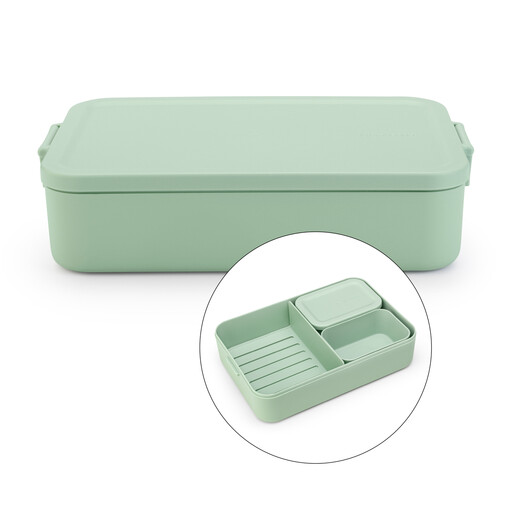
Why This Fits Their Persona: A practical reusable lunch box for office workers, students and families wanting one versatile container for everyday packed meals.
The 2-litre capacity and internal divider make the size clear, while clips provide a defined closure instead of relying on a loose-fitting lid.
Includes separate containers and a divider that doubles as a lifting tray; listed as dishwasher, microwave and freezer safe.
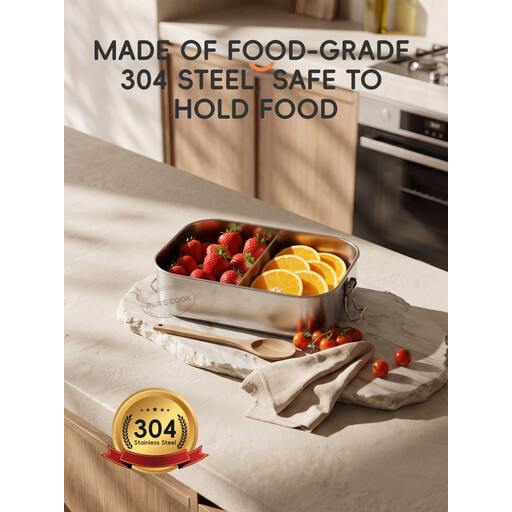
Why This Fits Their Persona: Suits commuters, meal-prep users and shoppers looking for a reusable metal lunch container with separate food sections.
Its listed silicone seal and lockable clips address the common problem of lids that are difficult to secure during transport.
304 stainless steel construction, two compartments and a stated 61.2 fl oz capacity.

Why This Fits Their Persona: A three-piece option for households, campers and meal-prep users who need different sizes for leftovers, produce or packed food.
The listing clearly states that it is not microwave or oven safe, helping buyers avoid unsafe heating assumptions.
304 stainless steel construction; sealed, stackable design; three sizes for refrigerator storage, camping and meal preparation.
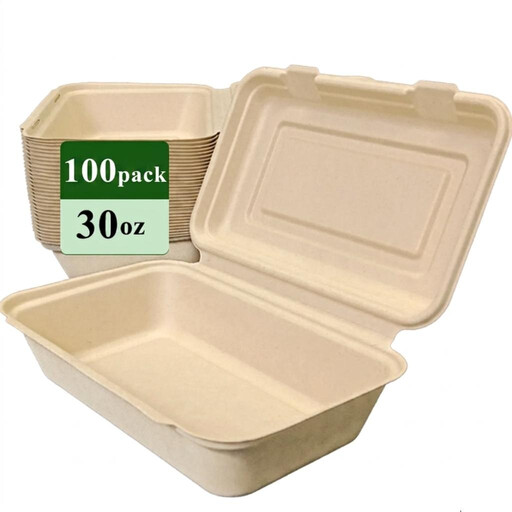
Why This Fits Their Persona: Designed for higher-volume takeaway service, event catering or businesses needing disposable packaging for prepared meals.
The pack quantity and 30oz capacity are specified, reducing uncertainty when planning takeaway portions and stock levels.
Set contains 100 clamshells; bamboo fibre construction and a hinged clamshell format for burgers, salads, wraps and noodles.
We have compiled a complete, real-time list of products that fully satisfy these strict selection criteria and UK safety regulations.
For a light lunch, around 500–800ml may be sufficient, while larger meals with fruit or snacks may require 1–2 litres. Divided bento boxes can help separate foods without needing several individual containers. Always compare external dimensions with your lunch bag and refrigerator shelf.
No. Stainless steel food containers should not be placed in a microwave. Transfer the food to a microwave-safe dish before heating, and check whether the product is suitable for an oven, freezer or dishwasher separately.
Not necessarily. Compostable bamboo clamshells may require commercial composting facilities, and council rules differ across the UK. Check the packaging information and your local authority’s waste guidance rather than placing them automatically in a recycling bin.