
24/7 Customer Support

Free returns

Same-day & Next-day Delivery

Quality Guaranteed

Unlock Your Welcome Offers: FREE Delivery | Up to 80% OFF | Free 30-day JoyPlus trial
Download the APP
A cupboard full of mismatched tubs can make meal preparation harder than it needs to be. Lids disappear, dry ingredients lose their texture and fridge containers leak just when you need them most. Choosing the right food storage containers is less about buying the largest set and more about matching capacity, materials and closure systems to the way your household cooks.
Marketing descriptions can also hide important limitations. Here are three common buying traps to avoid.
An airtight seal can help limit air and moisture exchange, but it does not automatically make a container suitable for hot food, freezing, microwaving or long-term preservation. Check the product instructions for each use. A container designed for room-temperature pantry storage may not be suitable for the oven or freezer.
A 10- or 12-piece set may look good value, but several containers of the same capacity can be impractical. Consider what you regularly store: flour and cereal need larger formats, while herbs, spices and leftovers usually suit smaller containers. Also check the external dimensions if your cupboards have fixed shelves.
Some lids, seals and frames require hand washing even when the containers themselves are dishwasher-safe. Removable silicone gaskets can also trap moisture if they are not dried properly. Always check whether the dishwasher-safe food containers include the lids and whether the manufacturer recommends the top rack.
For dry pantry goods, BPA-free plastic, glass, porcelain and stainless steel can all be practical options when used according to the manufacturer’s instructions.
Food-contact materials sold for household use should be used as intended and kept in good condition. Replace containers with deep scratches, damaged seals, cracks or warped lids.
For flour, rice and cereal, a close-fitting lid may be sufficient. For sauces, soups and packed lunches, look for a clearly described leak-proof food container with a secure closure. Latching lids can provide a more noticeable physical lock, while silicone gaskets help form a seal around the rim.
Do not carry a sealed container by its lid unless the instructions specifically permit this. Even an airtight container may spill if the lid is not fully seated or if the contents create pressure as they cool.
Measure your shelf, drawer or fridge compartment before ordering. Stackable storage jars can improve cupboard organisation, but only if the lid and base remain stable when stacked. Round containers can be easier to wash, while rectangular formats often use fridge and freezer space more efficiently.
For pantry staples, transparent bodies or lids make stock levels visible. For spices, a dedicated spice organiser can be more useful than placing small jars inside a large container.
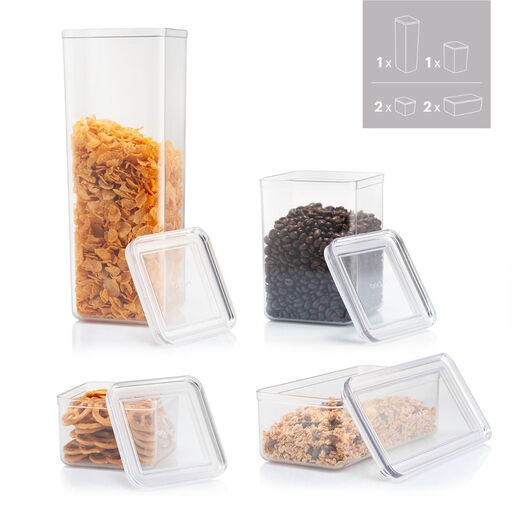
Why This Fits Their Persona: This mixed-size set gives smaller UK households a practical starting point for coffee, pasta, flour and nuts without committing to a large collection. It includes two 0.5L jars, two 1L jars, one 1.2L jar and one 2.6L container.
The varied capacities reduce the risk of buying several oversized containers, while transparent lids help identify contents before opening the cupboard.
BPA-free plastic bodies, airtight silicone gaskets and dishwasher-safe components, with top-rack placement recommended.
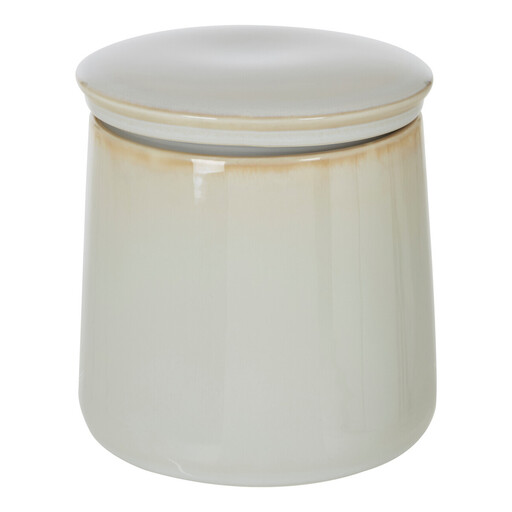
Why This Fits Their Persona: The stone-coloured glazed porcelain design suits kitchens where storage is also part of the room’s visual scheme. Its 14cm height and 12cm width and length make it suitable for a modest quantity of pantry staples.
The stated dimensions help with shelf planning, while the matching lid gives a defined closure rather than relying on an unspecified cover.
Durable glazed porcelain, easy-clean finish and a tapered shape. Handle with care and avoid abrasive cleaners.
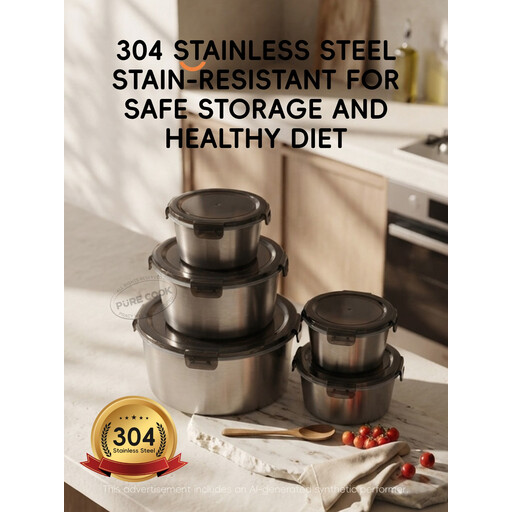
Why This Fits Their Persona: This five-piece set covers capacities from 350ml to 3,500ml, making it suitable for batch cooking, leftovers and households that regularly rotate between fridge and freezer storage.
The range of capacities is more adaptable than a uniform set, while the product listing specifically identifies the containers as freezer- and dishwasher-safe.
304 stainless steel construction, black transparent PP latching lids and round formats for storing portions of different sizes.
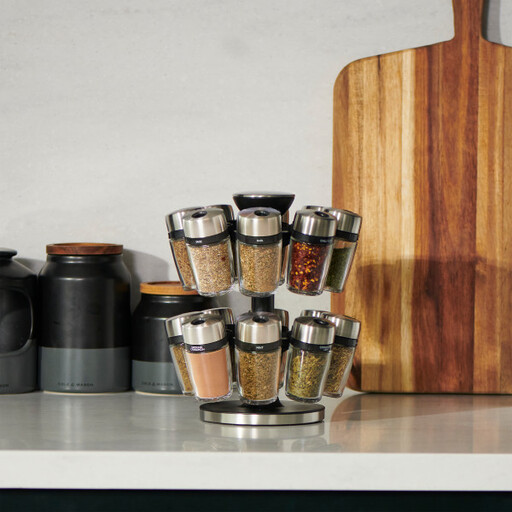
Why This Fits Their Persona: Cooks who use a broad range of herbs and spices can keep 16 labelled glass jars visible and accessible on one rotating two-tiered carousel.
The labels and 360-degree rotation address the common problem of losing small spice jars at the back of a cupboard. The care instructions clearly state that the frame is not dishwasher-safe.
Glass jars, stainless steel and ABS frame, plus lids with tight-seal, shake and pour settings. Hand-wash the jars and lids.
We have compiled a complete, real-time list of products that fully satisfy these strict selection criteria and UK safety regulations.
They can be useful for dry ingredients and foods that benefit from reduced exposure to air or moisture. Their value depends on the seal, the lid fit and how consistently the container is closed. Airtightness does not by itself confirm freezer, microwave or hot-food suitability.
The suitable material depends on the task. BPA-free plastic is lightweight and convenient for cupboards, glass provides clear visibility, porcelain suits decorative pantry storage and stainless steel offers a robust option for fridge or freezer use. Always follow the individual product’s care and temperature instructions.
There is no single lifespan. A well-maintained container can remain useful while the body, lid and seal are intact. Replace it when you notice cracks, warping, persistent odours, deep scratches or a gasket that no longer closes securely. Proper washing, complete drying and avoiding unsuitable heat can help extend its usable life.