Small-kitchen breadcrumb makers
You mainly turn leftover or slightly stale bread into crumbs and need the appliance to fit on a limited worktop or in a cupboard or drawer.


Start with the space you can give the appliance, then match its working capacity to the amount of bread you usually process. A compact processor with a knife blade and pulse control is a practical route for controlling crumb texture; a smaller bowl may mean repeated batches, while extra food-prep functions bring more components to store and clean.
You mainly turn leftover or slightly stale bread into crumbs and need the appliance to fit on a limited worktop or in a cupboard or drawer.
You want a knife blade and pulse control for occasional breadcrumbs, with manageable cleaning rather than a larger meal-prep setup.
You also plan to chop, grate or slice regularly, so bowl capacity, attachment storage and cleaning matter alongside the space the processor occupies.
Check storage dimensions first, then the capacity available for your usual bread quantity; decide whether other food-prep tasks justify additional attachments.
| Concern | What to check | Who this matters to |
|---|---|---|
| Storage and clearance | Compare width, depth and height with the intended space, allowing room to lift the lid. | If the appliance needs to go away after each use, fitting the cupboard or drawer matters more to me than a larger bowl. Around 36% of consumers would put storage first. |
| Crumb control | Look for a knife or chopping blade and pulse control; consider how you will process very fresh bread. | I want to stop at the crumb texture I need without bread collecting above the blade. Crumb control would be the primary concern for around 29% of consumers. |
| Batch capacity | Compare stated working or dry capacity with your usual quantity of bread, rather than relying on total bowl size. | When I make crumbs, I want a batch size that suits the bread I use without repeatedly overfilling a small bowl. Around 21% of consumers would prioritise batch capacity. |
| Other uses and cleaning | Check which attachments are included, where they will be stored and how the removable parts are cleaned. | For me, the machine needs to earn its cupboard space through other regular prep tasks without leaving too many pieces to wash. Around 14% of consumers would put those everyday uses first. |
Published dimensions differ substantially: Kenwood lists the FP120A at 15 × 27.5 × 17.5 cm (W × D × H), while Bosch lists the MultiTalent 3 at 37.5 × 22 × 26 cm (H × W × D).
Measure the worktop, cupboard or drawer you intend to use, including clearance for lifting the lid.
Kenwood advises that slightly stale bread processes better and warns that fresh bread may clog a processor.
Add bread progressively. If it collects above the blade, stop the machine and clear the bowl before continuing with a smaller batch.
A bowl’s total volume is not the same measure as dry or working capacity. Kenwood, Magimix and Bosch use different capacity descriptions across their compact models.
Check the capacity relevant to the ingredients you plan to process and leave enough room for the blade to move them.
Discs and other attachments add pieces to store, assemble and wash, even if you mainly want crumbs.
List the other tasks you will actually do, then check which accessories come with the model and where each one will go.
Kenwood’s compact range includes the basic FP120A and the drawer-storage MultiPro Go.
The Mini Plus is a compact option for smaller kitchens, with a stated 600 ml working capacity.
The MultiTalent 3 range is relevant when breadcrumbs are one of several regular food-prep tasks.
These processors and choppers offer different approaches to occasional breadcrumbs and other chopping tasks. Compare their storage fit and usable batch size before choosing; for models that do not expressly list breadcrumb use, check the intended blade and bowl setup.
 No image available
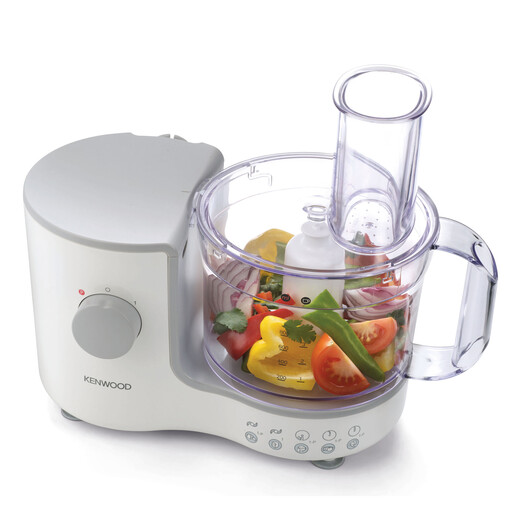
Consider the FP120A if breadcrumbs are the main task and its measurements fit your storage space.
Kenwood lists a knife blade, pulse control and dimensions of 15 × 27.5 × 17.5 cm (W × D × H). Its 1.4 L bowl size is not a recommended breadcrumb batch size; compare the stated dry capacity with the quantity you usually process.
 No image available
This mini chopper is worth considering for occasional small quantities of breadcrumbs, provided its usable capacity suits your bread quantity.
Its product name specifies a 350 ml bowl, two speeds and a dishwasher-safe bowl. Check its dimensions against your storage space, and follow the stated limit on continuous motor use.
 No image available
Consider this model if you also want a blender, but check that its processor bowl and blade arrangement suit bread before choosing it for crumbs.
The product name specifies a 2 L processor bowl; that figure does not establish how much bread to process at once. Measure the space available for the appliance and lid.
 No image available
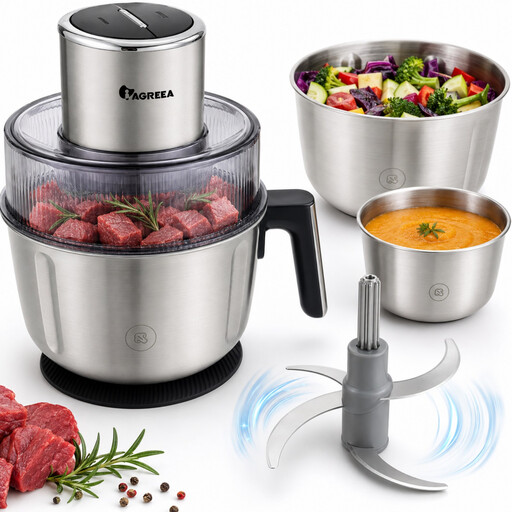
The nesting bowls may suit a cupboard where storing several bowls separately would be awkward. Check that the blade arrangement suits breadcrumbs before relying on it for that task.
The product name lists 2.5 L, 2.2 L and 1.8 L stainless-steel bowls, two-speed control and triple-curved blades. Those bowl volumes are not dry breadcrumb working capacities; measure the complete stored setup as well.
Yes, with a suitable chopping or knife blade. Kenwood advises using slightly stale bread, removing the crusts and adding cubes progressively; pulse control lets you stop when the crumbs reach the texture you want.
Fresh bread may collect above the blades rather than processing evenly, according to Kenwood. Stop and clear the bowl if that happens, use smaller amounts, or choose slightly stale bread for the next batch.
Choose by the amount of bread you normally process and the model’s working or dry capacity, not its headline bowl volume. Magimix lists a 600 ml working capacity for the Mini Plus, while Kenwood lists a 0.75 L dry working capacity for the MultiPro Go; either may require repeated batches depending on your usual quantity.