Family-batch bar makers
If you want to prepare one larger mixture for a gathering, compare working capacity with your recipe quantity. Kenwood and Magimix both list working capacities below the total bowl sizes of their 3L models.


Choose a food processor with a knife blade, pulse control and enough stated working capacity for your actual oat-bar mixture—not just a large-sounding bowl size. A compact model may suit an occasional, modest batch, while a larger bowl is worth considering if you regularly prepare food for a gathering; either way, check the model’s limits for dense mixtures before planning to process everything at once.
If you want to prepare one larger mixture for a gathering, compare working capacity with your recipe quantity. Kenwood and Magimix both list working capacities below the total bowl sizes of their 3L models.
If your method calls for blitzing oats and combining them with binders into a thick dough, a knife blade and pulse control are relevant checks. Good Food describes this blending method in its protein-bar recipe.
If you make bars only occasionally, consider where the machine and its attachments will go between uses. Bosch lists in-bowl accessory storage and dishwasher-safe accessories for its MCM3201BGB.
Start with the method and quantity in the recipe you intend to make. A bar mixture that needs blitzing calls for different equipment from one mixed by hand, and a larger labelled bowl does not necessarily hold a larger working batch.
| Concern | What to check | Who this matters to |
|---|---|---|
| Usable batch capacity | Compare the recipe quantity with the stated working or usable capacity and the manual’s maximum quantity for dense mixtures. | I would rather prepare the gathering’s mixture in one session than discover that I need to split it. Around 40% of consumers put batch capacity first. |
| Control over a thick mixture | Check that the exact model includes a knife blade and pulse or moment control; consult its instructions for processing limits. | When my recipe blends oats with sticky ingredients, I want to stop and judge the texture as it comes together. Around 40% of consumers prioritise that control. |
| Storage and cleaning | Check the machine’s dimensions, attachment storage and which parts its manual permits in the dishwasher. | If I make bars occasionally, I need an appliance I can put away and clean without a lengthy routine. For around 20% of consumers, that convenience comes first. |
A dense mixture may have a lower practical limit than the number printed for the bowl. Magimix lists its 4200XL with a 3L total capacity but a 1.3L working capacity.
Compare working capacity and the model manual’s quantity guidance with your recipe; plan separate batches if necessary.
Good Food describes one bar method that blends ingredients into a thick dough and another that mixes oats with binders without that processing step.
Read the method before buying. If it only asks you to combine ingredients, a bowl and spoon may be enough; look for a processor when chopping or blending is part of what you want to do.
Motor wattage does not tell you how a particular model will handle your recipe. Which? assesses food processors across tasks including chopping, mixing and kneading, as well as ease of cleaning.
Use exact-model specifications to check capacity and tools, then consider independent task-based testing where available.
Extra blades and discs need somewhere to be stored and may have different cleaning instructions. Features such as in-bowl storage vary by model.
Check which attachments are included, where they can be kept and which parts the manual allows in the dishwasher.
Kenwood’s range includes compact processors and multifunction models relevant to buyers who also prepare other baking ingredients.
Bosch offers smaller MultiTalent 3 and larger MultiTalent 8 processors, giving buyers different bowl sizes to assess against their usual batches.
Magimix’s 4200XL is aimed at regular household food preparation, including tasks beyond oat bars.
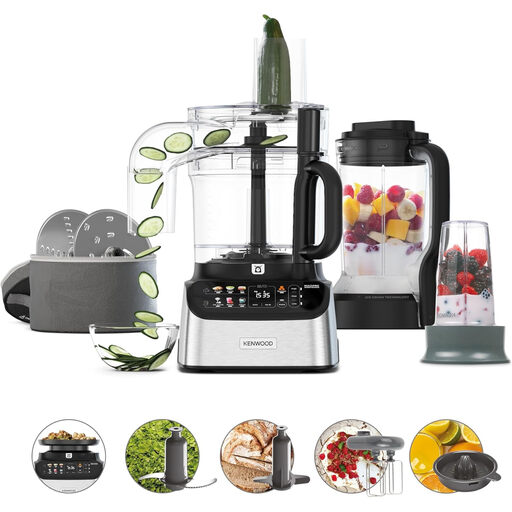
This 3L food processor is a choice to consider if your oat-bar method calls for controlled blending and you also want a machine for other preparation tasks. Check its working capacity and dense-mixture limits against your recipe before relying on the bowl-size figure for a single family batch.
 No image available
Consider this model if you want pulse control for a recipe that blends oats and binders, alongside tools for other preparation tasks.
The listed configuration has a 3L bowl, 1000W motor, variable speed, integrated weighing and 13 accessories. The 3L figure is the bowl size, not a confirmed working quantity for thick oat-bar mixture; check the model manual before scaling up your recipe.
Check the manual to identify which parts can go in the dishwasher.
Not necessarily: choose by the amount your recipe makes and the model’s working capacity and dense-mixture guidance. For example, Kenwood lists 1.5L working capacity for the FDP65.180SI, while Magimix lists 1.3L for the 4200XL, despite both having 3L total bowls.
Yes, if your recipe asks you to blitz oats or blend them with sticky ingredients: pulse or moment control lets you stop and assess the texture. It does not establish how much mixture a particular processor can handle, so follow the recipe and model instructions.
No. Good Food describes both a blended bar mixture that becomes a thick dough and a granola-bar method in which the oat mixture is combined with binders. Choose equipment for the steps in the recipe you intend to use.
Check your local council or retailer for a suitable electrical-equipment collection route. The UK Waste Electrical and Electronic Equipment Regulations 2013 address the collection and treatment of such equipment, but the available route depends on local arrangements.