Small-batch lunchbox bakers
If you make one modest batch at a time, usable capacity and cupboard space may matter more than a large bowl. Kenwood lists a 1.3L bowl and 0.75L working dry capacity for its compact MultiPro Go FDP23.130GY.


For a small batch of savoury lunchbox scones, choose a food processor with documented dough-making guidance, pulse control and enough working capacity for your usual recipe; a large bowl or dedicated dough tool is not automatically necessary. Magimix’s cheese-scone method uses short pulses and finishes the rough dough by hand, so the ability to stop promptly matters more than prolonged kneading.
If you make one modest batch at a time, usable capacity and cupboard space may matter more than a large bowl. Kenwood lists a 1.3L bowl and 0.75L working dry capacity for its compact MultiPro Go FDP23.130GY.
If you also grate cheese or chop herbs, check the included preparation accessories as well as the dough guidance. A larger processor may give you more working room, but it will need more storage space.
If you prepare lunchbox food for someone who avoids an allergen, choose food-contact parts you can remove, inspect and clean thoroughly. Food Standards Agency guidance for food operations identifies cleaning and prevention of allergen cross-contamination as important controls; the routine needed at home depends on the individual risk.
Start with the flour quantity in your usual recipe, then check how the exact processor handles dough and whether its parts fit your cleaning and storage routine.
| Concern | What to check | Who it matters to |
|---|---|---|
| Usable batch capacity | Compare the stated working dry capacity and any dough limit with your recipe’s flour quantity; bowl volume alone is not a dough limit. | If my scones include cheese and herbs, I need enough working room for the batch I actually make. Around 40% of consumers put batch fit first. |
| Control over dough texture | Look for pulse control and follow the exact model’s dough-tool instructions. Magimix’s cheese-scone method stops at a rough dough. | I want to stop mixing as soon as the dough comes together, rather than leave the processor running; about 30% of consumers prioritise control over texture. |
| Cleaning and storage | Check which food-contact parts can be removed and cleaned, and how blades and accessories are stored. | In a shared kitchen, I need to inspect dough-contact parts carefully and store accessories safely; roughly 30% of consumers put cleaning and storage first. |
Dough-making guidance varies by exact model: Kenwood describes dough making for the MultiPro Go FDP23.130GY and lists a dough tool for the MultiPro Express FDP65.180SI.
Check the product page or manual for the model and the tool you intend to use.
Magimix’s cheese-scone method calls for pulsing and then finishing the rough dough by hand, rather than treating it like bread dough.
Use short bursts and stop at the point specified by your recipe.
Kenwood lists 0.75L working dry capacity for the 1.3L MultiPro Go bowl and 1.5L for the 3L MultiPro Express bowl. Neither bowl volume should be read as a dough maximum.
Compare the working capacity and any stated dough limit with your regular batch.
A dishwasher-safe claim does not replace checking food-contact parts for residues when preparing food for someone who avoids an allergen.
Inspect and clean the bowl, lid, blades and other used parts as part of a routine appropriate to the individual risk.
Kenwood’s food-processor range includes compact and larger models with different documented approaches to dough.
The 3160 offers a larger-bowl option for people who expect to use a processor for baking and other preparation tasks.
The MCM3100W is a useful specification reference for comparing dough capacity and cleanability, rather than a current purchase option.
These Kenwood models are options for mixing scone dough alongside other food preparation. Compare their usable capacity and included tools with your recipe; a 3L bowl does not by itself establish how much dough either model can handle.
 No image available
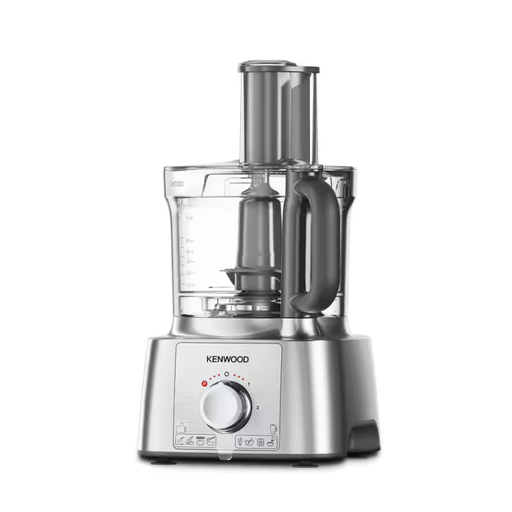
Consider this model if your scone recipe includes added ingredients and you want a documented dough tool and pulse control. Kenwood lists a 3L bowl and 1.5L working dry capacity; the product title specifies 1000W and six accessories.
Check the manual’s dough quantity against your recipe, and use short pulses rather than processing scone dough continuously. If allergen separation matters, check which food-contact parts you can inspect and clean thoroughly.
 No image available
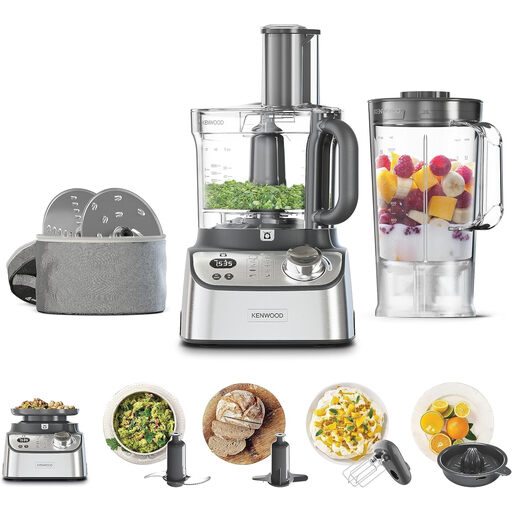
Consider this model if an integrated digital scale would be useful when preparing scone ingredients and you also want a processor for other preparation tasks. Its product title specifies a 3L bowl, 1000W and eight accessories.
Before choosing it for your regular batch, check the model’s working dry capacity, permitted dough quantity and instructions for the included accessories. For scones, stop processing when a rough dough forms and finish it by hand.
Not necessarily: use the tool and method specified for your exact processor and recipe. Some models include a dough tool, while Magimix’s cheese-scone method emphasises short pulses and finishing the rough dough by hand.
Choose by your recipe’s flour quantity and the model’s working capacity, not bowl litres alone. Kenwood lists 0.75L working dry capacity for the 1.3L MultiPro Go FDP23.130GY and 1.5L for the 3L MultiPro Express FDP65.180SI; check the separate dough guidance for either model.
A processor can bring the ingredients towards a rough dough, but do not assume it should run until the mixture is smooth. Magimix’s cheese-scone method stops processing and finishes the dough by hand.
Choose parts you can remove, inspect and clean thoroughly, and use a cross-contamination routine appropriate to the person’s allergy. Food Standards Agency guidance for food operations identifies cleaning and allergen cross-contamination controls as important; a dishwasher-safe label alone is not a complete cleaning plan.