What matters when choosing
Decide whether you are learning a physical key arrangement or entering foreign-language text through software. Then weigh the demands of the shared desk and your work devices.
| Concern |
What to check |
Who this matters to |
| Language input and layout |
Confirm the exact printed layout and the Windows or macOS input layout or input method you plan to use. |
If I am memorising AZERTY or QWERTZ key positions, I need the legends and software mapping to match; if I only need to enter text, an input source may suffice. Roughly 42% of consumers put correct language input or physical layout first. |
| Disruption to colleagues |
Check quiet-typing claims for the exact model and switch; compare sound figures only when their test methods match. |
For repeated drills beside colleagues, I want to limit typing noise without assuming that a low-profile design or acoustic foam proves quiet operation. Around 33% of consumers prioritise low-disruption practice. |
| Desk fit and connections |
Decide whether you need a number pad, then check available ports, permitted wireless connections and device compatibility. |
When practice shares a desk and devices with office work, I need a keyboard that fits the space and can connect under workplace rules. Roughly 25% of consumers place desk fit and connection flexibility first. |
Joybuy product choices
These keyboards offer different ways to practise at a shared desk: UK- or US-labelled boards for software-based input, and a German QWERTZ model for physical-layout practice. Check the exact variant against your language and workplace requirements.
 No image available
Ticktype DP104, Gecha Gray, Silent Tactile Switches
Consider this US-layout board if software-based language entry meets your practice goal; check that its legends and your chosen input layout work for you.
The named configuration is a full-size, 108-key, tri-mode mechanical keyboard with hot-swappable Silent Tactile Switches and an 8000mAh battery. The switch name does not establish a measured noise level for your office.
View on Joybuy
 No image available
ET Silent Wireless Keyboard and Mouse Combo, US Layout
This US-layout set is a choice for software-based language entry when you also want a mouse; confirm the printed legends suit your input method.
The product name specifies a full-size keyboard and 2.4GHz wireless connection. Check how that connection works with your device and workplace rules; “Silent” in the name is not a comparable noise measurement.
View on Joybuy
 No image available
Targus EcoSmart™ Full-Size Wireless Keyboard (UK)
A UK-labelled board can suit language practice through a software input source if learning another physical layout is not the goal.
This is the full-size wireless variant. Check its exact legends and connection method before ordering, particularly if workplace pairing or receiver use is restricted.
View on Joybuy
 No image available
Hyper® HyperSpace Next Bluetooth Wireless Keyboard (UK), White
Consider this UK-labelled keyboard for software-based language entry if Bluetooth use is permitted on the device you will practise with.
It is the white Bluetooth wireless variant. If keeping typing noise low is essential at your shared desk, check the exact model’s sound characteristics before buying.
View on Joybuy
 No image available
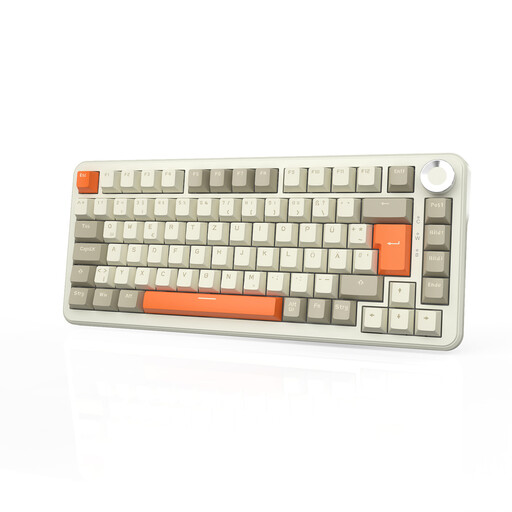
AJAZZ AK820 MAX, German QWERTZ, Flying Fish Switch
This is the physical-layout choice here if German QWERTZ key positions and legends are what you intend to practise; match it to the operating-system layout.
The named configuration is a 75% tri-mode wireless mechanical keyboard with German keycaps and an 8000mAh battery. Check device compatibility and switch noise against your shared-office requirements.
View on Joybuy
Common questions
Do I need keys printed in the language I am learning?
You need matching printed legends if learning that physical key arrangement is part of your goal. For text entry through software, Microsoft Support documents adding and changing Windows keyboard layouts, while Apple Support documents adding and switching macOS input sources; check that the resulting key mapping works for your exercises.
Is a mechanical keyboard necessarily too noisy for a shared office?
No single answer applies to every mechanical keyboard. Keychron lists acoustic materials on its V6 Max ISO range, but that does not establish how a particular switch configuration compares for noise; check independent sound testing for the exact configuration if quiet typing is essential.
What should I check before connecting a keyboard at work?
Check the keyboard’s connection method, the ports and wireless capabilities of your work device, and whether workplace IT policy permits Bluetooth pairing or a personal USB receiver. Multi-device switching is useful only when the devices you intend to use can connect.
What safety information matters when ordering a keyboard online?
Check the exact product’s appropriate marking and manufacturer name and address, as advised by GOV.UK consumer safety guidance. For Great Britain, government guidance explains that UKCA and CE markings reflect the manufacturer’s assessment against relevant requirements; consult the separate Northern Ireland guidance if that is the destination rather than assuming the same marking rules apply.
How should I dispose of an old keyboard?
Use an appropriate electrical-equipment collection or recycling route rather than treating the keyboard as ordinary household rubbish. UK waste electrical and electronic equipment guidance promotes recovery, reuse and recycling; check the available local or retailer handover route.


