What should you check before buying?
Start with the finished volume, then choose a preparation method your kitchen can manage and check the dose and ingredients of the exact product.
| Priority | What to check | Your needs |
|---|
| Batch quantity |
Four UK pints is about 2.27 litres under the definition published on legislation.gov.uk. Check the pack’s dose and intended liquid volume per serving; do not convert dry pack weight directly into drink yield. |
I’m making enough for several friends and may need to allow for larger mugs or second servings. |
| Preparation |
Check whether the exact mix calls for hot milk or permits hot water, and whether you have suitable equipment for the full batch. Tesco’s instructions for Cadbury Hot Chocolate Cocoa Powder 500g specify hot milk. |
Heating milk for everyone may work in my kitchen; otherwise, I’d look for a mix with hot-water instructions. |
| Format and flavour |
Compare the stated dose for a standard powder, a flavoured jar or flakes. Tesco lists Options Salted Caramel in a 220g jar; Marks & Spencer says its Belgian milk chocolate flakes melt into hot milk. |
I may want one flavour for the whole batch, or a separate flavoured choice for guests who prefer it. |
| Ingredients and allergens |
Read the current ingredients, declared allergens and precautionary statements for each variant. The Food Standards Agency explains that precautionary allergen labelling communicates the possibility of unintended allergen presence. |
If a guest has an allergy, I need to check the particular product I’ll serve, not just its brand or preparation method. |
Brand and range references
These examples show how pack formats and instructions differ; check the particular product rather than applying a range description to every variant.
Cadbury
Tesco lists Cadbury Hot Chocolate Cocoa Powder in a 500g pack for preparation with hot milk.
- Tesco’s instructions specify three teaspoons stirred into hot milk.
- The teaspoon instruction gives no gram weight for calculating batch yield; Tesco also lists a may-contain-milk statement.
Tesco
Tesco’s hot-chocolate range includes an Instant Hot Chocolate 400g pack and a separate Drinking Chocolate product.
- The separate formats give hosts a starting point for checking preparation methods.
- Check the dose and ingredients of the chosen pack rather than treating the two formats as interchangeable.
Galaxy
Tesco lists Galaxy Instant Hot Chocolate Drink in a 370g pack.
- Its instant format is worth considering when comparing preparation instructions for a group.
- Galaxy advises checking allergen information on the pack; details from another Galaxy variant should not be applied to this one.
Options
Tesco lists Options flavoured hot chocolate, including Salted Caramel, in 220g jars.
- A flavoured jar can provide a distinct choice alongside a shared batch.
- Check its stated dose before relying on a 220g jar for four pints.
M&S
Marks & Spencer lists both instant hot chocolate and Belgian chocolate flakes, with different preparation methods and ingredients.
- Its Belgian milk chocolate flakes are described as melting into hot milk.
- Its Instant Hot Chocolate lists milk ingredients, while the Belgian dark flakes list soya and carry a nut-allergy notice; check the exact pack.
Joybuy hot-chocolate options
These 300g and 500g hot-chocolate products offer pack-size choices for a shared brunch. Use each product’s preparation directions to plan a four-pint batch.
 No image available
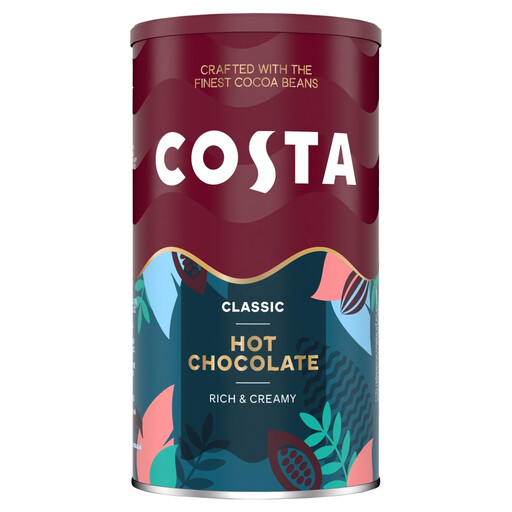
Costa Hot Chocolate 300g
For a shared brunch, check this 300g pack’s preparation directions to work out how much you need for four pints. Check the current ingredients and allergen information before serving guests.
Joybuy
 No image available
Cadbury Drinking Chocolate 500g
The 500g pack is an option to assess for a shared drinking-chocolate batch if you can heat milk. Confirm this pack’s dose and finished-drink yield when planning four pints, and check its current allergen statement.
Joybuy
 No image available
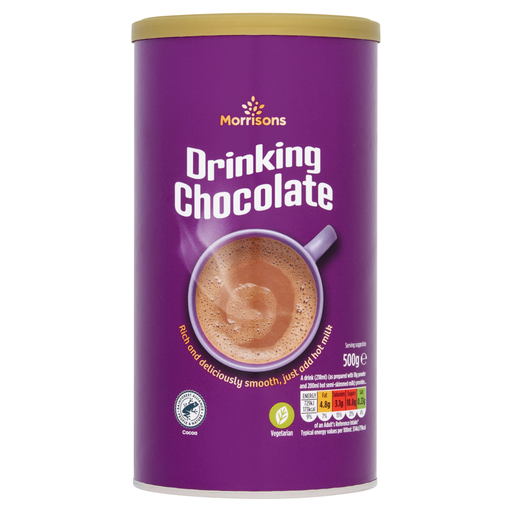
Morrisons Drinking Chocolate 500g
For a milk-based brunch batch, compare this 500g pack’s preparation dose with the four-pint target. Follow the current pack instructions and check its ingredients and allergens before serving.
Joybuy
Questions about serving a group
How much hot chocolate is four UK pints?
Four UK pints is about 2.27 litres, using the pint definition published on legislation.gov.uk. That is roughly 11 mugs of 200ml or nine mugs of 250ml, before allowing for seconds. These are liquid-volume calculations, not a yield claim for any powder.
Should I choose drinking chocolate or an instant mix for a group?
Choose a drinking chocolate with hot-milk instructions if you can heat enough milk; Tesco gives that preparation method for Cadbury Hot Chocolate Cocoa Powder 500g. If hot-water preparation suits your setup better, choose an instant mix whose own instructions permit it. Check the dose and allergens of whichever pack you buy.
Does instant or dark hot chocolate suit every allergy requirement?
No: the format name does not establish allergen suitability. Marks & Spencer lists milk ingredients in its Instant Hot Chocolate and soya in its Belgian dark chocolate flakes, which also carry a nut-allergy notice. Read the current label of the exact product before serving.
How should I store an opened hot-chocolate powder?
Follow the directions on the chosen pack. Marks & Spencer says to keep its Instant Hot Chocolate in a cool, dry place and consume it within four weeks of opening; do not assume that timeframe applies to other products.
Do chocolate flakes require a special appliance?
Marks & Spencer describes its Belgian milk chocolate flakes as melting into hot milk, without specifying a mandatory appliance. Follow the chosen flakes’ instructions and use equipment suitable for heating the amount of milk you need.


