Households that use milk every day
A four-pint fresh bottle is worth considering if you use skimmed milk for drinks, cereal or cooking and can finish it within the pack’s instructions after opening.


Choose a four-pint skimmed milk if your household will finish the fresh bottle within its opened-life guidance and ordinary skimmed milk provides the protein you want per serving. If protein per glass matters more than pack size, compare protein-enriched skimmed milk with other higher-protein milk, checking fat content and bottle size too. A clinically advised high-energy, high-protein diet calls for an individual plan rather than a switch based on the milk label alone.
A four-pint fresh bottle is worth considering if you use skimmed milk for drinks, cereal or cooking and can finish it within the pack’s instructions after opening.
Check protein per 100ml and for the portion you normally use. Sainsbury’s lists 3.6g per 100ml for its standard skimmed milk; the Arla B.O.B and SuperNutrio listings describe different milk formats with higher figures.
A smaller bottle or a filtered milk with suitable opened-life instructions may fit your routine better than four pints of fresh milk. Check the instructions on the exact skimmed product, rather than assuming all filtered milks keep for the same time.
Start with protein per portion, then choose a pack format your household can use and store as directed.
| Priority | What to check | Your needs |
|---|---|---|
| Protein per portion | Compare protein per 100ml, then calculate it for your usual portion. Sainsbury’s lists 3.6g per 100ml and 7.2g per 200ml for its four-pint skimmed milk. The checked Arla B.O.B skimmed and SuperNutrio semi-skimmed listings give 4.5g and 7g per 100ml respectively. | For my usual glass, cereal or recipe portion, I want to know how much protein the milk actually contributes; a larger bottle does not change the amount per 100ml. |
| Pack size and storage | Match bottle volume to use after opening. Sainsbury’s says to keep its 2.272L fresh skimmed milk below 5°C and consume it within three days of opening; the Arla B.O.B listing states seven days for its 2L product. Follow the exact pack. | Will my household finish a four-pint bottle in time, or would a different size or format mean less milk left over? |
| Milk format | Check whether an alternative is skimmed or semi-skimmed as well as its protein figure. The Arla B.O.B listing gives 0.4g fat per 100ml; the SuperNutrio semi-skimmed listing gives 1.7g per 100ml and comes in a 1L bottle. | Extra protein per serving matters to me, but I also want the milk format and bottle size to fit how I use it. |
| Reason for the diet | Distinguish a plan to increase protein without raising overall calories from a clinically advised high-energy, high-protein diet. Cambridge University Hospitals discusses lower-fat choices for the former; East Lancashire Hospitals NHS Trust identifies skimmed and semi-skimmed milk as lower-calorie, lower-protein dairy choices in its high-energy diet sheet. | If my diet is part of clinical care, I need to follow the individual plan rather than choose milk on a front-of-pack protein claim. |
| Current label | Check ingredients, allergens and nutrition on the bottle you receive. Sainsbury’s declares milk in its skimmed product, and ASDA cautions that online product information can change. | If milk allergy or a particular nutrition value matters, I need the details for this exact product, not another skimmed-milk listing. |
Pack volume and protein concentration answer different questions. The checked Sainsbury’s standard skimmed milk lists 3.6g protein per 100ml, compared with 4.5g for Arla B.O.B skimmed milk and 7g for SuperNutrio semi-skimmed milk.
Compare the nutrition panels on the same per-100ml basis before deciding whether four pints is the right pack.
Sainsbury’s instructs shoppers to consume its fresh four-pint skimmed milk within three days of opening. A bottle your household cannot finish in that period may leave milk unused.
Think through your likely use after opening, then compare the exact storage instructions on other sizes or filtered products.
East Lancashire Hospitals NHS Trust’s high-energy, high-protein diet sheet places skimmed and semi-skimmed milk among its lower-calorie, lower-protein dairy choices. Energy intake matters alongside protein in that clinical context.
If a clinician or dietitian has given you a diet plan, use that plan when choosing milk.
Milk is an allergen in the checked Sainsbury’s skimmed product, and ASDA warns that online nutrition and allergy information can change.
Check the delivered bottle’s ingredients, allergen declaration and nutrition panel when those details affect your choice.
Its British fresh skimmed milk provides a four-pint, 2.272L option.
Its British skimmed milk is listed in a four-pint format.
Tesco’s skimmed-milk listings include a 2.272L fresh bottle, a 2L filtered bottle and a six-pack of 1L UHT cartons.
Cravendale Filtered Fresh Skimmed Milk appears as a 2L option in Tesco’s skimmed-milk listings.
Its skimmed-milk listings include a 2.272L Essential bottle and 2L filtered options, including Arla B.O.B.
M&S describes fresh milk in sizes from one to four pints, alongside filtered chilled milk.
These Morrisons UHT skimmed-milk options offer either six separate 1L cartons for household use or a single 1L carton. They are not four-pint fresh-milk bottles; compare the label’s protein figure if protein per serving drives your choice.
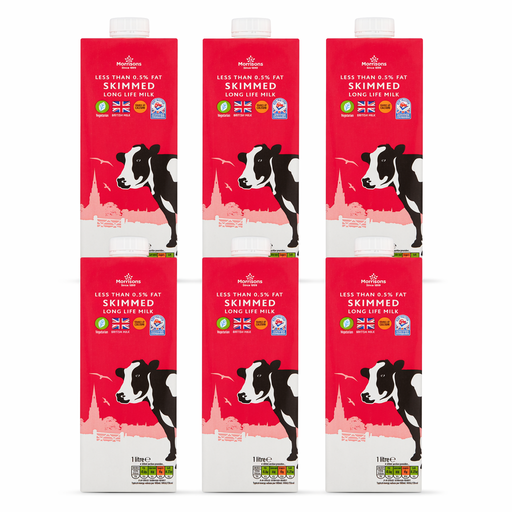 No image available
Six separate 1L cartons may suit a household that wants to open its skimmed milk one carton at a time rather than use a single four-pint bottle. Check each carton’s best-before date and storage instructions, and compare protein per 100ml with your intended serving.
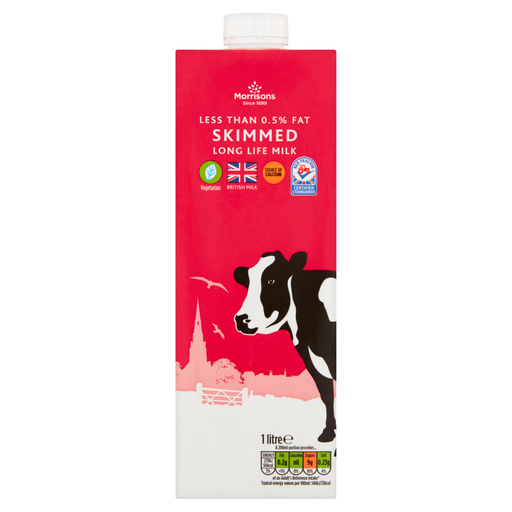 No image available
This single 1L carton is an option when a four-pint family bottle is more than you expect to use. Check its best-before date, storage instructions and protein per 100ml; the single carton does not provide a family-pack format.
Sainsbury’s lists 3.6g protein per 100ml for its British skimmed milk, giving 7.2g in a 200ml serving. Check the nutrition panel on the bottle you buy for that product’s figure.
Not because of its size: compare protein per 100ml. The checked Sainsbury’s standard skimmed milk lists 3.6g per 100ml, Arla B.O.B skimmed milk lists 4.5g, and the 1L SuperNutrio semi-skimmed milk lists 7g. The latter two are different formats from a standard four-pint skimmed bottle.
Follow the instructions on your exact bottle. Sainsbury’s says to refrigerate its four-pint skimmed milk below 5°C and consume it within three days of opening; do not assume the same period for another product.
No: the checked Sainsbury’s skimmed milk declares that it contains milk. Check the ingredients and allergen information of any alternative before choosing it.
Do not choose it solely because you want more protein. East Lancashire Hospitals NHS Trust’s high-energy, high-protein diet sheet identifies skimmed and semi-skimmed milk as lower-calorie, lower-protein dairy choices in that clinical context. Follow the food plan given by your clinician or dietitian.