What matters when choosing a bar?
Start with the dietary requirement the bar must meet. Then compare the amount you would eat and the nutrition declaration across suitable options.
| Priority | What to check | Your needs |
|---|
| Gluten and allergens |
Look for an explicit gluten-free label where needed. Read the ingredients, emphasised allergens and any “may contain” statement for the exact bar. |
I need the free-from claim to cover my particular requirement, not just gluten when I also avoid nuts, milk or soya. |
| Portion and calories |
Check kcal per bar and the stated serving size. Use the per 100g figure to compare bars of different sizes. |
If I eat a whole bar, I want to know its energy content as eaten rather than rely on how small it looks. |
| Nutrition trade-offs |
Compare sugars and saturated fat alongside protein and fibre, using both per-bar and per 100g values where shown. Read traffic-light labelling against the nutrition declaration. |
A protein, vegan or gluten-free label alone does not tell me whether the bar fits the snack I have planned. |
| Oat suitability |
For an oat bar needed for gluten avoidance, check that the product is explicitly labelled gluten-free. Consider individual tolerance to gluten-free oats. |
For coeliac disease, I cannot assume that ordinary oats, “pure oats” or organic oats meet my gluten-free requirement. |
Brand ranges to consider
Brand ranges differ, and a claim attached to one flavour does not necessarily apply to another. Check the precise bar before making a dietary or nutrition comparison.
Nature Valley
A reference point for gluten-free protein bars. Nature Valley UK identifies Protein Peanut & Chocolate and Protein Salted Caramel Nut as the gluten-free products in its range.
- The brand describes its Salted Caramel Nut 40g bar as providing around 10g protein and 4g fibre.
- That flavour contains peanuts, almond, soya and milk; gluten-free does not make it suitable for those avoiding these ingredients.
TREK
Offers plant-based protein bars and flapjacks for shoppers considering a vegan format.
- TREK describes its bars as plant-based and its Protein Flapjacks as providing 9g plant-based protein.
- Check the exact flavour’s gluten-free designation, allergens and nutrition declaration rather than applying a range description to every bar.
Eat Natural
Offers a selection of gluten-free cereal bars, according to its UK range information.
- The range offers another place to compare gluten-free bar formats.
- Check the exact variant for nuts, milk, soya and ingredients relevant to a vegan requirement.
Graze
Its Oat Boost flapjacks provide an oat-based format to compare by portion and nutrition declaration.
- Graze makes a lower-sugar comparison claim about its Oat Boost flapjacks; use the current pack for the values relevant to your choice.
- Do not assume that every Graze cereal bar is gluten-free. Check the individual product’s label.
Kellogg’s
A useful reminder that portion information and free-from suitability are separate checks.
- Kellogg’s lists 104 kcal per 27g Special K Red Berry Bar.
- That bar lists barley, oats, milk, soya and wheat as allergens, so its per-bar calorie figure does not make it a gluten-free option.
Alpen
A comparison brand to check carefully when gluten avoidance is essential.
- Alpen’s product guidance gives a clear starting point for assessing its range against a gluten-free requirement.
- Alpen states that all its products contain gluten from wheat, barley or oats; it also identifies several older bar lines as no longer made.
Joybuy cereal-bar options
These options include TREK oat flapjacks and two Nature Valley protein-bar flavours. For any bar you need to be gluten-free, confirm the wording and other allergens on its current pack, then compare its nutrition per bar.
 No image available
TREK Salted Caramel Protein Flapjacks 3 x 50g
An oat-flapjack option for a planned snack; TREK describes its bars as plant-based. If you need to avoid gluten, confirm this flavour’s gluten-free wording and allergens on the pack, and compare its kcal and sugars per bar.
View on Joybuy
 No image available
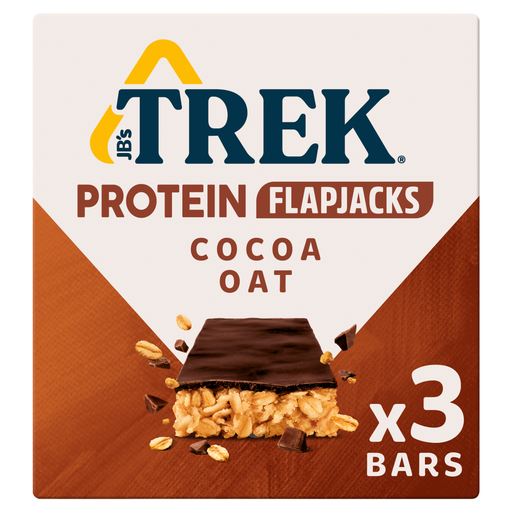
TREK Cocoa Oat Protein Flapjacks 3 x 50g
A cocoa oat-flapjack format from TREK’s plant-based range. Check this flavour’s current gluten-free label and allergen statement if either affects your choice; use its per-bar calories, sugars and saturated fat for the snack comparison.
View on Joybuy
 No image available
Nature Valley Protein Salted Caramel Nut Bars 4 x 40g
Nature Valley UK identifies this flavour as gluten-free and describes each 40g bar as providing around 10g protein and 4g fibre. It contains peanuts, almond, soya and milk. Check the current pack’s calories and full nutrition declaration alongside those ingredients.
View on Joybuy
 No image available
Nature Valley Protein Peanut & Chocolate Bars 8 x 40g
Nature Valley UK identifies this flavour as gluten-free and lists approximately 10g protein and 196 kcal per 40g bar. It contains peanuts, soya and milk; read the current pack for its full allergen statement and compare sugars and saturated fat with other suitable bars.
View on Joybuy
Questions about free-from cereal bars
Does gluten-free mean a cereal bar is free from other allergens?
No. A gluten-free claim does not mean the bar is free from peanuts, tree nuts, milk or soya. Nature Valley’s gluten-free Protein Salted Caramel Nut bar, for example, contains peanuts, almond, soya and milk; check the precise product’s ingredients and any precautionary allergen statement.
Can an oat-based bar suit someone with coeliac disease?
Choose an oat bar explicitly labelled gluten-free rather than assuming ordinary oats are suitable. Coeliac UK explains that standard oats can be contaminated with wheat, barley or rye, and that a small number of people remain sensitive to gluten-free oats. Take account of your individual advice about oats.
Should I compare calories per bar or per 100g?
Use both: kcal per bar shows the amount in one bar, while per 100g values help compare different bar sizes. The NHS notes that nutrition information is given per 100g and sometimes per portion; check whether the stated portion matches what you intend to eat.
Is a protein cereal bar automatically a better choice for weight management?
No. Protein is one part of the nutrition declaration, not a measure of how a bar fits your overall energy intake. Compare kcal, sugars and saturated fat per bar, and meet any gluten-free or other allergen requirement before deciding between flavours.


