Students avoiding a named allergen
If you need to avoid milk, wheat, soya, peanuts, tree nuts or sesame, the exact flavour’s ingredients and precautionary allergen statement matter more than a broad ‘free-from’ description.


Choose a protein bar for a lecture lunch by the specific ingredient or allergen you need to avoid, then check the ingredients and any ‘may contain’ statement for that exact flavour. Dairy-free and vegan describe different things, while a standard high-protein bar may contain milk proteins; the right choice also depends on its portion, portability and any sweetener warnings.
If you need to avoid milk, wheat, soya, peanuts, tree nuts or sesame, the exact flavour’s ingredients and precautionary allergen statement matter more than a broad ‘free-from’ description.
An explicitly dairy-free range can help you start looking for a bar without milk-derived ingredients. A vegan label does not answer separate questions about wheat, soya or possible allergen traces.
If you have no allergen exclusion, compare the portion and protein stated for each bar, how it is packaged and any ingredient or sweetener warnings before putting it in your bag.
Start with the ingredient you must avoid; only then compare portions and the practical details of eating a bar during a lecture day.
| Priority | What to check | Your needs |
|---|---|---|
| Specific allergens | Read the ingredients for the exact flavour and check any ‘may contain’ statement separately. The Food Standards Agency describes precautionary allergen labelling as communicating possible unintended allergen presence. | I need to know whether this particular bar fits the allergen I avoid, not just whether its front label says ‘free-from’. |
| Dairy-free or vegan | Check for milk-derived ingredients on a dairy-free product; check wheat, soya and other relevant allergens independently on a vegan product. Barebells lists wheat and soya in its Vegan Fudge Brownie bar and warns that it may contain milk, peanuts, tree nuts and sesame. | A plant-based bar might fit my food preference, but I still need to check it against each of my allergen requirements. |
| Portion and packing | Compare the stated bar weight and protein per bar, rather than figures for differently sized servings. Check whether the product is individually wrapped if it needs to travel in a bag. | For a gap between lectures, I want a portion I can carry and eat without preparation. |
| Sweeteners and warnings | Read the sweetener information and any excessive-consumption warning on the exact product. Grenade and PhD publish laxative-effect warnings for some bars; a warning for one product must not be assumed to apply to every flavour. | If sweeteners have bothered me before, I would rather check the pack before relying on an unfamiliar bar during a long class. |
Those descriptions do not rule out other ingredients or a precautionary statement. Barebells Vegan Fudge Brownie, for example, contains wheat and soya and may contain milk, peanuts, tree nuts and sesame.
Note each allergen you need to avoid and read both statements on the exact flavour whenever you buy it, including when switching flavours.
Grenade lists milk proteins in its Salted Caramel bar, and PhD describes a whey-protein centre in Smart Bar. Neither description makes those products a dairy-free starting point.
If avoiding milk, start with an explicitly dairy-free product, then check its current ingredients and precautionary statement.
Some bars carry warnings that excessive consumption may have a laxative effect. That is worth considering if you know you are sensitive to their sweeteners.
Read the serving and warning information, and try an unfamiliar product on a less time-pressured day.
A protein-bar category brings different products together; it does not establish whether an individual flavour meets your allergen requirements.
Use the category to find possibilities, then check the specific listing and the physical pack before eating the bar.
These examples show why the product line and flavour matter more than the brand name alone.
Myprotein has a dedicated dairy-free protein-bar category.
Barebells offers vegan as well as other protein-bar lines.
Grenade offers several protein-bar flavours with different ingredient lists.
PhD presents Smart Bar as a snack for between meals or on the go.
Tesco’s protein-bar category groups products from different brands for browsing.
These flapjacks and bars are options to compare for a lecture-day snack. Their names and pack sizes help distinguish them, but the current label for each flavour must determine whether it meets your ingredient or allergen requirements.
 Image unavailable
The three-flapjack pack offers a stated 50 g portion for planning a snack between lectures. If you avoid gluten, milk or soya, check the exact pack’s ingredients, claims and precautionary statement before choosing it.
 Image unavailable
The named peanut-and-chocolate variant comes as four 40 g bars. If you need to avoid peanuts or another allergen, check the full ingredients and ‘may contain’ statement on this exact pack; do not use a gluten-free claim as a substitute for those checks.
 Image unavailable
This salted-caramel nut variant is listed as four 40 g bars. Check which nuts and other allergens appear on its current pack, including any precautionary statement, before treating it as suitable for a free-from requirement.
 Image unavailable
The Double Chocolate pack contains twelve stated 50 g bars, a format to compare if you regularly take a bar to campus. Check this Soft Core flavour’s milk and soya ingredients, other allergen statements and sweetener warnings rather than applying details from another Grenade bar.
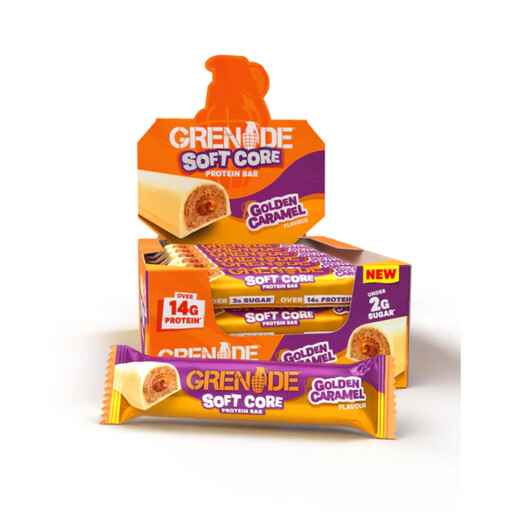 Image unavailable
This Golden Caramel pack also lists twelve 50 g bars. Compare its own ingredients, allergen statements and sweetener warnings with the Double Chocolate flavour: similar pack sizes do not establish identical formulations.
No. Barebells says its Vegan Fudge Brownie bar contains wheat and soya and may contain milk, peanuts, tree nuts and sesame. Check the exact flavour against the ingredients and traces you need to avoid.
Read the full ingredients list and any separate precautionary statement, such as ‘may contain’, for the exact bar. The Food Standards Agency explains that precautionary allergen labelling communicates possible unintended presence of a regulated allergen; it is a different check from identifying ingredients deliberately used in the product.
Check the label on the product you are handed. For food prepacked for direct sale in the UK, the labelling requirements in force since 1 October 2021 call for the food name and a full ingredients list with the 14 regulated allergens emphasised, according to the Food Standards Agency and Food Standards Scotland. If a label is unclear or the item has been substituted, ask staff about that specific product before choosing it.
Do not assume so: Grenade lists milk proteins in its Salted Caramel bar, and PhD describes a whey-protein centre in Smart Bar. Check the exact flavour and current pack if milk avoidance is essential.
Some bars warn that excessive consumption may have a laxative effect. Grenade gives this warning for its Salted Caramel bar, so if you know you are sensitive to sweeteners, read the warning on your chosen flavour and try an unfamiliar bar on a less time-pressured day.