Gluten-free snack shoppers
If you want a bar to eat while watching TV and need to avoid gluten, look for a gluten-free claim on the exact product. Check its other ingredients too: gluten-free does not mean free from oats, nuts, milk or soya.


Choose a TV-night snack bar by the specific ingredient or allergen the eater needs to avoid, rather than treating “free-from” or “vegan” as an all-purpose assurance. A gluten-free bar may still contain nuts, milk or soya; check the ingredients and precautionary allergen wording on the current pack before serving it to someone with an allergy.
If you want a bar to eat while watching TV and need to avoid gluten, look for a gluten-free claim on the exact product. Check its other ingredients too: gluten-free does not mean free from oats, nuts, milk or soya.
Dairy-free and vegan labels can narrow a sweet-snack shortlist, but they answer different questions from allergen labelling. The Food Standards Agency cautions that a vegan product may still be unsuitable for someone with a relevant food allergy because of cross-contact.
When a bar will be shared with someone who must avoid nuts, peanuts, milk or soya, check the exact flavour’s ingredients and precautionary statement before choosing it. A brand name or a broad dietary claim cannot replace that pack-level check.
Settle the eater’s ingredient and allergen exclusions before comparing cocoa flavours, bar formats or per-bar nutrition.
| Priority | What to check | Your needs |
|---|---|---|
| Specific allergens | Read the current ingredients and any “may contain” statement for the exact flavour. The Food Standards Agency explains that precautionary wording signals possible unintended allergen presence. | I’m buying for someone who needs to avoid a particular allergen, so both added ingredients and relevant cross-contact warnings matter. |
| Gluten and oats | Look for a gluten-free claim on the individual bar. Check for oats separately if the eater has an oat allergy: the Food Standards Agency identifies oats as an allergen in their own right. | For gluten avoidance, I want an explicitly labelled product; if oats are also a problem, a gluten-free oat flapjack will not meet that need. |
| Vegan or dairy-free | Check which claim the pack actually makes, then read the milk ingredients and precautionary wording if milk allergy is relevant. Vegan labelling alone is not an allergy check. | I’d like a plant-based or dairy-free cocoa-style snack, but I still need to check any separate allergy requirements. |
| Flavour and portion | Once the allergen checks are settled, compare cocoa or chocolate flavours, fruit-and-nut bars and oat flapjacks. Use the stated serving size when comparing per-bar nutrition. | A single bar suits my TV-night snack plan; I can choose the flavour and format after checking that the ingredients work for the eater. |
Vegan labelling describes the dietary formulation, not the absence of allergen cross-contact. The Food Standards Agency warns that this distinction matters for people with food hypersensitivities.
Use the vegan claim to narrow dietary options, then check the ingredients and precautionary allergen statement on the pack.
Gluten-free cocoa-style bars can have different other allergens: Tesco lists cashews in nakd. Cocoa Delight, while Nature Valley identifies peanut, soya and milk in its Protein Peanut & Chocolate bar.
Start with every allergen the eater must avoid, rather than assuming one free-from claim covers them all.
An oat-based recipe does not itself establish that a bar is gluten-free. The Food Standards Agency also identifies oats as an allergen in their own right.
Check the exact bar for a gluten-free claim where needed, and avoid an oat-containing bar if the eater must avoid oats.
An online description helps make a shortlist, but the bar being served is the one whose ingredients and allergen statement matter.
Read the current wrapper or outer pack before serving, especially when buying a different flavour or pack format.
These examples show why a brand or range can narrow a search without establishing that every flavour meets the same dietary or allergen requirements.
Fruit-and-nut bars include the cocoa-style Cocoa Delight. Tesco labels that specific product gluten-free, dairy-free and vegan.
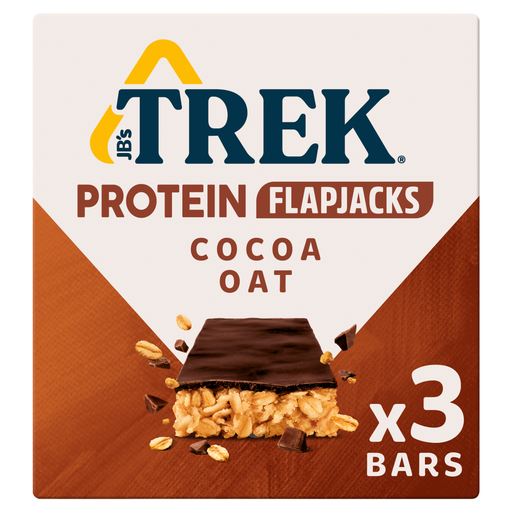
TREK’s Cocoa Oat Protein Flapjack is an oat-based cocoa option labelled gluten-free and vegan by Waitrose & Partners.
Nature Valley lists its Protein Peanut & Chocolate bar as gluten-free, with around 10 g protein per 40 g bar.
Eat Natural lists a UK gluten-free range spanning several bar formats and flavours.
Alpen is primarily a muesli reference rather than a gluten-free snack-bar route here.
Graze includes oat-based Oat Boost flapjacks in its UK range.
These cocoa, chocolate and salted-caramel bars offer different flavours and pack sizes for a TV-night shortlist. Check each current pack against the eater’s dietary and allergen requirements before serving.
 No image available
A cocoa-oat flapjack format for a TV-night snack, supplied as 16 x 50 g bars. Its listed limitations identify soya and oats and precautionary warnings for milk, nuts and peanuts; check the current pack against the eater’s requirements.
 No image available
A three-bar cocoa-oat flapjack pack for shoppers considering a plant-based format. Joybuy’s ingredient information lists gluten-free oats and soya; check the current pack for its complete ingredients and precautionary allergen wording.
 No image available
A salted-caramel alternative to the cocoa bars, supplied as 3 x 50 g flapjacks. Its listed limitations identify soya; check the current pack for any gluten-free claim and the full allergen statement relevant to the eater.
 No image available
A peanut-and-chocolate option supplied as four 40 g bars. Nature Valley lists this product as gluten-free and identifies peanut, soya and milk ingredients, with possible tree-nut presence; it is not suitable for shoppers who must avoid those allergens.
 No image available
A salted-caramel nut option supplied as four 40 g bars. Its listed limitations identify peanuts, almonds, milk and soya; check the current pack for the complete ingredients, precautionary wording and any dietary claim you require.
No. The Food Standards Agency cautions that vegan labelling alone does not establish suitability for someone with a relevant food allergy, because cross-contact can matter. Check the ingredients and precautionary allergen statement on the exact pack.
No. For gluten avoidance, look for a gluten-free claim on the exact product rather than relying on its oat-based recipe. The Food Standards Agency also identifies oats as an allergen in their own right, so check for oats separately if necessary.
It is precautionary allergen labelling indicating that the named allergen could be unintentionally present. The Food Standards Agency explains that this warning can matter even when the allergen is not listed as an ingredient.
Tesco labels nakd. Cocoa Delight dairy-free, but it contains cashews and may contain soya, peanuts and other nuts. Check the current pack against every allergen the eater needs to avoid, not dairy alone.