
24/7 Customer Support

Free returns

Same-day & Next-day Delivery

Quality Guaranteed

Unlock Your Welcome Offers: FREE Delivery | Up to 80% OFF | Free 30-day JoyPlus trial
Download the APP
Choosing a new freestanding fridge freezer is a significant decision for any household. It's an appliance you'll rely on daily, impacting everything from your energy bills and food freshness to your kitchen's overall look and feel. With so many features, sizes and styles available, it can be challenging to determine which model truly fits your needs.
As the Joybuy Product Recommendation Officer, my role is to provide clear, practical guidance to help you make an informed choice. This guide will walk you through the key considerations for buying a new fridge freezer in the UK and highlight a few standout models that cater to different households and budgets.
Before diving into specific products, let's cover a few essential features. Focusing on these will help you narrow down the options and find an appliance that serves your home well for years to come.
Since 2021, appliances in the UK use a simpler A-G energy rating scale, with 'A' being the most efficient. An energy efficient fridge freezer can have a noticeable impact on your household electricity costs over its lifetime. While models with higher ratings like A or B may have a greater initial cost, the long-term savings on energy bills can make them a worthwhile consideration. Always check the estimated annual energy consumption (in kWh) on the energy label for a more direct comparison.
The right capacity depends entirely on your household's size and shopping habits. Capacity is measured in litres. A smaller household might be well-served by a model under 300 litres, while larger families may require a large capacity fridge freezer of 400 litres or more.
Pay close attention to the split between the fridge and freezer. A 60/40 fridge freezer, with a larger fridge section, is common and suits those who buy more fresh food. Also, measure your available space carefully. If your kitchen is compact, a slimline fridge freezer (typically under 55cm wide) can be an excellent space-saving solution.
One of the most sought-after features is Total No Frost technology. A total no frost fridge freezer circulates cool air to prevent any ice from building up in the freezer compartment. This eliminates the need for manual defrosting and ensures the appliance runs efficiently.
Another key factor, especially for open-plan living spaces, is the noise level, measured in decibels (dB). A quiet fridge freezer operates at or below 40 dB, which is comparable to a quiet library. This ensures your kitchen remains a peaceful environment.
Here are a few freestanding fridge freezer models that offer a great combination of modern features, practicality and style.
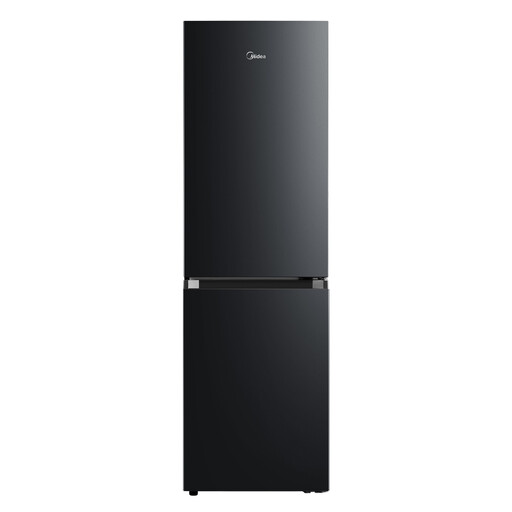
View Product: Midea MDRB379FGD30 Total No Frost Fridge Freezer

View Product: Midea MDRB424FGD01W 310L Fridge Freezer

View Product: Haier 2D 60 Series 5 Pro Fridge Freezer
If a freestanding model doesn't quite suit your kitchen design, perhaps you're planning a fully fitted look. In that case, an appliance that sits hidden behind a cabinet door could be the ideal solution.
For a seamless, built-in aesthetic, you might want to explore our range of Integrated larder fridge options.
A total no frost fridge freezer uses a fan to circulate cold, dry air throughout the freezer compartment. This prevents the formation of ice crystals on your food and the interior walls, meaning you never have to go through the chore of manually defrosting the appliance. It also helps maintain a consistent temperature for better food preservation.
Consider both your household size and kitchen space. For capacity, a general guide is 100-150 litres for 1-2 people, plus an extra 50 litres for each additional person. For physical size, carefully measure the height, width and depth of the space where the appliance will go. Remember to leave a few centimetres of clearance around the back and sides for ventilation.
Under the current A-G scale, any appliance rated D or above is considered to have good energy efficiency. Models in the A, B or C categories represent a significant step up in efficiency and will offer the lowest running costs, making them an excellent long-term choice for reducing household energy consumption.