
24/7 Customer Support

Free returns

Same-day & Next-day Delivery

Quality Guaranteed

Unlock Your Welcome Offers: FREE Delivery | Up to 80% OFF | Free 30-day JoyPlus trial
Download the APP
Buying a freestyle stunt scooter for kids is different from choosing a scooter for commuting or casual trips. A trick scooter needs to cope with repeated landings, handlebar rotation and hard use at a skatepark, while still being manageable for a young rider.
The product descriptions can make similar scooters appear identical, but small differences in construction, wheel size and rider guidance affect whether a scooter feels stable or becomes frustrating to use. Before ordering, watch for these common buying traps.
A low scooter weight can help children learn hops, spins and basic tailwhips. However, weight alone does not indicate durability. Check the combination of deck material, fork construction, handlebar design and clamp system.
Aluminium decks are generally easier for younger riders to lift, while steel components can add strength but increase overall weight. A scooter weighing around 3.6–4.4 kg may be manageable for many children, but the correct choice depends on the rider’s size, confidence and intended tricks.
Age guidance is not a substitute for checking the rider’s height and weight. Some products are listed for children aged 6 and up, while others are intended for riders aged 8 and over or young people up to 18.
Also check the maximum user weight. Several scooters in this selection support up to 100 kg or 220 lb, but this does not mean every child will find the handlebar height or deck proportions comfortable. A scooter can have a high weight limit while still being physically too large for a smaller rider.
ABEC ratings, wheel hardness and large wheels are useful comparison points, but they do not automatically make a scooter suitable for beginners. A new rider may benefit more from a predictable fixed handlebar, comfortable grips and a stable deck than from features aimed at advanced skatepark riding.
For an entry-level stunt scooter, prioritise fit, control and straightforward maintenance before appearance or technical-sounding claims.
A complete scooter for tricks should have a rigid setup rather than suspension designed for ordinary road comfort. Rigid forks and decks provide a more predictable platform for jumps and rotations.
Look for:
A BMX freestyle scooter is not simply a small version of a normal kick scooter. Avoid products that do not clearly explain the deck, fork or clamp construction.
Many beginner and intermediate scooters use 100 mm or 110 mm solid polyurethane wheels. Smaller 100 mm wheels can feel responsive and keep the scooter relatively light. The 110 mm format may offer a little more rolling stability and clearance, although it can add weight.
Solid PU wheels are puncture-resistant and do not require inflation. Check the wheel core material as well as the tyre compound, since a metal or alloy core can provide a different balance of stiffness and weight than a plastic core.
Bearings are commonly described using ABEC ratings. ABEC 7 and ABEC-9 bearings appear across the listed models. The rating is a manufacturing tolerance classification, not a guarantee of overall ride quality. Wheel alignment, lubrication, load and maintenance also influence how smoothly a scooter rolls.
A rear flex or foot brake is common on a scooter for tricks. It should stop the rear wheel without interfering with normal foot placement. Read the instructions before use and check that the brake is firmly attached.
Most of the featured scooters arrive mostly assembled, with the handlebar secured using a three-bolt clamp. Nevertheless, parents should:
The Stunted models state that they are EN71 tested and CE UKCA compliant. This is useful product information, but parents should still follow the supplied age guidance and warnings. Protective equipment, including a properly fitting helmet, knee pads and elbow pads, is advisable for children learning tricks. Adult supervision is recommended for younger riders.
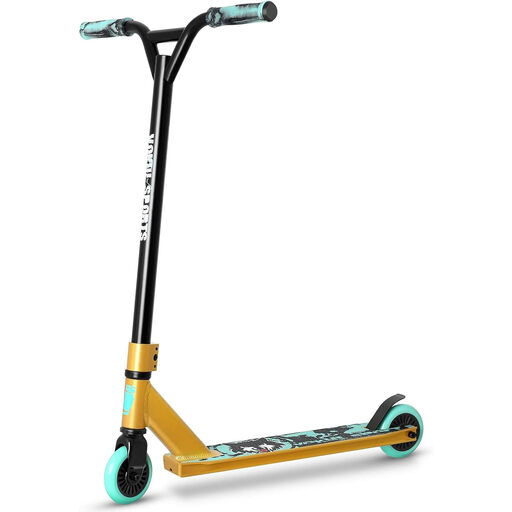
Why This Fits Their Persona: A practical entry-level stunt scooter for children aged 6 and up who are learning basic tricks at home, on smooth paths or at a local skatepark.
The fixed handlebar and rigid suspension provide predictable handling, while the stated 3.6 kg weight keeps it easier to manoeuvre.
100 mm solid PU wheels, TPE grips, rear braking and a stated 100 kg weight limit.
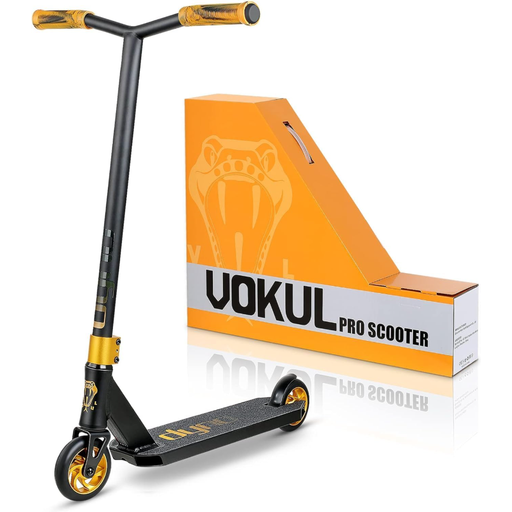
Why This Fits Their Persona: Suited to older children, teens and adults wanting a more substantial freestyle scooter for skatepark and street practice.
Its one-piece T4T6 fork, T-6061 aluminium deck and stated 6-month warranty offer clearer construction and support details than vague performance claims.
110 mm solid PU wheels, ABEC-9 bearings, non-slip deck and a one-piece fork, with assembly limited to tightening the three-bolt clamp.
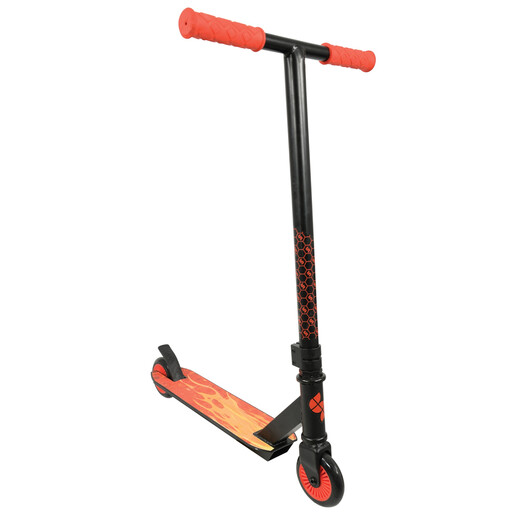
Why This Fits Their Persona: A suitable option for children aged 8 and over who want a steel-deck scooter for regular beginner tricks and skatepark sessions.
The product description specifies a single-piece steel handlebar and stem, double clamp, 100 kg maximum weight and EN71 and CE UKCA compliance.
100 mm 85A PU cast wheels, ABEC 7 bearings, 360° handlebar rotation and a reactive nylon flex rear footbrake.
Some models are listed for children aged 6 and over, but age is only one part of the decision. Check the scooter’s handlebar height, deck size and weight limit against the child’s height and build. A younger rider should begin with simple balance and braking practice under adult supervision rather than advanced tricks.
Lifespan depends on riding frequency, landing technique, rider weight and surface conditions. Regularly tightening bolts, checking wheels and keeping the scooter dry can help reduce avoidable wear. Replace damaged grips, wheels or brake parts promptly, and stop using the scooter if the deck, fork or handlebar develops cracks or excessive movement.
Solid polyurethane wheels do not need inflation, which removes the cost and inconvenience of replacing inner tubes. Ongoing expenses may include replacement grips, bearings, wheels and brake components. Avoid wet paths, grit and high-pressure washing, as these can accelerate wear and affect bearings.