Regular family batch bakers
If you freeze dough often, look for room to separate labelled portions from the family’s other frozen food and retrieve them without unpacking the freezer.


A tall upright freezer is a practical choice for regular family batches when separate drawers make dough portions easy to find; an under-counter model suits a tighter kitchen, while a chest freezer is worth considering if the main problem is running out of storage space. Whichever format fits, check its freezer temperature, usable space and installation requirements—and confirm the exact model’s operating temperature range before placing it in a garage.
If you freeze dough often, look for room to separate labelled portions from the family’s other frozen food and retrieve them without unpacking the freezer.
If space below a worktop is your main constraint, an under-counter freezer may fit your kitchen, provided its compartments accommodate the portions you make.
If you plan to store baking batches in a garage or outbuilding, check that the chosen model is specified to operate at the temperatures that location reaches.
Start with the installation space and the amount of dough you need to store alongside everyday food. GOV.UK home-freezing guidance for England, Northern Ireland and Wales says a freezer should be around −18°C; portion homemade food and freeze it promptly.
Consider it when: You regularly freeze family batches and want drawers or shelves for keeping portions accessible.
Allow for: A tall installation space; freezer volume and internal layouts differ between models.
Consider it when: You repeatedly run out of frozen-food space and have floor space for another appliance.
Allow for: Top-opening access; label and organise portions so older batches remain easy to find.
Consider it when: Kitchen space limits your choice and dough batches are occasional.
Allow for: Less compartment space for a large baking session or other frozen food.
Consider it when: The freezer needs to fit a compatible kitchen cabinet.
Allow for: Cabinet, ventilation and door-fitting requirements that a freestanding model does not share.
| Concern | What to check | Who this matters to |
|---|---|---|
| Organised capacity | Compare freezer-only litres and whether drawers or baskets fit your portion containers alongside everyday food. | When I make several batches, I need to keep dated portions together without crowding out other food. Around 50% of consumers put organised capacity first. |
| Compact fit | Measure the installation space and required clearances, then check the compartment layout. | A limited kitchen footprint means I need an appliance that fits below the worktop while holding the portions I actually freeze. Compact fit comes first for around 33% of consumers. |
| Installation location | For a garage or outbuilding, check the exact model’s stated ambient-temperature operating range. | If my overflow freezer goes in an outbuilding, I need it to suit the temperatures there. Around 17% of consumers make the installation environment their primary concern. |
A freezer can fit the available space yet leave too little room for dough portions and the family’s usual frozen food. Bosch lists 242 litres for its GSN36VLFPG, while Beko lists 177 litres for its FNE4545W; those figures describe different models, not every tall freezer.
Measure the installation space and compare freezer-only volume with the drawer layout and containers you expect to use.
Frost-free and No Frost features concern ice build-up and defrosting, not proof that fresh dough will freeze adequately without attention to temperature and portion size.
Assess defrosting convenience separately from the model’s temperature controls and stated freezing capacity, and divide dough into portions before freezing.
Low-ambient operation is model-specific. Beko states that its FreezerGuard-equipped FNE4545W and UFF4584 can operate at ambient temperatures down to −15°C; that specification does not apply to other models automatically.
Check the exact model’s operating range against the temperatures expected at its intended location.
GOV.UK home-freezing guidance advises dividing homemade food into smaller portions so it cools and freezes more quickly. A single large pack also makes it harder to take out only the dough needed for one baking session.
Pack dough in sealed, dated baking-session portions and freeze it promptly, following the handling instructions relevant to your recipe.
Beko lists tall freestanding and under-counter freezers relevant to different kitchen spaces.
Bosch offers freestanding, integrated and under-counter formats; the GSN36VLFPG is a tall upright example.
Hotpoint lists integrated and freestanding freezer formats, including the integrated tall HTSD18F013H1.
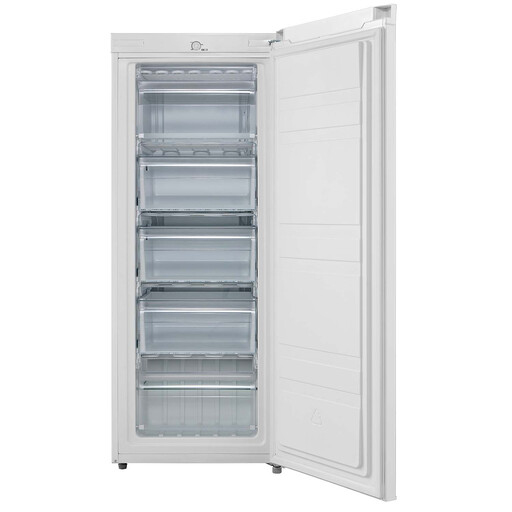
This tall upright model is a choice to consider if you want separate compartments for family-sized dough portions. Check its fit and features against your own kitchen and freezing routine.
 No image available
Consider this upright freezer if you want separate spaces for portions of biscuit dough and other frozen food.
The listing states a 160-litre capacity and five compartments: two shelves with flip covers and three drawers. It also specifies an adjustable thermostat and reversible door, and states that the freezer can maintain −18°C.
Check the installation dimensions and required clearances before buying. If fast-freeze or a particular defrost method matters to you, confirm that feature for this model.
GOV.UK home-freezing guidance for England, Northern Ireland and Wales says a freezer should be around −18°C. Check the chosen appliance’s controls and follow its manufacturer’s instructions for setting and monitoring the temperature.
Divide it into portions you can take out for individual baking sessions. GOV.UK advises freezing homemade food as soon as possible and using smaller portions to help it cool and freeze more quickly; seal and date the portions before storing them.
No: a Fast Freeze function is a model-specific convenience, not a substitute for portioning dough promptly and keeping the freezer around −18°C. If you expect to add substantial fresh batches, check whether the model has the function and follow its instructions for using it.
No; garage suitability depends on the exact freezer’s stated operating temperature range and the conditions in your garage. Beko specifies operation down to an ambient −15°C for its named FreezerGuard models, but that claim should not be assumed for other freezers.