Shared-kitchen batch cooks
People who freeze repeated, labelled portions of vegetable stock and need a layout that makes containers easy to identify and rotate. GOV.UK advises labelling food before freezing it.


Choose a freezer for shared vegetable-stock batches by checking whether the containers fit, how people will retrieve and separate them, and where the appliance can be installed. A tall upright offers drawers for organising portions; an undercounter model suits tighter space, an integrated model needs compatible housing, and a chest freezer needs a workable plan for finding and rotating stock. GOV.UK advises cooling cooked food before freezing, dividing it into smaller portions and labelling it; Bosch UK recommends a freezer temperature of -18°C.
People who freeze repeated, labelled portions of vegetable stock and need a layout that makes containers easy to identify and rotate. GOV.UK advises labelling food before freezing it.
People fitting a dedicated freezer beneath a worktop or into existing cabinetry, where the opening and installation requirements determine which format is practical. General guidance advises checking hinge compatibility when replacing a built-in appliance.
Operators sharing a kitchen for food-business activity who must plan temperature monitoring and contamination controls as well as freezer storage. The Food Standards Agency’s MyHACCP guidance addresses both facilities and food-safety controls.
Start with the amount of cooled stock you freeze at once and the space available, then check whether the storage layout lets everyone find labelled portions without disrupting other food.
Choose when: Several people regularly need access to stock kept in separate drawers or compartments.
Allow for: Full appliance height and a drawer layout that fits your actual containers.
Choose when: Under-worktop space is the deciding constraint and your usual batch fits the compartments.
Allow for: Less room for portions if the internal layout cannot accommodate the batch.
Choose when: An existing fitted-kitchen housing is compatible and a built-in installation is required.
Allow for: Cabinet and hinge compatibility; General guidance highlights hinge type when replacing a built-in appliance.
Consider when: Floor space is available and the planned container arrangement permits reliable stock rotation.
Allow for: A method of finding labelled tubs without leaving older portions buried.
| Concern | What to check | Who this matters to |
|---|---|---|
| Cooling and temperature | Plan to cool and label portions before freezing, and check that the freezer can be set to -18°C and monitored as needed. GOV.UK gives the handling advice; Bosch UK recommends -18°C. | If I am responsible for food handling, I need a cooling routine and a freezer-temperature check I can keep up with. Roughly 31% of consumers put these controls first. |
| Batch capacity | Compare a typical batch and your container dimensions with the internal layout and the model’s stated freezing capacity. | When several portions go in together, I need room for the whole batch without choosing by the litre figure alone. For around 25% of consumers, batch fit is the primary concern. |
| Shared access | Look for a layout that supports labelled, separated portions; consider a door-open alarm if the model offers one. | I need other users to identify and retrieve stock without losing track of whose container is whose. Shared-access organisation comes first for roughly 25% of consumers. |
| Installation fit | Measure the opening and check ventilation and door clearance; for integrated replacements, confirm the hinge type. | If the freezer must occupy a particular space, I need to know it can be installed there before comparing storage features. Around 19% of consumers prioritise fit. |
A stated compartment volume does not show whether your stock containers fit inside its drawers or leave a usable arrangement for the rest of the batch.
Measure the widest and tallest container, count a normal batch and compare both with the internal layout and stated freezing capacity.
GOV.UK advises cooling cooked food before it goes into the freezer. A model’s fast-freezing function does not replace that step.
Cool the stock, divide it into smaller labelled portions, then follow the appliance instructions for any fast-freezing setting.
Low-ambient operation depends on the individual model; Beko specifies FreezerGuard for named models, not for every freezer.
Check the planned location against the exact model’s permitted ambient range, ventilation instructions and warranty terms.
A freezer layout cannot replace procedures for monitoring temperatures and managing contamination in a food-business kitchen. The Food Standards Agency’s MyHACCP guidance addresses these controls.
If the shared kitchen operates as a food business, establish suitable labelling, separation, cleaning and temperature-monitoring procedures alongside the appliance choice.
Beko UK lists freestanding tall, undercounter and integrated freezer models relevant to different kitchen layouts.
Bosch UK provides freezer-temperature guidance and specifications for individual models.
Hisense is relevant when comparing chest-freezer storage with upright or undercounter layouts; Which? includes its chest models in its UK freezer listings.
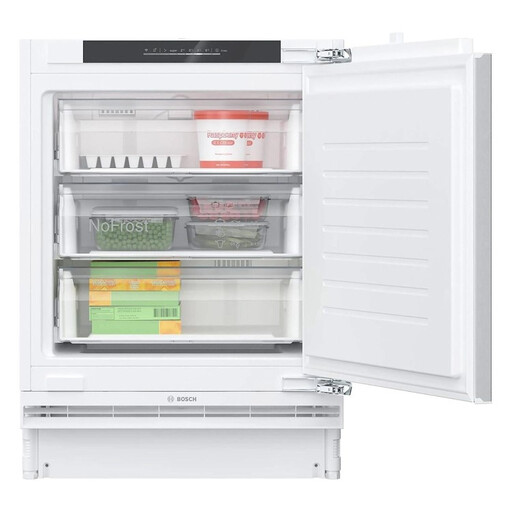
This built-under option is for a compatible household or similar shared kitchen where installation space is limited. Confirm the housing and the appliance’s permitted use before choosing it.
 No image available
Consider this No Frost built-under model if your household or similar shared kitchen has a compatible under-worktop housing.
Before ordering, confirm the cabinet opening, furniture-door and hinge fit, plinth ventilation and space for your stock containers. Its stated use restriction rules it out for a food-business kitchen.
Yes. GOV.UK advises cooling cooked food before putting it in the freezer, dividing it into smaller portions and labelling everything you freeze.
Use -18°C as a selection and operating target: Bosch UK recommends that temperature for freezers. Check how the chosen appliance is set and how you will monitor it; a GOV.UK freezer-monitoring record for food-service settings specifies at or below -18°C.
The answer depends on how the kitchen operates, so sharing a kitchen alone does not settle its recordkeeping duties. If it is run as a food business, use the operation’s food-safety procedures to determine its monitoring and records; the Food Standards Agency’s MyHACCP guidance calls for adequate temperature-monitoring facilities and contamination controls.
Label portions and allocate drawers or containers so people can identify and rotate their stock. Where a food business also handles raw and ready-to-eat foods, follow its separation or management controls; a convenient freezer layout does not replace hygiene procedures, as the Food Standards Agency’s MyHACCP guidance makes clear.