Regular batch cooks
If you freeze meal-sized portions often, drawers can help you separate newly added mash from older meals and find what you need later. Check the exact model’s freezing capacity when you commonly add several portions together.


For regularly frozen meal-sized portions of mashed potato, a frost-free upright freezer offers drawers that make portions easier to separate and retrieve; consider a chest freezer when a larger stock matters more than quick access. An under-counter or integrated model makes more sense when kitchen space or cabinetry sets the limits. Whichever format fits, check that it can maintain around −18°C, along with its usable volume and capacity for freezing newly added food.
If you freeze meal-sized portions often, drawers can help you separate newly added mash from older meals and find what you need later. Check the exact model’s freezing capacity when you commonly add several portions together.
If you freeze larger quantities less often, a chest freezer is worth considering where you have room for the appliance and its opening lid. Baskets and labels help keep portions accessible.
If you freeze fewer portions and need the appliance beneath a worktop or within existing cabinetry, check installation dimensions before choosing storage volume.
Choose when: You regularly freeze separate meal-sized tubs and want drawer-by-drawer access.
Trade-off: Check the usable volume and space for taller containers rather than assuming the appliance’s height provides enough storage.
Choose when: You keep a larger stock of labelled portions and have a suitable place for the appliance.
Trade-off: Food at the bottom takes more effort to retrieve, making baskets and lid clearance important.
Choose when: Fitting the existing kitchen matters more than storing a large batch.
Trade-off: The available space limits the appliance choice; an integrated model must also fit its specified niche.
| Concern | What to check | Who this matters to |
|---|---|---|
| Safe storage and new portions | Confirm the freezer can maintain around −18°C, as advised by the Food Standards Agency and Food Standards Scotland. For larger additions, compare stated freezing capacity in kg/24 h. | I often add several cooled portions at once and need space to freeze them without losing track of older food. Around 50% of consumers put safe storage and handling new portions first. |
| Volume and access | Compare usable freezer volume, internal baskets or drawers, container space and clearance for the lid or door. | My batches share space with other frozen food, so I need enough room and a way to retrieve labelled tubs. For around 30% of consumers, storage volume and access are the main priority. |
| Fit and upkeep | Check appliance and niche dimensions, installation requirements, frost-free features and the exact model’s energy information. | A freezer has to fit my kitchen, and I want to know what upkeep its design requires. Kitchen fit and maintenance come first for around 20% of consumers. |
An appliance can fit its intended spot yet still make stacked mash containers awkward to sort or retrieve.
Compare usable frozen volume and internal layout, allow room for the door or lid to open, and label portions before stacking them.
Food Standards Agency guidance says warm dishes should be cooled before freezing; smaller portions cool more quickly and are easier to defrost in usable amounts.
Divide the mash into meal-sized freezer-safe containers or bags, cool it appropriately, then freeze it promptly.
An outbuilding’s temperature may fall outside an appliance’s specified operating range. Beko states that particular FreezerGuard models operate in ambient temperatures down to −15°C; that does not apply to every freezer.
Check the approved ambient-temperature range and installation instructions for the exact model and location.
Frost-free technology addresses ice build-up, but the feature name does not tell you how much newly added food a model can freeze in 24 hours.
Compare the exact model’s freezing capacity, usable volume and energy information as well as its defrosting features.
Relevant when comparing upright and chest formats, particularly for a proposed garage or outbuilding location.
Relevant when drawer organisation and NoFrost options matter.
Relevant when comparing freestanding, chest and built-in formats within one range.
Relevant when a specified built-in niche and separated drawer storage drive the choice.
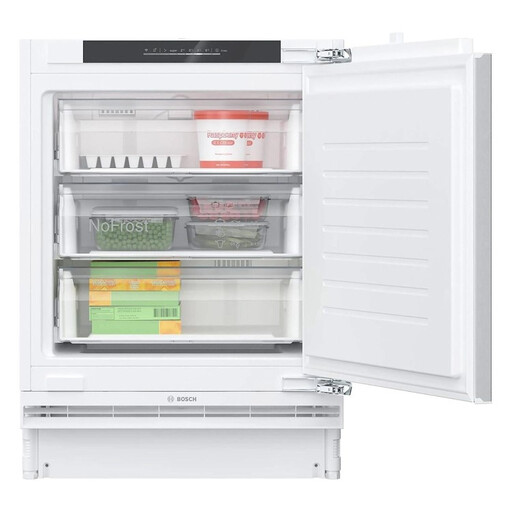
This built-under option is relevant when portioned mash needs to fit into an existing kitchen layout. Check its installation requirements and available freezer space against the batches you plan to store.
 No image available
Consider this model if a built-under freezer suits your kitchen and portion-storage needs.
Confirm its installation dimensions and ventilation requirements; if you regularly add several cooled portions together, check its stated freezing capacity too.
Yes, once it has cooled appropriately. Food Standards Agency and Food Standards Scotland guidance advises keeping a freezer around −18°C; divide mash into smaller portions and freeze them promptly after cooling.
Not for every small portion, but it is worth checking if you regularly add several cooled portions at once. Compare the exact freezer’s stated capacity in kg/24 h and follow its instructions for any fast-freeze setting.
No; suitability depends on the exact model’s approved ambient-temperature range. Beko states that particular FreezerGuard models operate down to −15°C ambient temperature, so check the specification of the appliance you intend to buy.
Compare the energy label and product information sheet for each exact freezer model, alongside the storage volume and installation requirements that matter to you. A frost-free feature alone does not establish how the models compare on energy information.