Families freezing several pastry meals
If you freeze batches in separate meal-sized packs, drawers or shelves can help you find one pack without moving everything else. Check that your usual containers fit the compartments.


Choose a tall upright freezer if you regularly need to find one meal-sized pastry pack; choose a chest freezer if open space for larger batches matters more than direct access. An under-counter or integrated freezer makes more sense when kitchen space or cabinetry sets the limit. Whichever format you choose, check that your packs fit, the door or lid can open fully, and the appliance suits its intended location; GOV.UK advises keeping a freezer around −18°C.
If you freeze batches in separate meal-sized packs, drawers or shelves can help you find one pack without moving everything else. Check that your usual containers fit the compartments.
A chest freezer offers open storage for larger batches and other family meals. You will need a way to group and label smaller pastry packs so they remain easy to find.
An under-counter or integrated freezer may suit a restricted space. For a fitted replacement, check the housing measurements and cabinet-door hinge arrangement as well as the appliance dimensions.
Decide whether access to individual portions, room for bulk batches or a fixed installation space drives the choice. Then compare the usable layout and the checks that apply to the freezer’s location.
Choose when: You want separate spaces for meal-sized pastry packs that you retrieve regularly.
Allow for: Floor space, height and enough room to open the door and access the compartments.
Choose when: Larger pastry batches and other family meals need open storage space.
Allow for: A larger footprint, lid clearance and baskets or labels to keep small packs accessible.
Choose when: The available kitchen space or existing cabinetry determines where the freezer must go.
Allow for: Less room for bulk batches; an integrated replacement must also match its housing and hinge arrangement.
| Concern | What to check | Who this matters to |
|---|---|---|
| Capacity and layout | Compare freezer capacity in litres with the space available in drawers, shelves or baskets for your usual packs. | If I freeze several family meals at once, I need room to keep the portions separate rather than relying on capacity alone. Around 31% of consumers put capacity and organisation first. |
| Access to portions | Check how easily you can reach individual packs, including those at the bottom of a chest freezer. | When I need just one meal-sized pack, I want to find the older portions without searching through a large batch. For around 31% of consumers, easy retrieval is the primary concern. |
| Kitchen fit | Measure the installation space and door or lid clearance; for integrated models, check housing and hinge compatibility. | If the freezer must sit under a worktop or behind a cabinet door, I need it to fit and open properly. Fitting the available space comes first for around 15% of consumers. |
| Location and energy use | Compare energy-label consumption for appropriately sized models, and check the exact model’s ambient-temperature range before outbuilding use. | For a freezer that will run in a cold outbuilding, or when ongoing electricity use shapes my choice, I need to check more than its storage volume. Around 23% of consumers prioritise location suitability or energy use. |
A freezer may fit its space but still be awkward to use if your pastry containers do not fit the compartments or its door cannot open fully. An integrated appliance also needs a compatible housing and hinge arrangement.
Measure the space, opening clearance and your usual containers before choosing a model.
Its open cavity accommodates bulk storage, but smaller or older portions can be harder to retrieve from the bottom.
Plan labelled baskets or groups of packs for a chest freezer; consider drawers if you more often take out one portion at a time.
Ambient-temperature suitability depends on the model. Beko states that its applicable Freezer Guard models can operate down to −15°C; that claim does not apply to every freezer.
Check the exact appliance’s operating range and installation instructions against the temperatures expected in the intended location.
Unlabelled packs make it harder to identify a filling or use older portions first. Cooked food also needs appropriate cooling before freezing.
Divide food into portions, label and date the packs, and follow the relevant cooling and freezing instructions. GOV.UK advises keeping a freezer around −18°C.
Its range offers examples of tall freestanding and integrated under-counter storage for different kitchen layouts.
Its freezer range includes upright and built-in formats for households comparing compartment layouts.
Its HCE300NFEK is a chest-freezer example for households considering open storage for larger batches.
Its range includes freestanding, chest and built-in freezers, including an integrated tall option.
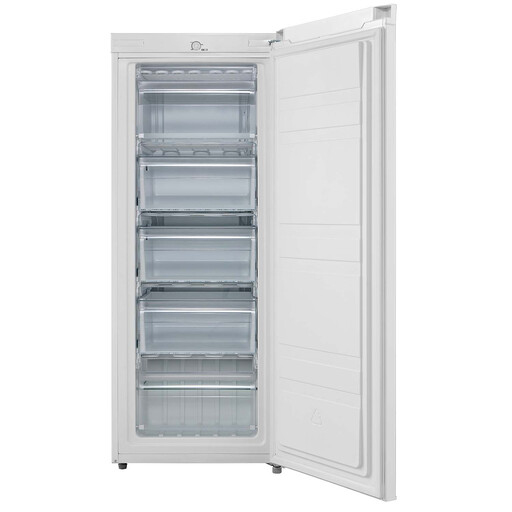
This tall freestanding option is relevant if you want separate freezer space for family pastry portions. Compare its capacity and internal fit with the packs you normally freeze.
 No image available
A freestanding tall option if you want dedicated space for family pastry portions; check that your usual packs fit its compartments.
The product name specifies a 160-litre capacity, adjustable thermostat, reversible door, 4-star freezing and energy class E.
Check the dimensions and door clearance for your space, the annual energy consumption for comparison, and the stated ambient-temperature range if it will go in an outbuilding.
A freezer should be around −18°C, according to GOV.UK home-food-safety guidance. Check the appliance instructions for how to set and monitor its temperature.
Divide them into manageable portions and label the packs so you can identify and rotate them. Cool cooked food appropriately before freezing, and follow any packaging or recipe instructions that apply.
Follow the product or recipe instructions for the particular pastry and filling. GOV.UK advises defrosting food fully before cooking unless the manufacturer says it can be cooked from frozen, and recommends defrosting in the fridge.
Only choose an appliance whose stated ambient operating range covers the temperatures expected there. Beko says applicable Freezer Guard models can operate down to −15°C, but you must check the specification and installation instructions for the exact model you intend to buy.