Space-limited cottage cooks
If you freeze occasional meal-sized portions, an under-counter format may fit a compact kitchen while keeping labelled food within easy reach. Check the installation space as well as the room available inside.


Choose an under-counter freezer for occasional portions in a compact kitchen, a tall upright for several prepared dishes that need easy access, or a chest freezer when bulk storage matters more than retrieving individual portions. Whichever format fits, check that the exact model suits the cottage’s winter room temperature and can be kept at around −18°C after the mash has been cooled and portioned.
If you freeze occasional meal-sized portions, an under-counter format may fit a compact kitchen while keeping labelled food within easy reach. Check the installation space as well as the room available inside.
If you prepare several meals between guest stays, consider how much room the portions and other frozen food need, and whether drawers or baskets will make older batches easy to retrieve.
If the freezer will stand in a cold utility room, annex or outbuilding, the exact model’s permitted ambient-temperature range is a deciding factor, not a detail to assume from its format.
Choose a format around the available space and how often you need to retrieve portions; then check the installation conditions for the exact model. For frozen storage, the Food Standards Agency and Food Standards Scotland advise keeping a freezer at around −18°C.
Choose it when: A compact kitchen needs room for occasional labelled portions and a limited amount of other frozen food.
Trade-off: Its smaller format leaves less reserve storage for several prepared meals.
Choose it when: Several batches or dishes need to be stored separately and reached frequently.
Trade-off: It needs sufficient height and installation clearance; frost-free operation does not establish cold-room suitability.
Choose it when: Bulk frozen-food storage takes priority and there is room for the cabinet and its opening lid.
Trade-off: Small portions can be harder to find and retrieve from the bottom without baskets or other organisation.
| Concern | What to check | Who this matters to |
|---|---|---|
| Safe freezing | Check how to set and monitor around −18°C, and whether portion-sized containers fit. | I need to cool cooked mash promptly and keep the portions properly frozen until they are used; around 42% of consumers would put safe freezing first. |
| Space and access | Measure the installation and opening space; compare drawers, baskets and usable storage layout. | In a small cottage kitchen, I want to find an older labelled portion without moving everything else; roughly 33% of consumers would make space and access their priority. |
| Cold-room compatibility | Compare the coldest likely room temperature with the exact model’s ambient operating range and installation instructions. | If the cottage is unheated between stays, I need the freezer to suit its winter location; about 25% of consumers would prioritise cold-room compatibility. |
Bosch advises checking an appliance’s climate class, while Beko’s low-ambient FreezerGuard claim applies to specified models. A familiar brand name or freezer format does not establish the operating range of the model you choose.
Check the coldest likely room temperature against the exact model’s rating information and installation instructions before choosing its position.
Individual tubs or bags of mash can be awkward to rotate in a deep chest freezer, even when there is enough room for them.
Plan where labelled portions will go: drawers suit frequent access, while baskets or stackable containers can help organise a chest freezer.
The Food Standards Agency advises cooling warm cooked food before freezing; smaller portions cool more quickly than one large batch.
Divide the mash into shallow, meal-sized portions, cool it promptly, label it with the date and freeze it as soon as possible once cooled.
Electrical Safety First advises placing a fridge or freezer close to a wall socket and not using an extension lead.
Choose a position with a suitable wall socket, then follow the exact appliance’s ventilation and installation instructions.
Its range includes under-counter, upright and chest-freezer formats relevant to different cottage layouts.
Its chest and under-counter options may be relevant where storage layout or a cold cottage room shapes the choice.
Its upright-freezer information is useful when drawer organisation and installation in a conventional kitchen matter.
Its tall and under-counter ranges include options for buyers considering frost-free storage.
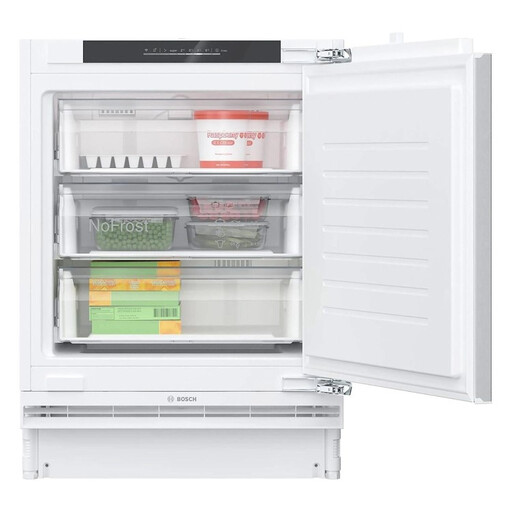
This built-under option is relevant if the cottage has a fitted kitchen space and you plan to freeze cooled mash in manageable portions. Check its installation requirements and winter room-temperature suitability before ordering.
 No image available
Consider this built-under model if the cottage has a suitable fitted-kitchen space for freezing portioned mash.
Its listed features include No Frost. Before ordering, check the niche dimensions, plinth ventilation and installation instructions; if the room may become cold, confirm the exact model’s permitted ambient-temperature range.
Keep the freezer at around −18°C. The Food Standards Agency and Food Standards Scotland give that temperature for frozen storage; check that the installed appliance can be set and maintained accordingly.
Cool cooked mash before freezing it. The Food Standards Agency advises putting cooked food in the fridge within one to two hours and dividing it into smaller portions to help it cool quickly; freeze it as soon as possible once cooled.
Only choose a model whose stated ambient operating range suits that room. Bosch advises checking the climate class; Beko, Liebherr and Blomberg describe operation down to −15°C for applicable models, not for every freezer they sell.
Defrost it in the fridge rather than at room temperature. Food Standards Scotland advises using defrosted food within one to two days and reheating food that has been frozen only once.
Electrical Safety First advises placing a fridge or freezer close to a wall socket and not using an extension lead. Check the chosen appliance’s installation instructions when deciding where it will stand.