Family batch cooks
You cook several portions of pasta sauce at once and want labelled containers or bags that you can find when planning another family meal. GOV.UK advises dividing food into smaller portions to help it cool quickly.


Choose the freezer format around your available space and how often you need to retrieve individual sauce portions. An upright freezer suits regular access to labelled containers, while a chest freezer is worth considering when bulk storage matters more; an under-counter or integrated model may suit a kitchen with tighter installation constraints. Whichever format you choose, check that your containers fit and that the appliance can maintain the Food Standards Agency’s recommended domestic freezer temperature of −18 °C.
You cook several portions of pasta sauce at once and want labelled containers or bags that you can find when planning another family meal. GOV.UK advises dividing food into smaller portions to help it cool quickly.
You need room for leftovers, but the freezer must also fit an existing kitchen space, an under-counter position or a planned integrated cabinet.
You want to compare defrosting requirements and product-specific energy-label information alongside the space available for your portions.
Start with the freezer format that fits your home and the way you retrieve portions, then compare the exact model’s layout and upkeep requirements.
Consider it when: You regularly retrieve individual, labelled sauce portions and have space for a standalone appliance.
Allow for: Drawers that may not fit your usual tubs or bags, even when the quoted capacity appears sufficient.
Consider it when: You often freeze large batches and have floor space for bulk storage.
Allow for: Finding individual portions among other food; baskets and clear labels can help you organise them.
Consider it when: The kitchen layout or cabinetry determines where the appliance can go.
Allow for: A smaller rotation of portions and, for integrated models, cabinet, ventilation and door-fitting requirements.
| Concern | What to check | Who this matters to |
|---|---|---|
| Portion storage | Measure your usual tubs or freezer bags and compare them with the exact drawer, shelf or basket layout; litres alone do not establish container fit. | When I freeze several family-meal portions, I want each labelled tub or bag to be easy to find; around 42% of consumers put portion organisation first. |
| Installation fit | Measure the intended space and door clearance. For an integrated model, check cabinet and ventilation instructions; for an outbuilding, check the permitted ambient-temperature range. | If my kitchen has limited space, I need a format that fits the planned location; roughly 33% of consumers prioritise installation fit. |
| Upkeep and electricity use | Compare each model’s energy-label information and confirm whether it has No Frost, Low Frost or manual defrosting requirements. | I would rather limit manual defrosting and check electricity information before choosing; about 25% of consumers place upkeep and running-cost information first. |
A freezer can have sufficient quoted capacity but still be awkward for wide tubs or stacked bags, making individual portions difficult to retrieve.
Measure the containers you normally use and compare them with the exact model’s drawers, shelves or baskets before ordering.
Outbuilding suitability depends on the particular model and its approved ambient-temperature range. Beko describes Freezer Guard for selected models, not its entire range.
Check the intended installation location against the model’s instructions before buying.
A large quantity of cooked sauce takes longer to cool than smaller portions.
Divide it into meal-sized containers or freezer bags and cool it quickly before refrigerating or freezing. GOV.UK advises putting leftovers in the fridge within two hours and freezing them if they will not be eaten within 48 hours.
Fridges and freezers need specialist recycling because of the gases they contain, according to Recycle Your Electricals.
Arrange retailer take-back or another suitable specialist recycling option before the replacement arrives.
Relevant when comparing frost-free models or checking whether a particular freezer is suitable for an outbuilding.
Relevant when considering freestanding or built-in formats with a possible No Frost option.
Relevant when comparing freestanding, integrated and chest freezer formats.
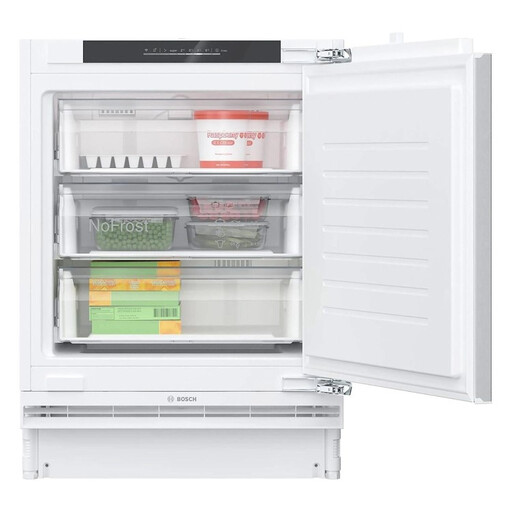
This built-under option is relevant if kitchen installation space shapes your choice; check its fit and internal storage against the portions you plan to freeze.
 No image available
For a kitchen with a suitable built-under space where you plan to store portioned sauce.
The product title specifies No Frost and an E rating. Before ordering, check the cabinet opening, furniture-door arrangement, ventilation requirements and whether your usual sauce containers fit the internal storage.
Divide it into portions before freezing. GOV.UK advises using smaller containers or freezer bags so food cools quickly; choose portions that match what your household normally defrosts for a meal.
Check that the domestic freezer can maintain −18 °C, the temperature recommended in a Food Standards Agency research review. Follow the appliance instructions for its setting and use an appropriate freezer thermometer where practical.
Cool cooked sauce quickly in smaller portions. GOV.UK advises putting leftovers in the fridge within two hours, then freezing them if they will not be eaten within 48 hours.
Only choose an outbuilding location if the exact model’s permitted ambient-temperature range and installation instructions cover it. A brand-level garage-use feature does not establish suitability for every freezer in its range.
Arrange suitable take-back or specialist recycling when replacing it. Recycle Your Electricals explains that fridges and freezers require specialist recycling because of the gases they contain; ask the seller what collection arrangements it offers.