Regular family batch cooks
If you freeze several containers of tomato sauce at a time, look for storage that lets you label, separate and retrieve them without moving everything else.


Choose an under-counter freezer if you have room for only a few portions, an upright freezer if you regularly need to separate and retrieve family batches, or a chest freezer if bulk storage matters more than easy access to individual containers. Whichever format fits your routine, check that your containers and the appliance fit the intended space, and compare the exact model’s freezing capacity and installation requirements.
If you freeze several containers of tomato sauce at a time, look for storage that lets you label, separate and retrieve them without moving everything else.
If you usually put away only a few portions and need an appliance beneath a worktop, check the available space before deciding how much storage you can accommodate.
If sauce is only part of a larger batch-cooking routine, a chest freezer may be worth considering where you have the floor space and can keep individual portions organised. Which? identifies this format as an option for households that often run out of freezer space.
Choose it when: You freeze a limited number of portions and need the appliance beneath a worktop.
Allow for: Less room for containers; check the selected model’s internal layout as well as its installation dimensions.
Choose it when: Regular batches call for separate storage areas and straightforward access to labelled tubs.
Allow for: The required height and, for an integrated model, a compatible housing and door arrangement.
Choose it when: You need space for sauce alongside other bulk-frozen food and have room for the appliance.
Allow for: Lid clearance and a storage plan that keeps portions from being buried beneath other food.
| Concern | What to check | Who this matters to |
|---|---|---|
| Organised capacity | Compare frozen-compartment volume with the size of your containers, then check drawer, shelf or basket clearances. | I want to put away several labelled family portions and find one without unpacking the rest; around 40% of consumers would put organised storage first. |
| Compact fit | Measure the intended space, door swing and access route; check the model’s ventilation requirements. | When there is only room beneath the worktop, I can accept fewer stored portions. Compact fit would be the primary need for around 30% of consumers. |
| Freezing and upkeep | Compare rated freezing capacity in kg/24 h and check whether the exact model has a frost-management system that suits you. | I regularly add cooled batches and want to know what the freezer is rated to handle, without overlooking defrosting effort; around 20% of consumers would prioritise this combination. |
| Cold-location suitability | Check the manufacturer’s stated ambient operating range for the exact model and its installation instructions. | If the freezer will stand in a cold garage or outbuilding, I need confirmation that it can operate there; this would come first for around 10% of consumers. |
A freezer can have enough stated volume yet still be awkward for wide sauce containers or hard to search when portions are stacked beneath other food.
Measure your containers and inspect the drawer, shelf or basket layout. Label portions with their contents and date; Northern Care Alliance NHS Foundation Trust advises labelling food frozen in batches.
Freezer features do not replace careful handling of cooked food. Large portions can also be less convenient to thaw and use later.
Divide the sauce into covered portions and cool it promptly before freezing. NHS batch-cooking guidance, published in its advice on preparing baby food, says to cool cooked food ideally within 1 to 2 hours before freezing or refrigerating; take particular care where a household member needs stricter food-safety precautions.
Frost management and suitability for a cold location are different model characteristics.
Check the intended location against the exact freezer’s stated ambient operating range. Beko says its UFF4584 and FFP4671 FreezerGuard models can operate at ambient temperatures down to -15°C; do not extend that claim to other models.
An energy class does not tell you whether the freezer has the storage layout, freezing capacity or dimensions your kitchen needs.
Compare energy information alongside usable storage and installation fit. The UK Department for Energy Security and Net Zero and Office for Product Safety and Standards state that products within the energy-labelling rules must display an energy label at the point of sale.
A reference point for comparing model-specific upright freezer capacity, frost management and storage layout.
Relevant when comparing compact and tall formats for a location that may become cold.
A brand to consider when comparing chest storage with integrated freezer formats.
These integrated upright and built-under freezers suit different kitchen spaces. For family batches, start with the housing or under-worktop fit, then check whether your sauce containers fit the internal storage; a chest freezer remains a separate format to consider for bulk storage.
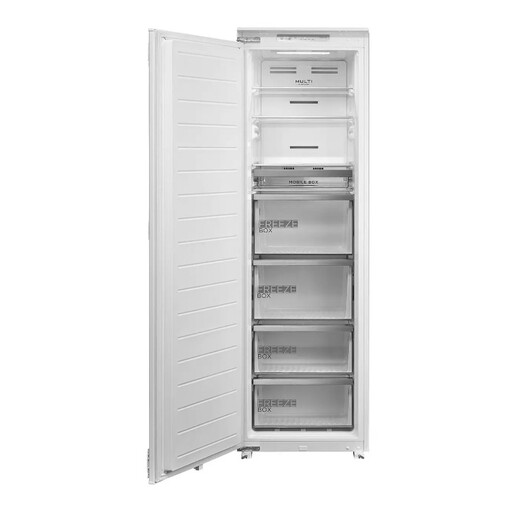 No image available
Consider this for an integrated kitchen where you want to separate frozen portions; check the internal compartments against your containers before choosing it.
The product name specifies Total No Frost, a sliding hinge and an E energy rating. Confirm the housing and hinge arrangement, and check rated freezing capacity if you freeze a large batch at once.
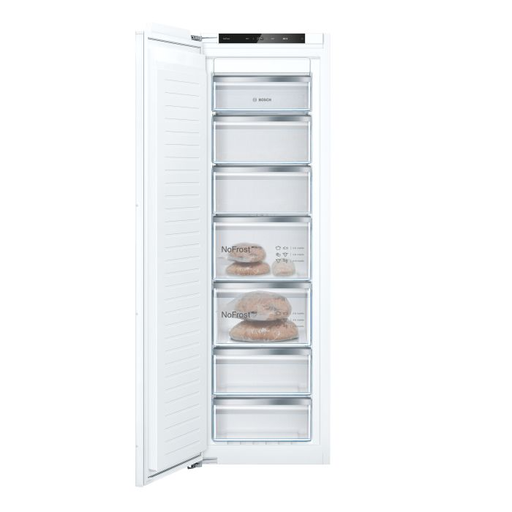 No image available
Consider this upright format if you regularly store separate family batches and have a compatible tall housing; measure the sauce containers against its internal compartments.
The product name specifies 212 L, NoFrost, a fixed hinge and an E energy rating. Check the required niche dimensions and rated freezing capacity for your kitchen and batch size.
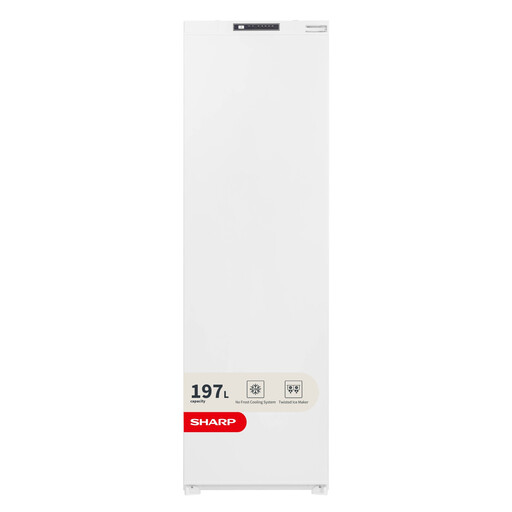 No image available
Consider this for an integrated upright installation where separating family portions matters; confirm that its drawers accommodate your containers.
The product name gives 177 × 54 cm and an E energy rating. Allow for manual defrosting, and confirm the housing and installation requirements.
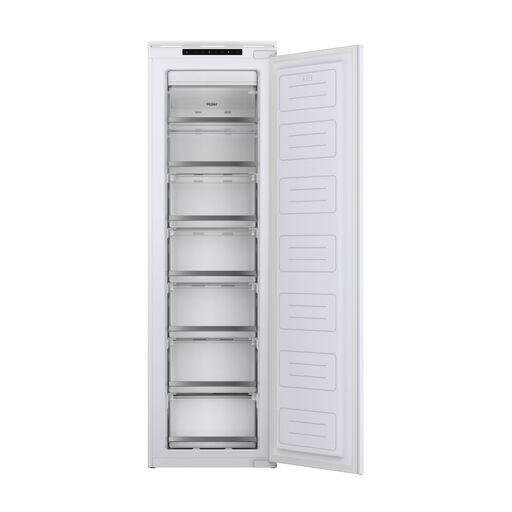 No image available
Consider this tall upright model if you want to keep several batches separate in an integrated kitchen; check the internal drawer dimensions for your tubs.
The product name specifies 200 L, Total No Frost, a sliding hinge and an E energy rating. Confirm the housing and hinge requirements before purchase.
 No image available
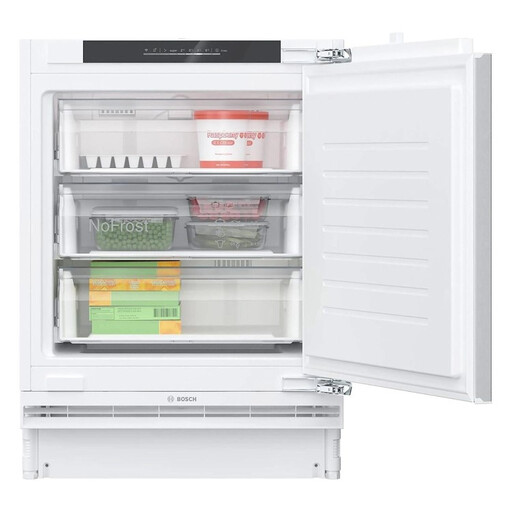
Consider this built-under format when kitchen space limits the choice and you freeze a few portions rather than repeated large batches.
The product name specifies NoFrost and an E energy rating. Check container fit, ventilation and furniture-door arrangements, as well as rated freezing capacity if you add sizeable batches.
Cool the cooked sauce promptly, divide it into covered portions and freeze it once cooled. NHS batch-cooking advice, given in its guidance on preparing baby food, recommends cooling cooked food ideally within 1 to 2 hours before freezing or refrigerating.
Check that the freezer maintains the temperature appropriate to your household’s food-safety needs, rather than relying on its setting alone. Guy’s and St Thomas’ NHS Foundation Trust advises keeping a freezer below -18°C in its guidance for people undergoing chemotherapy; Which? states that food needs to be kept below -16°C to preserve it. An appliance thermometer can help you check the actual temperature.
Use the fridge or a microwave defrost setting instead of leaving it to thaw at room temperature. NHS food-handling guidance identifies those as safer thawing options; make sure reheated sauce is steaming hot throughout.
Compare the displayed energy label with the freezer’s capacity and installation information, not its energy class in isolation. The UK Department for Energy Security and Net Zero and Office for Product Safety and Standards state that products covered by energy-labelling rules must display an energy label at the point of sale.
Check the exact model’s approved ambient operating range before placing it in a garage. Beko states that its UFF4584 and FFP4671 FreezerGuard models can operate at ambient temperatures down to -15°C, but that does not establish suitability for other freezers.