Solo batch-cookers with limited kitchen space
You make several curry portions at once but need an appliance that fits your kitchen and lets you retrieve one meal without shifting everything else.


For one person freezing individual curry portions in a kitchen, a freestanding under-counter freezer with separate drawers is a practical starting point if its drawers fit your containers. Choose an integrated model for compatible cabinetry, a small chest freezer when reserve storage matters more than quick access, or an outbuilding-capable model only when its stated ambient-temperature range covers the intended location.
You make several curry portions at once but need an appliance that fits your kitchen and lets you retrieve one meal without shifting everything else.
You keep labelled tubs alongside other frozen food and want compartments that make individual portions easy to separate and find.
You need storage away from the kitchen, making the exact model’s stated operating-temperature range as important as its capacity.
Start with where the freezer will go and how often you will retrieve a single portion; capacity is useful only if your containers fit the storage layout.
Choose when: You have a suitable kitchen space and want drawer access to individual portions.
Trade-off: Compact storage limits how much else you can freeze; check the full appliance depth and required clearance.
Choose when: The freezer must sit behind an existing kitchen cabinet door and the new model fits the installation.
Trade-off: Cabinet openings, hinges and ventilation requirements restrict which replacements will fit.
Choose when: You want to build up a reserve of portions and have space for a top-opening appliance.
Trade-off: Stacked food can take longer to sort through when you only want one tub; allow room to open the lid.
| Concern | What to check | Who this matters to |
|---|---|---|
| Space and installation | Measure the available height, width and depth, then check door or lid clearance and the model’s installation instructions. For an integrated replacement, confirm the cabinet and hinge arrangement. | If my kitchen is tight, the freezer has to fit before extra capacity matters. Around 40% of consumers put installation fit first. |
| Portion storage and access | Compare net freezer volume and internal drawer or basket dimensions with your actual tubs and the number of portions you plan to keep. | When I freeze several meals, I want to find one labelled tub without unpacking the rest. Roughly 30% of consumers prioritise portion access. |
| Upkeep and location | Check the defrost system and annual energy information. For a garage or outbuilding, confirm that the exact model’s stated ambient-temperature range covers the site. | I would rather avoid frequent defrosting, or I need the appliance outside the kitchen. About 30% of consumers place upkeep or location suitability first. |
A freezer can fit the gap while its drawers are too narrow or shallow for your curry tubs.
Measure the installation space, then compare your containers with the internal storage layout as well as the stated net capacity.
A built-under freezer needs a suitable cabinet opening, door arrangement and ventilation; a freestanding model is not a direct substitute.
Check the exact replacement model’s hinge type and installation instructions before ordering.
An incompatible replacement may also mean cabinet-door, hinge or fitting work.
Suitability for low ambient temperatures varies by model, so an indoor installation rating should not be assumed to cover an unheated garage.
Choose a model whose manufacturer-stated operating range covers the temperatures expected at its intended location.
Prompt cooling matters before storage. NHS advice for batch-cooked food says to cool it ideally within one to two hours; its guidance for rice specifies cooling within one hour before putting it in the fridge or freezer.
Divide curry into shallow individual portions to help it cool promptly, then cover and refrigerate or freeze it. Take particular care if the meal includes rice.
A reference point for under-counter freezers, including named models with low-ambient ratings.
A reference point when comparing a freestanding under-counter format with an integrated built-under installation.
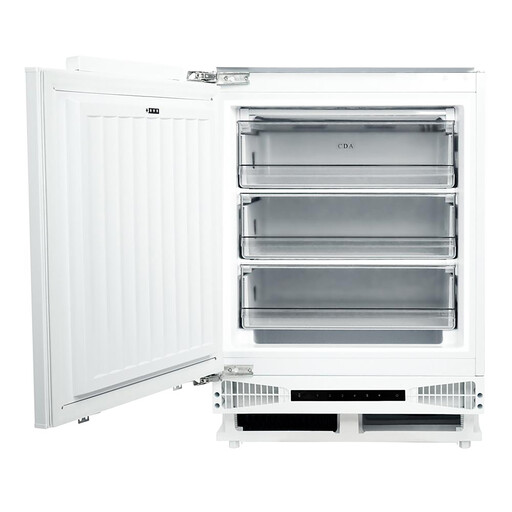
A reference point for a drawer-based under-counter layout.
These choices include freestanding and integrated appliances for storing individual portions. The CDA FW284 is an integrated fridge-freezer rather than a dedicated freezer, so consider it only if you also need chilled storage.
 No image available
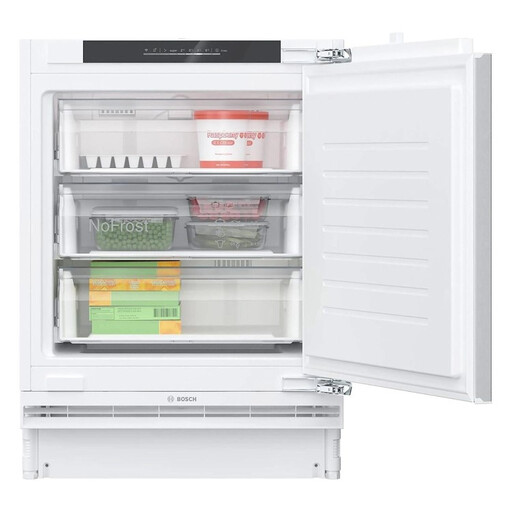
Consider this model when you need a freezer behind a compatible kitchen cabinet door. Bosch GB specifies an 85 L frozen compartment, NoFrost and dimensions of 820 × 598 × 548 mm. Check the cabinet, door and ventilation requirements, along with whether your tubs fit inside.
 No image available
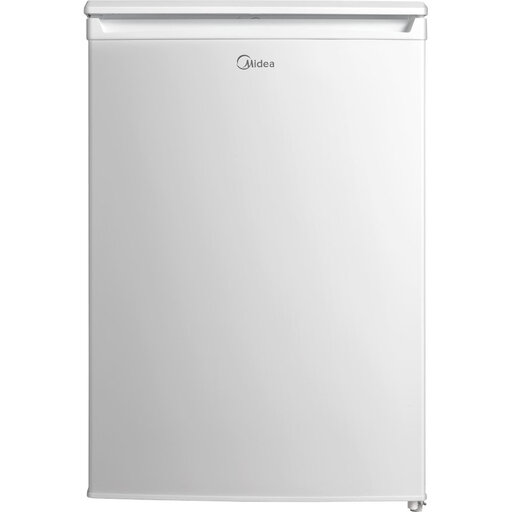
This freestanding under-counter option is worth checking for a compact kitchen. Confirm its net capacity, internal drawer measurements and available installation space against your containers; allow for manual defrosting.
 No image available
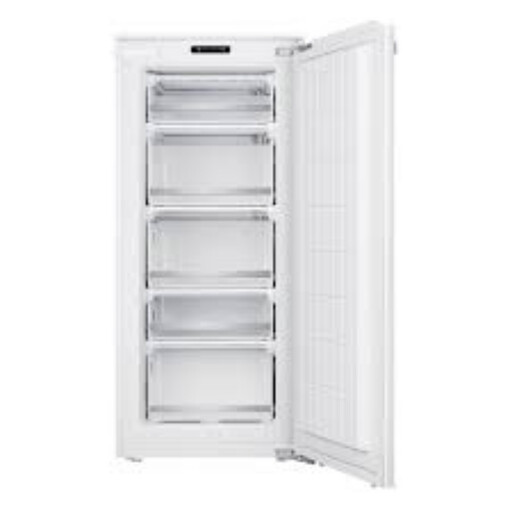
Consider this integrated format if you have suitable cabinetry and need room for several portions. Its three-quarter-height installation is not interchangeable with a standard under-counter opening; check cabinet and door fit as well as the space inside its baskets.
 No image available
This freestanding model is an option where its stated 55 cm width suits the kitchen space. Check whether its shelf-based layout accommodates your tubs rather than assuming separate drawers; manual defrosting is specified.
 No image available
Consider this appliance only if you need chilled storage as well as space for frozen portions. It is not a dedicated under-counter freezer; confirm the cabinet opening, sliding-hinge arrangement and freezer-drawer dimensions, and allow for manual freezer defrosting.
Cool it promptly before freezing, rather than leaving it standing for a long time. NHS batch-cooking guidance says food should ideally cool within one to two hours; for rice, it specifies cooling within one hour before putting it straight in the fridge or freezer. Dividing a batch into shallow portions helps it cool.
Choose space for the number and size of tubs you will actually keep, plus any other frozen food. Beko UK describes its under-counter range as typically offering 85–105 L, but a litre figure cannot tell you whether a particular drawer fits your containers.
No; check the exact model’s stated ambient-temperature range against the intended location. Beko UK states that its UFS4584 can operate down to -15°C, but that model-specific claim does not apply to other freezers.
No. Freezing is not a substitute for following the food’s use-by date and storage instructions before it goes into the freezer. Food Standards Agency research identifies particular concerns for ready-to-eat food that may not receive a further cooking step after defrosting.
Check each freezer’s energy label and annual energy-consumption figure alongside its size and format. UK government appliance guidance advises considering the capacity you need as well as the energy rating; an energy class on its own does not show what an appliance will consume in a year.