Seasonal pea preservers
If you freeze a garden, allotment or bulk-bought crop, allow room for multiple cooled batches and a way to keep older labelled portions accessible.


Choose a chest freezer for large seasonal batches if you have floor space; a tall upright makes labelled portions easier to retrieve regularly, while an under-counter model suits smaller batches and a tight kitchen. Whichever format you choose, check that it can operate at around −18°C, compare its energy information, and confirm the approved ambient-temperature range if it will stand in an unheated space.
If you freeze a garden, allotment or bulk-bought crop, allow room for multiple cooled batches and a way to keep older labelled portions accessible.
If you take out small portions for everyday meals, drawers, shelves or baskets can help you find the right bag without searching through deeper storage.
A tight kitchen calls for careful measurement. For an unheated garage or outbuilding, the exact model’s approved ambient-temperature range matters as well as its dimensions.
Start with the amount of cooled peas you expect to freeze at once and how often you need to retrieve portions. Then check the appliance’s temperature, installation requirements and energy information.
Choose it when: You preserve large seasonal batches and have dedicated floor space.
Allow for: The footprint and lid clearance, and less immediate access to small portions stored below other food.
Choose it when: You regularly retrieve labelled portions and want shelves or drawers to organise them.
Allow for: Model-specific storage volume and layout; do not assume frost-free or fast-freeze features are included.
Choose it when: Batches are small and fitting the freezer into a compact kitchen is the main constraint.
Allow for: Limited room for a large harvest; check both storage volume and stated freezing capacity.
| Concern | What to check | Who this matters to |
|---|---|---|
| Batch capacity | Compare frozen-compartment volume and stated freezing capacity in kg/24 h against your largest cooled batch. | If I freeze a large pea harvest, I need room to add portions without crowding the food already stored; around 33% of consumers put batch capacity first. |
| Freezing and storage temperature | Check operation around −18°C and the model’s freezing capacity; follow its instructions for any fast-freeze mode. The Food Standards Agency advises a home-freezer temperature of around −18°C. | When I add freshly cooled portions, I want to know the freezer can take the batch and maintain the required storage temperature; around 27% of consumers make this their primary concern. |
| Portion access | Look at the exact drawer, shelf or basket layout and whether labelled bags will remain easy to reach. | For everyday meals, I need to find a small portion without rummaging through a harvest’s worth of bags; around 20% of consumers prioritise access. |
| Fit and location | Measure the space and opening clearance. For an unheated location, check the model’s approved ambient range; compare its energy label and product information sheet. | If my only available spot is a compact kitchen or an unheated outbuilding, the freezer must fit and be suitable for that location; around 20% of consumers put these installation needs first. |
A freezer’s footprint does not tell you how much food fits inside or how much newly cooled food it is stated to freeze in 24 hours.
Compare compartment volume and stated freezing capacity with your largest batch, then measure the installation space and opening clearance.
Low-ambient operation is model-specific. Beko states that its CF4371 FreezerGuard can operate at ambient temperatures as low as −15°C; that does not establish suitability for other models.
Check the exact appliance’s approved ambient-temperature range against the temperatures at its intended location.
Those model-specific features do not replace cooling and portioning food before freezing or maintaining the freezer at the appropriate temperature.
Cool the blanched peas, divide and label the portions, and follow the appliance instructions if you use a fast-freeze function.
Two models with useful storage space may have different stated electricity consumption, so capacity alone does not describe their ongoing use.
Compare the energy label and product information sheet for the exact models alongside usable volume and installation fit.
Beko offers chest, tall upright and under-counter freezer formats relevant to different batch sizes and spaces.
Bosch lists upright and under-counter freezers, with storage and freezing features that vary by model.
Miele’s freestanding freezer range includes models with differing storage layouts and defrosting features.
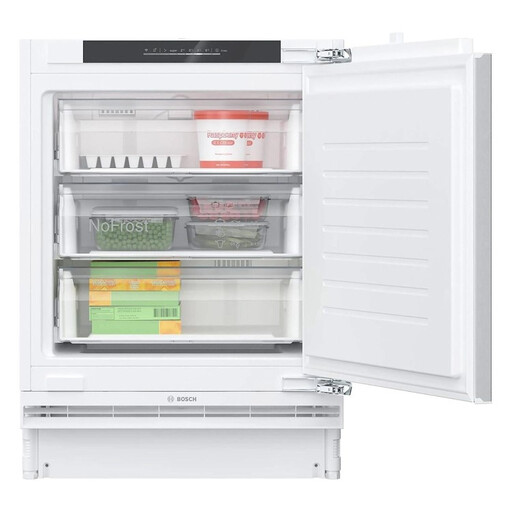
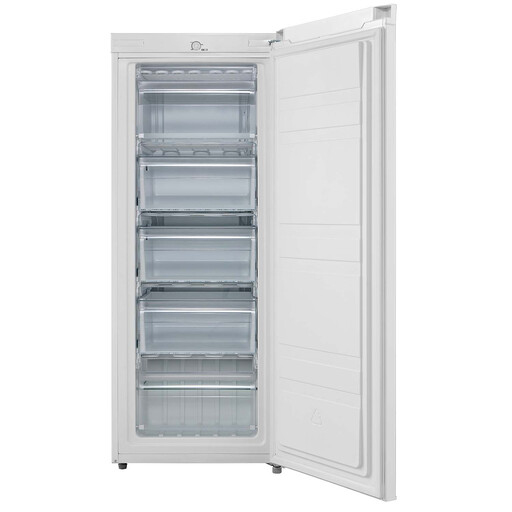
These choices cover a built-under freezer for a fitted kitchen and a freestanding tall freezer for organised portion storage. Check each model’s dimensions and stated freezing capacity against your space and largest batch.
 No image available
Consider this built-under model when kitchen floor space is limited and you freeze smaller portions. Confirm the cabinet opening, furniture-door arrangement and ventilation requirements before choosing it.
 No image available
Consider this freestanding upright model if you want separate spaces for regularly used pea portions. Its stated features include an adjustable thermostat, reversible door and four-star freezer rating; check its external dimensions and freezing capacity before planning a large batch.
The Food Standards Agency advises keeping a home freezer at around −18°C. Check the appliance’s temperature setting and cool and portion the peas before freezing them.
Cool them first and divide them into smaller portions. Food Standards Agency guidance advises cooling warm food before freezing and using smaller portions or freezer bags to help it cool quickly.
Check the exact model’s approved ambient-temperature range before placing it in an unheated space. Beko states that its CF4371 FreezerGuard can operate at ambient temperatures as low as −15°C, but that model-specific statement does not apply to other freezers.
Compare the energy label and product information sheet for each exact model alongside its usable volume. UK guidance from the Department for Energy Security and Net Zero and the Office for Product Safety and Standards says in-scope products must display an energy label at the point of sale, including on a website, and have a product information sheet.