One-person batch cook with limited kitchen space
You cook several servings of lentil stew at once and need to check whether a compact freezer will fit both your portions and your kitchen.


If your existing freezer has room for your cooled, single-meal portions, you may not need another appliance. When it is regularly full, a compact upright freezer is a way to add storage without choosing a tall model; consider a larger freezer only if you also freeze substantial amounts of other food. Check the usable space, dimensions and energy label of any model you consider.
You cook several servings of lentil stew at once and need to check whether a compact freezer will fit both your portions and your kitchen.
You freeze other prepared meals alongside stew and want enough room to keep different portions organised.
You plan to keep the appliance outside a heated kitchen, so its stated operating temperature and installation requirements matter as much as its size.
Check the room left in your existing freezer before choosing extra capacity. If you need another appliance, decide where it can go and how much defrosting work you are willing to do.
Consider it when: You freeze occasional single-meal portions and still have usable space after other frozen food.
Trade-off: Its freezer compartment may fill quickly; check the frozen-storage share rather than the appliance’s total volume. Bosch describes fridge-freezers with different fridge-to-freezer splits.
Consider it when: You need dedicated space for portions but have limited room for another appliance.
Trade-off: Its capacity is more limited than a tall freezer’s, and Low Frost models can still need defrosting. Check the door swing and internal layout.
Consider it when: You regularly freeze many prepared meals or need separate space for a wider range of frozen food.
Trade-off: The extra capacity may go unused if you only freeze occasional portions for one; compare its dimensions and annual energy figure with smaller models.
| Concern | What to check | Who this matters to |
|---|---|---|
| Space and capacity | Measure the appliance space, including room to open its door or lid, and compare usable frozen volume with the portions you plan to store. | If kitchen space is tight, I want enough room for labelled meals without giving an appliance more floor space than I can spare. Around 40% of consumers put fit and portion capacity first. |
| Energy and defrosting | Compare each model’s energy-label information and check whether it says Low Frost, Frost Free or NoFrost. | If I will run a second appliance continuously, I want to weigh its energy use against the defrosting work it requires. Around 30% of consumers prioritise those ownership demands. |
| Freezing and placement | Check the intended freezer temperature and, for a garage or outbuilding, the exact model’s stated minimum ambient temperature. | If my freezer will stand in an unheated space, I need to know it is suitable there before relying on it for cooked portions. Around 30% of consumers put freezing conditions and placement first. |
Extra capacity is useful only if you will use it. Manufacturer figures for the cited models vary: Beko lists 210.50 kWh a year for its 177 L FNE4545W, while Hotpoint and Indesit each list 168 kWh a year for the 95 L models described below. These model figures do not establish a rule for every freezer size.
Check the space in your current freezer, then compare the dimensions, volume and annual energy figures of models that could hold your usual batch.
Low Frost reduces ice build-up; it does not mean that manual defrosting will never be needed.
If avoiding that task matters to you, look for Frost Free or NoFrost on the exact model.
NHS advice says to cool batch-cooked food, ideally within 1 to 2 hours, before freezing or refrigerating it. One large container also makes it harder to take out just a single meal.
Cool the stew promptly, divide it into one-meal portions and label the containers with their contents and freezing date.
Suitability for low ambient temperatures depends on the model, not simply on whether it is upright, under-counter or frost-free.
Compare the model’s stated minimum ambient temperature and installation instructions with conditions in the intended space.
A reference point for freestanding under-counter storage: Hotpoint lists the H55Z1 112W UK as a 95 L freezer.
The freestanding I55Z1 112W UK is another 95 L under-counter model to measure against your available space.
The GTV15NWEBG offers a compact under-counter option for buyers who want to consider NoFrost.
The FNE4545W is a tall upright to consider when batches and other frozen food call for substantially more room.
These choices include built-under, freestanding under-counter, integrated and chest freezers for adding frozen storage. Their installation and access requirements differ, so start with the format that fits your kitchen and the way you retrieve single portions.
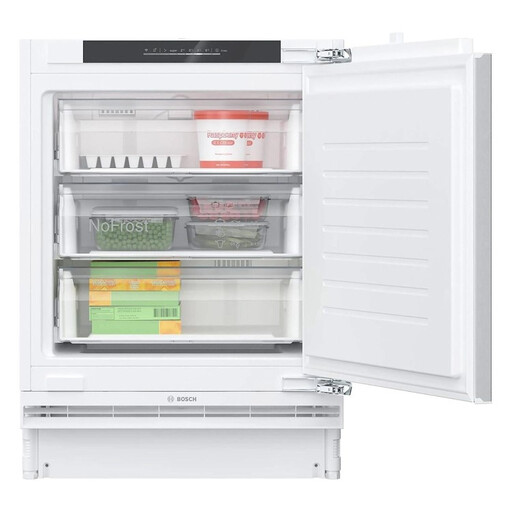 No image available
Consider this model if you have a suitable built-under cabinet and want to avoid manual defrosting.
The product name specifies No Frost and an E energy rating. Check cabinet fit and installation requirements before choosing a built-under appliance.
 No image available
Consider this freestanding model when you need dedicated storage for portions in an under-counter space.
The product name specifies 85 L, 55 cm and an E energy rating. Manual defrosting is required; check the space available for the door to open.
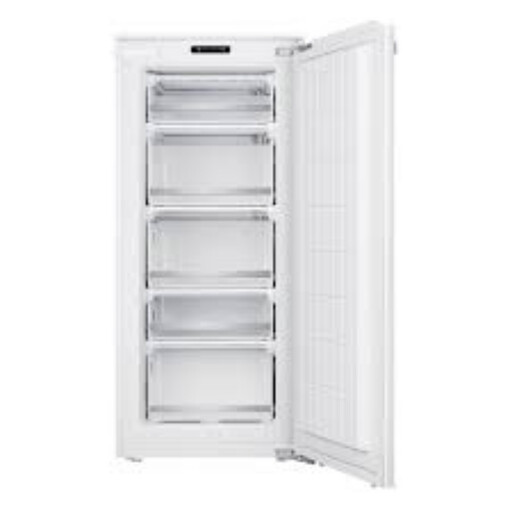 No image available
Consider this format if you want additional portion storage within a compatible fitted kitchen.
It is an integrated three-quarter-height model, not a freestanding under-counter freezer. Check cabinet compatibility, installation requirements and how much freshly cooked food you intend to freeze at once.
 No image available
Consider a chest format only if you have room to open its lid and can retrieve individual portions conveniently.
The product name specifies switchable refrigerator and freezer modes, an E energy class, a seven-level thermostat and a removable basket. Check its freezer-mode settings and defrosting instructions for your intended use.
Cool it promptly before freezing: NHS guidance says batch-cooked food should ideally be cooled within 1 to 2 hours, then frozen or refrigerated. Dividing the stew into one-meal portions lets you take out only what you need.
Cambridge University Hospitals advises keeping a freezer at or below −18°C and checking its temperature at least weekly. Follow the instructions for your particular appliance when setting and checking it.
Use the energy-label information for each exact model, including annual energy use, rather than comparing rating letters alone. Energy Saving Trust explains that appliance labels also provide information such as noise and performance; capacity matters when deciding whether the extra storage is useful to you.
Only if the exact model’s stated ambient-temperature range and installation instructions suit that garage. Hotpoint’s H55Z1 112W UK and Indesit’s I55Z1 112W UK are described as suitable for operation down to −15°C, but that does not establish the same suitability for other under-counter models.