Solo batch-cook with limited kitchen space
If you regularly make stock for individual meals, a compact freezer could give labelled portions their own space. Measure the intended location before deciding whether an under-counter appliance will fit.


If you freeze vegetable stock for one person, start with the freezer compartment you already have: it may be enough for occasional, labelled portions. A dedicated under-counter freezer makes more sense when regular batches need their own organised space; consider a larger freezer only if stock is part of a wider high-volume routine. Whichever route you choose, cool and portion the stock before freezing, and check that the freezer operates around −18°C, as GOV.UK advises.
If you regularly make stock for individual meals, a compact freezer could give labelled portions their own space. Measure the intended location before deciding whether an under-counter appliance will fit.
A dedicated freezer with automatic defrosting may suit you if you would rather avoid manual defrosting. Check the feature on the exact model; it does not establish whether the appliance fits your space.
If you make small batches now and then, your existing freezer may hold the cooled, labelled portions without another appliance. Check the available space and whether the freezer operates around −18°C, in line with GOV.UK guidance.
Choose it when: Occasional stock portions fit alongside the food you already freeze.
Trade-off: Stock shares storage space with other food, with less separation for labelled portions.
Choose it when: Regular batches would benefit from dedicated storage in a measured under-counter space.
Trade-off: It occupies space and adds an appliance that runs continuously.
Choose it when: Stock is only part of a broader high-volume batch-cooking or shared-storage routine.
Trade-off: It needs more room, and small portions may need baskets, drawers or an inventory to stay easy to find.
| Concern | What to check | Who this matters to |
|---|---|---|
| Cooling, portions and frozen storage | Plan space for smaller, labelled portions and a way to check that the freezer operates around −18°C, as GOV.UK advises. | If I make a batch of stock, I need to cool it and freeze portions I can use one at a time. Around 45% of consumers would put safe portioning and storage first. |
| Fit and usable space | Measure height, width and depth, then check the model’s ventilation and door-clearance instructions and its frozen volume. | With little kitchen space, I need room for my usual batches without committing to an appliance larger than I can accommodate; roughly 33% of consumers would make compact fit and capacity their main concern. |
| Defrosting, noise and electricity information | Compare the exact models’ defrost systems, declared noise and energy-label information. | If a freezer will sit near my living space, I want to weigh day-to-day noise and maintenance alongside its electricity information. About 22% of consumers would prioritise these ownership considerations. |
An under-counter format does not mean every model has the same width or depth: Beko lists the UFF4584 at 84 × 54 × 59 cm, while Liebherr lists the Fe 1404 at 85 × 55 × 60.7 cm.
Measure the intended position and check the exact model’s installation instructions for ventilation and door clearance before ordering.
A freezer does not correct poor cooling beforehand. GOV.UK advises cooling cooked food before freezing it and dividing food into smaller portions.
Cool the stock promptly in smaller, clean containers or freezer bags, label the portions and freeze them once cooled.
Bosch identifies the GTV15NWEBG as not Full NoFrost. Beko’s FreezerGuard ambient-temperature claim applies to the UFF4584 under the brand’s stated conditions, not to every under-counter freezer.
Check the exact model’s defrost system and permitted ambient-temperature range before choosing its location.
An energy class alone does not tell you whether a freezer’s capacity and features suit the amount of stock you make.
Once you have narrowed the choice by fit and storage needs, compare energy-label and product-information details for the exact models.
Beko offers under-counter freezer models for compact kitchen and utility-room spaces.
Bosch offers compact dedicated freezers with model-specific technical information.
Liebherr offers under-counter models with different defrost systems and published dimensions.
These dedicated freezers include built-under, integrated and freestanding formats. Check the installation type before comparing them for stock portions: an integrated or built-under model calls for a different space from a freestanding under-counter one.
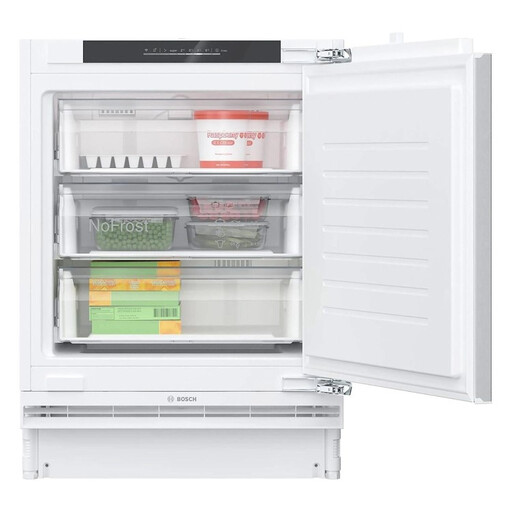 No image available
Consider this model if labelled stock portions need dedicated storage in a built-under kitchen layout. Its title identifies NoFrost and an E energy rating; check the furniture-door, cabinet and ventilation requirements, along with how you will verify a temperature around −18°C.
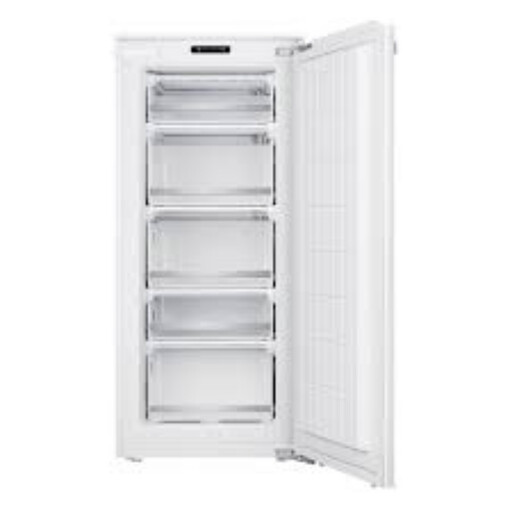 No image available
This is a dedicated-storage option if your kitchen has space for an integrated three-quarter-height appliance rather than a freestanding under-counter freezer. Confirm the cabinet opening, door fixing and installation requirements, and how you will check the freezer temperature around −18°C.
 No image available
Consider this freestanding model if you want dedicated stock storage in a compact under-counter space. Its title states 85 L, a 55 cm width and an E energy rating; allow for manual defrosting, and check whether the shelf arrangement suits your labelled containers.
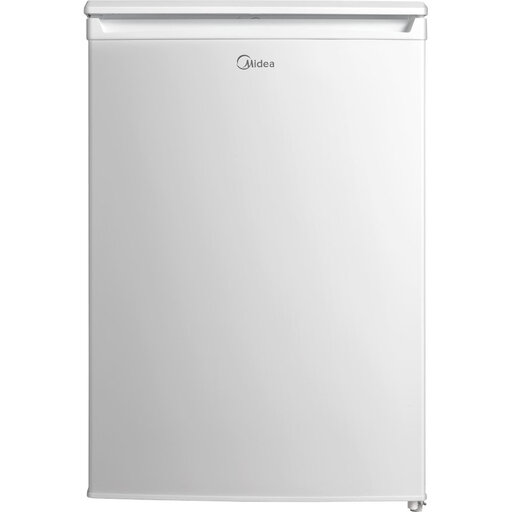 No image available
This freestanding under-counter model is worth considering if you want separate space for labelled stock portions. Confirm its usable capacity for your usual batches before choosing it, and allow for manual defrosting.
Yes. GOV.UK advises cooling cooked food before freezing it and dividing food into smaller portions. Cool warm stock promptly in smaller containers or freezer bags rather than putting a large warm pot straight into the freezer.
Check that the freezer operates around −18°C, as GOV.UK advises. Freezing does not replace safe cooling before storage or safe defrosting afterwards.
Smaller, labelled portions are more practical when you cook for one because you can take out the amount needed for a meal. GOV.UK also advises dividing food into smaller portions before freezing.
Defrost stock in the fridge where possible rather than leaving it on the counter. Food Standards Scotland advises fridge defrosting because bacteria can start growing again at higher temperatures.
Compare energy-label and product-information details for the exact models after checking that their size and storage arrangements suit you. An energy class on its own does not settle which capacity is proportionate for your stock batches.