Families preparing fresh meals
If you regularly prepare vegetables, salads and ready-to-serve ingredients for several people, focus on usable fridge space, a produce drawer and shelves that accommodate your containers.


Choose a fridge or fridge freezer with enough usable chilled space for covered cucumber slices and other meal ingredients, plus a layout that keeps ready-to-eat food separate from raw food. A larger fridge share may suit a family that buys more fresh than frozen food, but check the exact model’s dimensions, produce storage and energy information before choosing a format.
If you regularly prepare vegetables, salads and ready-to-serve ingredients for several people, focus on usable fridge space, a produce drawer and shelves that accommodate your containers.
If prepared food shares the fridge with raw ingredients, you need room to keep ready-to-eat food apart from raw meat, fish and eggs. NHS guidance specifically advises keeping raw meat and eggs away from other foods.
If the appliance must fit an existing space, decide whether the cabinetry calls for an integrated model or whether a freestanding fridge freezer has enough room for installation and door opening.
Start with the space your family needs for chilled ingredients, then check how the appliance fits your kitchen and how you will separate prepared food from raw food.
Consider it when: You have space for a freestanding appliance and buy more fresh food than frozen food. Bosch says a 60/40 or 70/30 split can suit that shopping pattern.
Trade-off: A larger fridge share leaves less room for frozen food; wider formats also need more installation and door-opening space.
Consider it when: The kitchen has a suitable appliance cabinet and you want a produce drawer behind matching cabinet doors.
Trade-off: Cabinet dimensions, hinge type, ventilation and door arrangement must match the exact model.
| Concern | What to check | Who this matters to |
|---|---|---|
| Fresh-food space | Compare fridge-compartment litres and check whether a covered container fits alongside produce in the shelves and drawers. | If I prepare several fresh ingredients for a family meal, I need room to organise them without relying on the appliance’s total capacity figure. Around 42% of consumers put fresh-food space first. |
| Chilled-food safety | Check the temperature controls and allow separate space for covered ready-to-eat food and raw ingredients. | When raw food shares my fridge with prepared cucumber slices, keeping them apart is my priority. For around 33% of consumers, chilled-food safety comes first. |
| Kitchen fit and energy information | Measure the installation space, door clearance and route into the kitchen; compare each model’s energy label and product information. | If I am replacing a fridge in a fixed space, I need an appliance that fits before weighing optional storage features. Kitchen fit and longer-term practicality come first for around 25% of consumers. |
A fridge freezer’s total litres include freezer space, which does not tell you how much room there is for prepared cucumber and other chilled ingredients.
Compare the fresh-food compartment volume and check whether your covered containers fit on the shelves you intend to use.
A dedicated drawer helps organise produce, but it does not replace cold storage or separation from raw food. The Food Standards Agency’s research review recommends that domestic refrigerators operate between 1°C and 5°C; NHS guidance advises keeping raw meat away from other foods.
Check the fridge temperature in use, keep prepared slices in a clean covered container and store covered raw meat on the bottom shelf.
Integrated models need a compatible cabinet and hinge arrangement, while tall or wide appliances may need more room than the space available.
Measure the opening, access route and door swing, then compare them with the exact model’s installation instructions, including ventilation requirements.
An energy class does not tell you whether two appliances have comparable capacity or the storage layout your household needs.
Read the model’s energy label and product information sheet alongside its capacity and dimensions, comparing similar formats where possible.
Bosch offers fridge-freezer layouts with different fridge-to-freezer splits and selected VitaFresh produce-storage features.
Beko has integrated fridge-freezer options for kitchens with matching cabinetry.
LG offers tall fridge freezers with model-specific fresh-food zones.
Samsung offers standard-width and wider fridge-freezer formats, with humidity-oriented storage on selected models.
These fridge freezers cover integrated layouts, a freestanding 60/40 model and a larger American-style format. Compare the space each requires and the fridge-to-freezer balance against how your family stores fresh ingredients.
 No image available
Consider this format if you want an American-style appliance for family food storage and have room for it. The stated 635L is total capacity, not fridge-only space.
Shiny Steel finish; plumbed ice and water dispenser. Check kitchen access, plumbing requirements, door clearance and the fridge compartment’s usable space.
 No image available
Consider this 70/30 layout if you want an integrated appliance with a larger fridge share than freezer share.
White finish. Check the cabinet opening, hinge arrangement and ventilation requirements, as well as space for your covered food containers.
 No image available
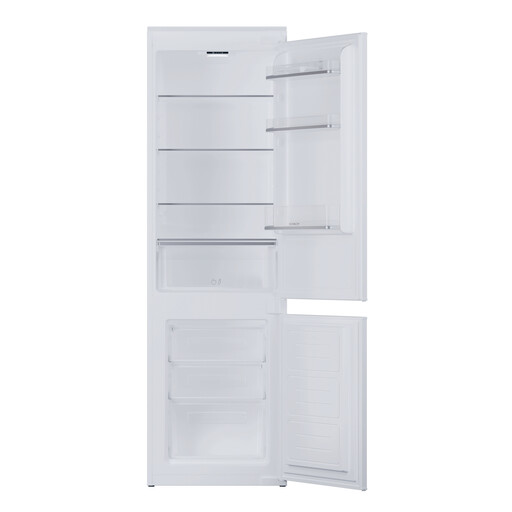
Consider this 70/30 model where an integrated appliance suits the kitchen and chilled ingredients take priority over freezer space.
262L stated total capacity and Low Frost design. Low Frost should not be treated as frost-free; check defrosting guidance and cabinet compatibility.
 No image available
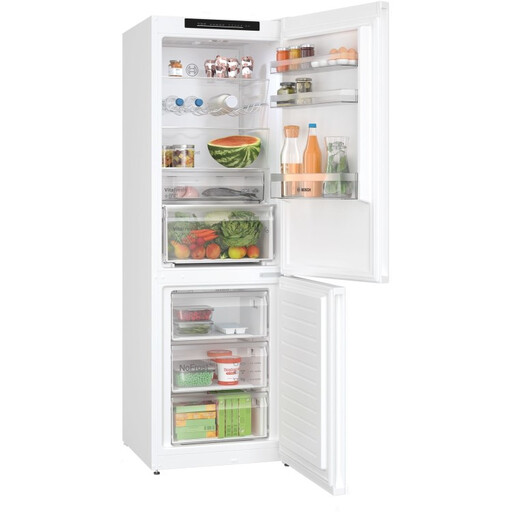
Consider this freestanding 60/40 layout if you buy more chilled ingredients than frozen food.
The title specifies a 186cm height, 60cm width and NoFrost design. Allow for the full depth, ventilation and door opening when measuring; confirm the exact drawers and shelf layout for your containers.
 No image available
Consider this 50/50 layout if an integrated appliance fits your kitchen and you want a more even fridge-to-freezer split.
249L stated total capacity and fixed-hinge installation. Check that the cabinet uses a compatible hinge arrangement and that the fridge compartment accommodates your fresh-food containers.
The Food Standards Agency’s research review recommends that domestic refrigerators operate between 1°C and 5°C. Check the temperature in your own fridge rather than assuming a produce drawer maintains it.
Yes, provided the ready-to-eat slices are protected from raw food and any drips. Keep the slices covered and separate; NHS guidance advises keeping raw meat away from other foods and storing it covered on the bottom shelf.
No. A clean fridge with sufficient chilled space and suitable separation meets the main storage need. A dedicated produce drawer may help you organise frequent fresh-food shops, but check whether the exact model has humidity control if you want that feature.
Compare the energy label and product information for the exact appliance alongside its capacity and format. UK Government energy-information guidance requires an energy label to be displayed at the point of sale for products within its scope.
NHS child-food guidance says food put in the fridge for young children should be eaten within two days. Follow any shorter instruction for the particular food, and do not reuse food left on a child’s plate.