Shared-kitchen batch bakers
If you freeze dough portions regularly, you need room to keep labelled batches distinct from other residents’ food. Freezer-compartment space matters more to this decision than headline total capacity.


Choose by usable freezer space and how easily residents can separate and retrieve dough portions, rather than by total appliance capacity alone. A freestanding model needs to fit the available space and door clearance; an integrated model also needs a compatible cabinet and hinge system. Frost-free operation is useful to consider for shared use, but it does not replace checks on storage layout and freezer temperature.
If you freeze dough portions regularly, you need room to keep labelled batches distinct from other residents’ food. Freezer-compartment space matters more to this decision than headline total capacity.
If the appliance must fit an existing opening, check its exact dimensions and whether the doors can open in a busy kitchen. For an integrated appliance, the cabinet and hinge system matter too.
If several people use the freezer and fresh dough batches are added often, look at the exact model’s frost-free system and any fast-freeze function. Neither feature tells you how much organised storage space you will have.
Check the frozen compartment and kitchen fit before comparing convenience features. For stored dough, the Food Standards Agency recommends a domestic-freezer temperature of −18 °C.
| Concern | What to check | Who this matters to |
|---|---|---|
| Dough storage and separation | Compare frozen-compartment litres and whether your usual containers or trays fit the drawer layout. Check the model’s freezer-temperature information. | When several people share the freezer, I need to find my labelled dough without moving everyone else’s food; around 42% of consumers put organised frozen storage first. |
| Kitchen fit and access | Measure the opening and delivery route, allow for door access, and confirm the hinge type if the appliance is integrated. | If the kitchen has a fixed cabinet opening or a busy walkway, I need the appliance and its doors to fit in everyday use; roughly 33% of consumers prioritise fit and access. |
| Routine use and running information | Check the exact model for frost-free and rapid-freeze functions, then compare its energy label and product information. | When new batches go in regularly, I want to manage frost and compare the appliance’s running information before choosing; about 25% of consumers place this need first. |
Total fridge-freezer capacity does not show how much space is available for dough alongside other residents’ frozen food. Bosch lists 89 L of frozen-compartment volume for the KGN36NWEAG and 76 L for the KIN86VSE0G.
Set out the containers or trays you normally freeze, then compare the exact model’s freezer volume and drawer arrangement.
An integrated appliance must suit its cabinet and hinge system. Bosch specifies a sliding hinge for the KIN86VSE0G, so matching appliance height alone is not enough.
Measure the opening and delivery route, identify the existing hinge system and check the full installation requirements before ordering.
An incompatible opening or hinge arrangement may require cabinet alterations.
These features do not establish that the freezer has room for everyone’s food or is set to the recommended storage temperature.
Check capacity and organisation first, then confirm the model’s freezer-temperature settings and follow its instructions for use.
Beko and Hotpoint describe freezer operation at low ambient temperatures for the cited models, but caution against using their fridge compartments in those conditions.
For an ordinary indoor shared kitchen, focus on fit and storage needs. Consider an outbuilding feature only for that placement, subject to the exact model’s instructions.
Bosch publishes model-level information useful for comparing freestanding and integrated fridge-freezers.
The Beko CFG4552 is relevant when comparing frost-free operation or considering a colder outbuilding location.
The Hotpoint HPKH 1261 W4UK offers model-specific dimensions and freezing features to compare against the kitchen’s needs.
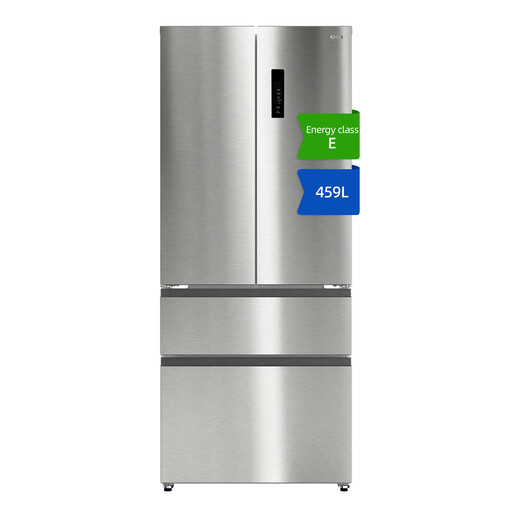
This four-door, frost-free fridge-freezer is a product to compare if you are weighing freezer organisation against the space available in a shared kitchen.
 No image available
Consider this model if a four-door, frost-free layout suits the shared kitchen, but check how much of its storage can accommodate dough and other residents’ food.
The product name specifies 459 L total capacity, 80 cm width and Total No Frost. Check the freezer drawers, installation clearances and model instructions for freezer-temperature settings before ordering.
The Food Standards Agency recommends −18 °C for domestic freezers. Check that the exact model can maintain that temperature, then set and use it according to the appliance instructions.
It is worth considering if reducing manual defrosting matters to the household. Frost-free operation does not tell you whether the drawers can hold several people’s food and dough, so compare the freezer layout as well.
Treat a rapid-freeze function as a secondary feature if you add fresh dough batches regularly. Hotpoint describes Fast Freeze on the HPKH 1261 W4UK as lowering temperature when food is added, while Bosch lists Super Freeze on the KIN86VSE0G; check storage space and temperature capability first.
A food-business kitchen needs storage arrangements suited to its operation, not just a household appliance choice. The Food Standards Agency’s MyHACCP guidance calls for adequate freezing and frozen-storage facilities and temperature monitoring where necessary; assess the business’s specific requirements before choosing equipment.
Compare the exact appliance’s energy label and product information alongside freezer volume and noise. UK government guidance describes energy-labelling requirements for products in scope; check the information applicable to the delivery location, as arrangements differ between Great Britain and Northern Ireland.