
24/7 Customer Support

Free returns

Same-day & Next-day Delivery

Quality Guaranteed

Unlock Your Welcome Offers: FREE Delivery | Up to 80% OFF | Free 30-day JoyPlus trial
Download the APP
A new fridge freezer is a significant investment for any UK home. It’s an appliance we rely on daily, yet the market is filled with confusing jargon and features that don't always deliver on their promises. Choosing the wrong model can lead to wasted energy, spoiled food and years of frustration. Before you commit, it’s crucial to understand the common pitfalls that many buyers fall into.
As the Joybuy Product Recommendation Officer, my role is to help you see past the marketing jargon and focus on what truly matters for your household. Let's look at the frequent missteps and how to avoid them.
Navigating the specifications can feel overwhelming. To simplify your search, focus on these three non-negotiable factors that will determine if a fridge freezer is right for your home.
Before looking at any other feature, measure your space carefully. Remember to leave adequate room for ventilation—typically 5cm at the back and sides—to ensure the appliance runs efficiently.
With energy costs being a key concern for UK households, the energy label is more important than ever. The rating system was updated in 2021, moving from the old A+++ system to a simpler A-G scale.
Under the new scale, it is much harder for a product to achieve the top A or B ratings. This means that an appliance with a D or E rating in 2026 is considered an energy efficient fridge freezer, offering significant savings compared to older models. Always check the estimated annual energy consumption (in kWh) on the label for a more direct comparison of running costs.
Once you've confirmed the size and efficiency, you can consider features that suit your lifestyle.
To help you match these features to your needs, here are a few models suited to different UK households.

Why This Fits Their Persona: With a colossal 635-litre net capacity, this American style fridge freezer is built for large families who buy in bulk and love to entertain. The plumbed ice and water dispenser is perfect for hosting, and the InstaView door allows quick checks without losing cold air.
It features a true Total No Frost system and an Inverter Linear Compressor that keeps the noise level at just 36 dB, making it exceptionally quiet for its size and ideal for open-plan kitchens.
Massive 635L net capacity. Plumbed water and ice dispenser with UVnano self-cleaning nozzle. Advanced cooling with LINEARCooling and DoorCooling+.
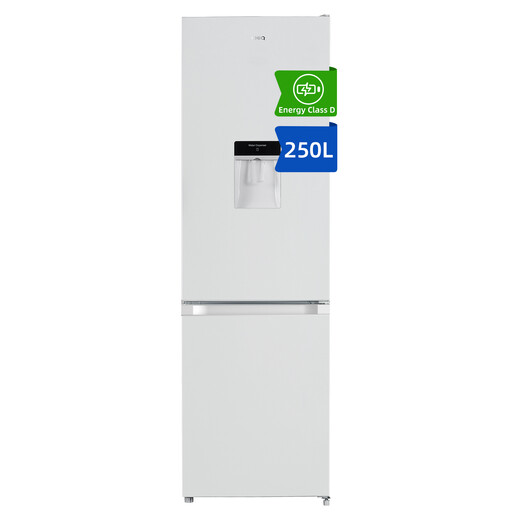
Why This Fits Their Persona: Ideal for those with smaller kitchens, flats or galley layouts. This slim fridge freezer has a 54cm width but a tall design to maximise its 250L capacity. The non-plumbed water dispenser is a great bonus for renters as it requires no installation.
It delivers on modern features without compromise, offering a Total No Frost system and a quiet 39 dB operation. Its impressive D energy rating also ensures it's an energy efficient fridge freezer for its class.
Space-saving 54cm width. Non-plumbed water dispenser for easy setup. D energy rating and quiet operation.
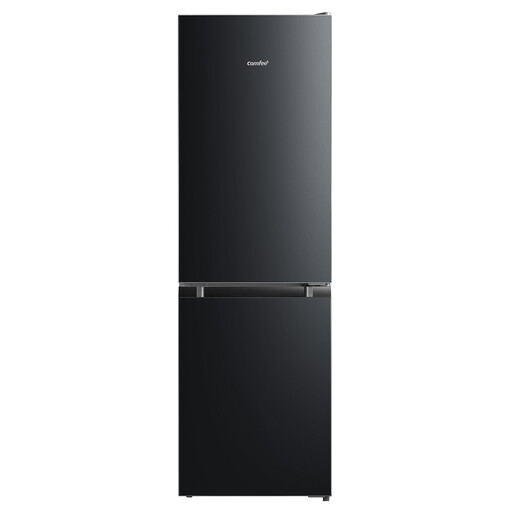
Why This Fits Their Persona: A practical and affordable choice for individuals, couples or smaller households. This freestanding fridge freezer provides 174L of essential storage in a compact 50cm width, finished in a stylish black fridge freezer look. It focuses on core performance without costly extras.
This model is transparent about its features. It has Low Frost technology, not Total No Frost, which is appropriate for its price point. It also operates at a very quiet 39 dB, avoiding the noisy appliance trap common in affordable models.
Very quiet operation (39 dB). Compact 50cm width. Reversible door for flexible installation.
We have compiled a complete, real-time list of products that fully satisfy these strict selection criteria and UK safety regulations.
As a general rule, most manufacturers recommend leaving a gap of at least 5cm (2 inches) at the back and on both sides of a freestanding fridge freezer. You should also leave around 10cm (4 inches) of clearance above it. This allows air to circulate properly, letting heat dissipate from the condenser coils and ensuring the appliance runs efficiently. Always check the specific model's user manual for precise requirements.
Yes. Following the 2021 change to the A-G energy rating scale, the standards became much stricter. An appliance that might have been A++ on the old scale could now be a D or E. Therefore, a D-rated model is considered a very good, energy efficient fridge freezer that will help manage household bills effectively compared to older appliances.
The expected lifespan of a new fridge freezer is typically around 10 to 15 years. The longevity can be influenced by the brand, the quality of its components (like the compressor) and how well it is maintained. Regular cleaning of the interior and the condenser coils at the back can help prolong its operational life and maintain efficiency.