
24/7 Customer Support

Free returns

Same-day & Next-day Delivery

Quality Guaranteed

Unlock Your Welcome Offers: FREE Delivery | Up to 80% OFF | Free 30-day JoyPlus trial
Download the APP
Buying a fridge freezer is rarely as simple as choosing a colour and capacity. A model may fit the available width but fail to open properly beside a wall, while an attractive energy label may not reflect how much electricity it uses in your household. For UK homeowners, families, couples, landlords and kitchen renovators, the most reliable choice starts with measurements, storage habits and installation requirements.
A fridge freezer can fit neatly into a 60cm space yet still be unsuitable if its doors cannot open far enough to remove drawers or shelves. Check the appliance’s height, width and depth, plus the manufacturer’s clearance requirements. Pay particular attention to skirting boards, worktops, nearby walls and kitchen islands.
For integrated models, measure the housing niche rather than just the cabinet door. Hinge type also matters: a fixed hinge and a sliding hinge require different cabinet-fitting arrangements.
The split describes the approximate allocation between fridge and freezer space, not the total amount of usable storage. A 60/40 fridge freezer is generally suitable for households buying more fresh food, whereas a 50/50 fridge freezer may suit batch cooking, frozen food storage or regular bulk shopping. A 70/30 fridge freezer gives more room for chilled groceries but less freezer capacity.
Always compare the separate fridge and freezer litres. Two appliances with similar external dimensions can have noticeably different internal layouts.
A frost-free fridge freezer, also called a No Frost fridge freezer, circulates cold air to reduce ice accumulation and manual defrosting. It is a practical maintenance feature, but it does not automatically make one appliance cheaper to run than another.
Compare the UK energy efficiency class from A to G, annual energy consumption in kWh and the appliance’s capacity. A larger fridge freezer may use more electricity overall even when its label appears favourable. Running costs also depend on room temperature, how often the doors are opened and how fully the appliance is loaded.
A freestanding fridge freezer is usually easier to replace or reposition. Models around 59–60cm wide are common in UK kitchens, but depth can vary considerably. Some appliances project beyond standard cabinetry, so check the full dimensions rather than relying on width alone.
An integrated fridge freezer sits behind a matching cabinet door for a continuous fitted-kitchen appearance. Confirm the required niche dimensions, door fixing system and whether the supplied hinge arrangement matches your existing kitchen.
For smaller rooms, an under-counter fridge with icebox may be more practical than a tall combination appliance. These models offer limited frozen storage, so they are better suited to singles, couples, utility rooms, home offices or use as a secondary appliance.
Use the stated net capacity as your main comparison. As a broad shopping guide:
A French door layout, such as the Midea model below, can make large platters and meal-preparation containers easier to store. However, wide doors and drawers still need sufficient clearance to operate fully.
No Frost reduces frost build-up, while low-frost systems reduce—but may not eliminate—the need for manual defrosting. Separate airflow systems can help distribute chilled air more evenly, but food should still be stored according to the manufacturer’s guidance.
For open-plan homes, compare the stated noise level in dB(A). Products listed at 35–39dB may be less noticeable than models with a higher figure, although perceived sound can vary by room and flooring.
A smart fridge freezer with Wi-Fi may offer remote temperature controls, holiday settings or energy monitoring. These features are useful if you will use the app; otherwise, they may add complexity without improving everyday storage.
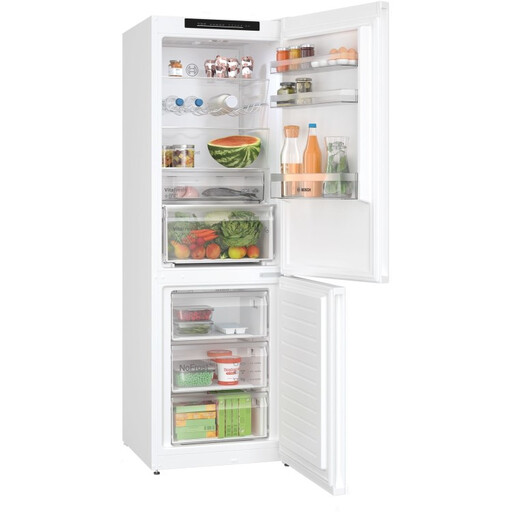
Why This Fits Their Persona: Its 600mm width suits many UK kitchen layouts, while the 321-litre capacity gives couples and growing households useful everyday storage without moving to a wider American-style format.
The No Frost system avoids routine manual defrosting, and PerfectFit is specified for positioning close to walls and furniture. Check the installation instructions before fitting.
218-litre fridge, 103-litre freezer, 35dB stated noise level and VitaFresh XXL climate-controlled drawers.
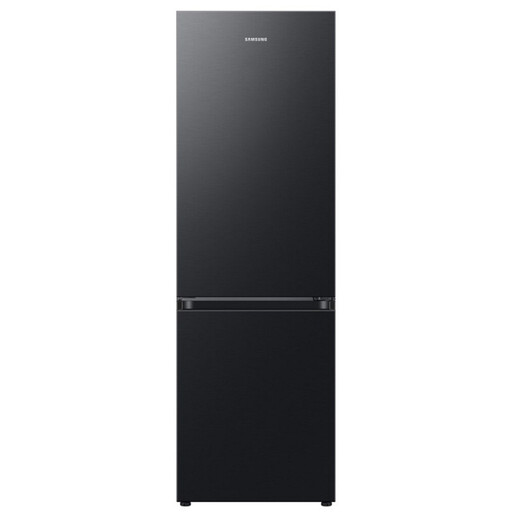
Why This Fits Their Persona: This freestanding model combines a standard-width footprint with Wi-Fi functions for households that value connected controls and a modern black finish.
The product specifications state Total No Frost, so buyers are not relying on a vague “easy maintenance” description. Its external dimensions should still be checked against door and ventilation space.
344-litre capacity, 230-litre fridge, 114-litre freezer, SmartThings Wi-Fi and 35dB stated noise level.
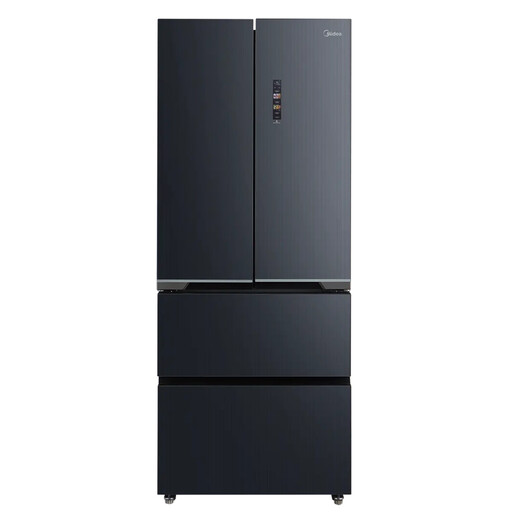
Why This Fits Their Persona: Families, keen cooks and bulk shoppers receive 435 litres of storage in a French door format that is 753mm wide and 600mm deep, rather than the dimensions of many wider American fridge freezers.
The stated 600mm depth helps address excessive projection, while separate freezer drawers make frozen food easier to organise. Confirm delivery access and door swing before ordering.
276-litre fridge, 159-litre freezer, Total No Frost, XL crisper and 35dB stated noise level.
If a seamless kitchen appearance is the priority, compare the niche dimensions before choosing an integrated fridge freezer. The Bosch KIN86NFE0G offers a 60/40 split, 260 litres and Total NoFrost with a fixed hinge. The Bosch KIN86NSE0G provides the same total capacity with a sliding hinge, which may suit replacement projects using an existing cabinet arrangement.
For more fresh-food storage, the Sharp SJ-BE250M1XS-EN offers a 70/30 configuration with 251 litres, while the Candy CB50S518EK uses a 50/50 split and provides 248 litres with low-frost cooling. These specifications illustrate why hinge type, split ratio and net capacity should be checked together.
We have compiled a complete, real-time list of products that fully satisfy these strict selection criteria and UK safety regulations.
Lifespan varies according to the model, installation, cleaning and usage. Keep ventilation areas clear, avoid overloading shelves and follow the manufacturer’s maintenance instructions. Warranty length is useful for comparing cover, but it should not be treated as a guaranteed lifespan.
They can be worthwhile if you want to avoid routine manual defrosting and keep freezer drawers usable. Compare the purchase price, annual kWh figure, capacity and noise level rather than paying for No Frost alone.
Keep the appliance away from direct heat, allow hot food to cool before storage, check that door seals close properly and avoid holding the door open unnecessarily. Select the correct size for your household, as unused capacity still occupies energy and kitchen space.