
24/7 Customer Support

Free returns

Same-day & Next-day Delivery

Quality Guaranteed

Unlock Your Welcome Offers: FREE Delivery | Up to 80% OFF | Free 30-day JoyPlus trial
Download the APP
Buying a fridge freezer is a long-term household decision, but attractive finishes and large litre figures can distract from the details that matter in daily use. A model may look suitable online yet fail to fit through a doorway, leave too little freezer space or cost more to run than expected.
The most common buying pitfalls include:
Measure the available space in millimetres, including height, width and depth. Then check:
Slim fridge freezers around 54–55cm wide can suit flats, smaller kitchens and narrow utility areas. Larger American fridge freezers, side-by-side fridge freezers and French door fridge freezers often require considerably more width and door-opening space.
Integrated freezers need extra care. Check the required housing niche, hinge type and furniture-door fixing system before ordering. A built-in appliance is not interchangeable with a freestanding model simply because the external measurements appear similar.
Total capacity is useful for comparing products, but the split between fridge and freezer compartments is more important for many households. Couples may prefer a 70/30 layout with more fresh-food storage, while families, batch cookers and bulk shoppers may benefit from a larger freezer.
Consider how you store food:
Total No Frost systems circulate cold air to help prevent ice accumulation, reducing the need for manual defrosting. Multi Air Flow or similar fan-assisted systems distribute chilled air around the cabinet, although food should still be stored according to the manufacturer’s guidance.
Check the appliance’s energy class and, where available, its annual kWh consumption. This figure gives a more practical indication of running demand than the letter alone. Features such as inverter compressors may adjust cooling output according to demand, while noise ratings around 35–41dB may be more suitable for open-plan homes.
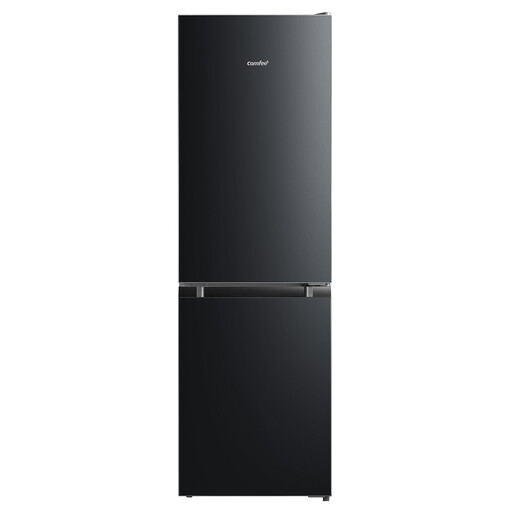
Why This Fits Their Persona: Its 150cm height and 50cm width suit smaller homes, rented kitchens and households of around two to three people.
The listed capacity is separated into 115L of fridge space and 59L of freezer space, rather than relying on one headline figure. Low Frost reduces ice build-up, although occasional defrosting remains part of ownership.
Reversible door, three freezer drawers, 4-star freezer rating and 39dB noise level.
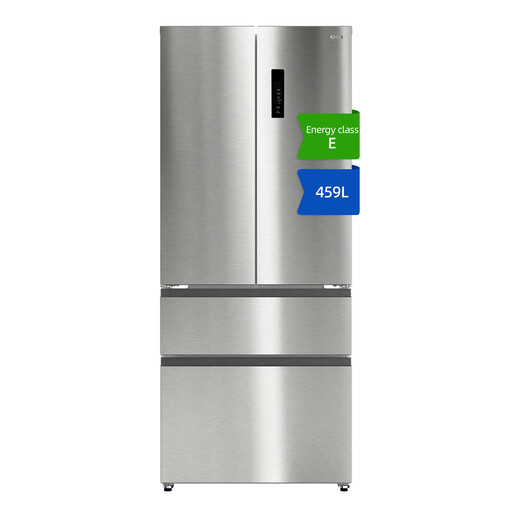
Why This Fits Their Persona: A four-door layout and 459L net volume provide flexible organisation for larger kitchens and households that value separate storage zones.
The 790mm width and 600mm depth are specified clearly, helping buyers assess kitchen fit instead of assuming that a slim-depth design is narrow.
Total No Frost, Care+ Space with three temperature modes, 37dB operation and E energy class.
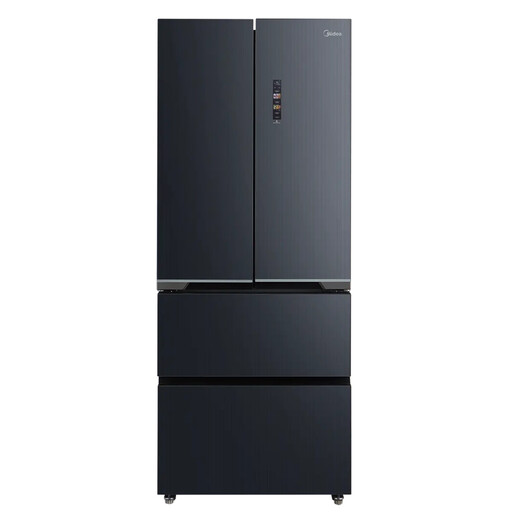
Why This Fits Their Persona: Suitable for families wanting American-style storage while keeping depth close to standard kitchen cabinetry.
The 600mm depth and 753mm width are stated alongside the 435L capacity, making it easier to assess projection and access before delivery.
276L fridge capacity, 159L freezer capacity, Total No Frost and 35dB noise level.
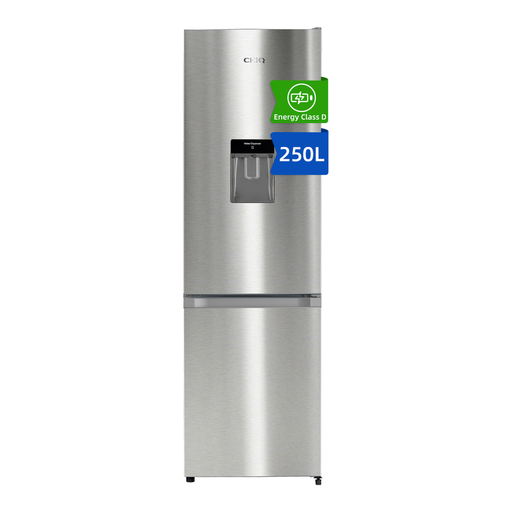
Why This Fits Their Persona: A 54cm-wide format works well in narrower UK kitchens, while the non-plumbed water dispenser avoids a dedicated plumbing connection.
Its 180L fridge and 70L freezer split is stated clearly, while Total No Frost avoids the maintenance expectations associated with manual-defrost models.
250L total capacity, 39dB noise level, three freezer drawers and D energy class.
We have compiled a complete, real-time list of products that fully satisfy these strict selection criteria and UK safety regulations.
They can be practical for households that want to reduce manual defrosting. Total No Frost models circulate dry, chilled air to help limit ice accumulation. They may cost more initially, so compare the appliance’s capacity, energy use, noise rating and warranty rather than focusing on frost-free status alone.
The required clearance varies by model. Follow the installation instructions, particularly for rear, side and top ventilation. Also allow additional room for doors and drawers to open fully. Never assume that an appliance will fit simply because its cabinet width matches the available gap.
It depends on capacity, energy consumption, household habits and available space. A combined fridge freezer may use less floor area and one electrical connection, while separate upright freezers and integrated freezers offer more flexible storage. Compare the annual kWh figures of the specific appliances before making a decision.