Solo cheese-and-fresh-food shopper
If cheese portions, milk, leftovers and fresh food take priority over frozen food, compare fridge capacity before choosing a split. Beko describes its 60/40 layouts as allocating 60% of capacity to the fridge.


Prioritise usable fridge space and a fit for your kitchen over total capacity when storing cheese portions for one person. Food Standards Scotland advises keeping a fridge between 0°C and 5°C and checking it with a thermometer. A compact appliance suits a restricted space; consider a fridge-heavy 60/40 layout if chilled food dominates, or a 50/50 layout if you also freeze food regularly.
If cheese portions, milk, leftovers and fresh food take priority over frozen food, compare fridge capacity before choosing a split. Beko describes its 60/40 layouts as allocating 60% of capacity to the fridge.
If the available space is narrow or low, check the appliance's width, height and depth alongside the room needed to open its doors. Capacity is of little use if the fridge-freezer cannot fit or its drawers cannot open properly.
If you keep cheese chilled but regularly freeze cooked portions, compare freezer litres as well as fridge litres. A 50/50 layout may suit that routine better than a fridge-heavy split, provided the appliance fits your kitchen.
Start with the room available for the appliance, then compare usable chilled storage and the freezer space your routine calls for. Food Standards Scotland advises checking that the fridge stays between 0°C and 5°C with a thermometer.
| Concern | What to check | Who this matters to |
|---|---|---|
| Usable chilled space | Compare fridge litres and shelf positions; make sure cheese containers and other chilled food can be stored as their packaging requires. | If cheese, milk and leftovers make up most of my stored food, I need fridge space that does not leave everything crowded. Roughly 46% of consumers would make chilled space their primary concern. |
| Kitchen fit | Measure width, height, depth and the access route; check door-opening and drawer clearance for the exact model. | In a narrow kitchen, I need to be able to install the appliance and open it fully, even if that means accepting less capacity. Around 36% of consumers would put fit first. |
| Freezer use and defrosting | Compare freezer litres and the exact defrost system; Low Frost and Total No Frost are not interchangeable. | If I freeze cooked portions regularly or want to avoid manual defrosting, freezer provision matters more than maximising fridge space. About 18% of consumers would prioritise freezer capacity and maintenance. |
A larger overall capacity does not tell you how much room is available for cheese and other chilled food.
Compare the fridge and freezer volumes separately, then look at the shelf arrangement. Beko defines its 60/40 layout as 60% fridge capacity and 40% freezer capacity.
A control setting is not a substitute for checking the temperature where food is stored.
Food Standards Scotland advises keeping the fridge between 0°C and 5°C and checking it regularly with a thermometer. Follow the cheese packaging's storage instructions too.
A Low Frost label should not be taken to mean that manual freezer defrosting will never be needed.
Check the defrost specification of the exact model if avoiding that task matters to you.
Choosing Low Frost when you expected a no-defrost system may leave you with occasional manual defrosting to plan for.
A fridge-freezer can fit the allotted floor space yet still be difficult to bring in or use if its doors and drawers lack clearance.
Measure the access route and installation position, then check the model's published dimensions and door requirements.
Midea is relevant when comparing compact freestanding fridge-freezers for a restricted space.
Beko provides fridge-heavy 60/40 layouts and the compact CNE4552 Total No Frost model as different options.
Bosch is relevant to shoppers considering a slim, standard-height 50/50 layout.
These freestanding options address kitchens where width is a constraint and chilled storage is the main reason for buying a fridge-freezer. Check each model's usable fridge space, temperature information and installation clearances against your own needs.
 No image available
Consider this model if a 47 cm-wide appliance fits your space and you mainly need chilled storage for one person.
The listed height is 144 cm, and the freezer is described as Low Frost rather than No Frost.
Check the fridge's temperature information and the clearance needed to open the doors before buying; use a fridge thermometer to check the temperature once installed.
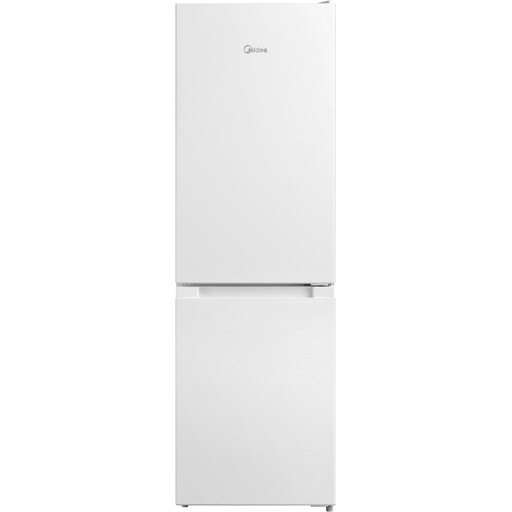 No image available
Consider this model if a 50 cm-wide appliance suits your kitchen and you want separate chilled and frozen storage.
Confirm the exact defrost system before choosing it, and check the installation and door-opening clearances against your space.
Check the model's fridge temperature information and use a thermometer to monitor chilled storage after installation.
Keep the fridge between 0°C and 5°C and check it regularly with a thermometer, as Food Standards Scotland advises. Follow each cheese pack's storage instructions and use-by information where applicable.
Choose by how you divide your storage between chilled and frozen food, not household size alone. Beko describes a 60/40 layout as giving 60% of capacity to the fridge; a 50/50 layout is worth considering if you freeze meals or buy frozen food regularly.
No: do not treat Low Frost as a promise that manual defrosting will never be needed. Beko describes the Total No Frost system on its CNE4552 as removing that task, so check the wording for the exact model you intend to buy.
Compare the energy labels for the specific fridge-freezers you are considering rather than choosing by a letter grade alone. UK guidance from the Department for Energy Security and Net Zero and the Office for Product Safety and Standards says products in scope must display an energy label at the point of sale, including on a website.