
24/7 Customer Support

Free returns

Same-day & Next-day Delivery

Quality Guaranteed

Unlock Your Welcome Offers: FREE Delivery | Up to 80% OFF | Free 30-day JoyPlus trial
Download the APP
Selecting a new fridge freezer can feel like a significant task. With an endless array of sizes, features and technical terms to decipher, it’s easy to feel overwhelmed. From understanding the new energy labels to deciding between different cooling technologies, finding the right appliance for your home requires careful consideration.
As the Joybuy Product Recommendation Officer, my role is to help you navigate these choices. This guide cuts through the marketing clutter, focusing on the practical features that matter for UK households. We will explore key factors to consider and highlight a few standout models to help you find an appliance that fits your kitchen, lifestyle and budget.
Before diving into specific models, let's cover a few essential points that will help narrow down your search for the perfect freestanding fridge freezer.
The first step is always to measure your space. Note the height, width and depth available, but remember to leave extra room for ventilation—typically 5cm at the back and top, and 1-2cm on the sides. This ensures your appliance runs efficiently.
Next, consider the capacity and layout. For many, a 60/40 fridge freezer offers a practical balance, with 60% of the space dedicated to fresh food and 40% for the freezer. If you have a large family or buy in bulk, a tall fridge freezer or a wider American-style model might be more suitable. Conversely, for smaller kitchens or flats, a slimline model can provide essential storage without dominating the room.
Since 2021, appliances in the UK use a simpler A-G energy rating scale. The standards are now much stricter, so don't be surprised to see very few models in the A or B categories. An energy efficient fridge freezer today might have a C or E rating, which often represents excellent performance and lower running costs compared to older appliances. Choosing a model with a good rating can make a noticeable difference to your electricity bills over the appliance's lifetime.
Defrosting the freezer is a chore nobody enjoys. Modern cooling technologies are designed to minimise or eliminate this task.
Here are a few recommendations that cater to different needs, from compact living to large family homes.
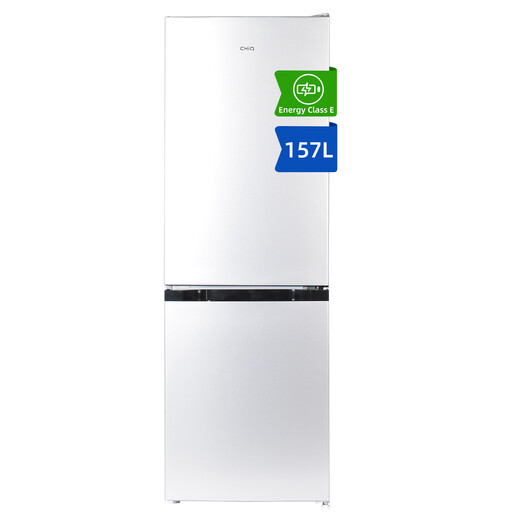
Why It Stands Out: The CHiQ JKR157LSE is a brilliant solution for anyone short on space. Its ultra-slim 47cm width allows it to fit into tight gaps where standard appliances cannot. Despite its compact footprint, it offers a well-organised 157-litre capacity, and its sleek silver fridge freezer finish adds a modern touch to any kitchen.
Pros:
Who is it for? This model is perfect for individuals or couples living in smaller homes, or for those seeking a reliable secondary fridge freezer for a garage or utility room.

Why It Stands Out: The LG GSXV80PZLE is more than just an appliance; it's a kitchen centrepiece. The signature InstaView panel illuminates the interior with two quick knocks, letting you see inside without opening the door and losing cold air. With a massive 635-litre capacity and a plumbed ice and water dispenser, it’s built for busy, modern households.
Pros:
Who is it for? Ideal for large families, people who love to entertain or anyone wanting to invest in a high-capacity, feature-rich appliance that makes a statement.

Why It Stands Out: This Midea model strikes an excellent balance between performance, capacity and running costs. Its standout feature is the impressive C energy rating, making it a very energy efficient fridge freezer for its size. Combined with Total No Frost technology and an ultra-quiet motor, it’s a practical and forward-thinking choice.
Pros:
Who is it for? This is a great all-rounder for medium-sized families or households who prioritise low running costs and minimal maintenance without compromising on modern features.
If these specific models aren't quite what you're looking for, or if you're interested in exploring other finishes and styles, there are many more to discover.
For a broader selection of modern designs, check out our full range of metallic fridge freezer models.
Under the current A-G scale (revised in 2021), the standards are much higher. Many high-quality, energy efficient fridge freezer models now fall into the C, D or E categories. An appliance with one of these ratings is considered efficient and will likely offer significant savings over an older model with a previous A+ or A++ rating.
'Low Frost' technology uses concealed evaporator pipes to drastically reduce the rate of ice formation in the freezer. You will only need to defrost it very infrequently. A no frost fridge freezer uses a fan to circulate dry air, which prevents any ice from building up at all, completely eliminating the need for manual defrosting.
First, measure the height, width and depth of the alcove or space where the appliance will go. It is crucial to then add extra space for ventilation to allow heat to escape. A good rule of thumb is to leave at least 5cm of clearance at the back and top, and 1-2cm on each side. This ensures the appliance can operate efficiently and prevents it from overheating.