A 50/50 fridge-freezer is a sensible starting point when several people regularly freeze sliced bread alongside other food: it gives freezer space more emphasis than a 60/40 or 70/30 layout. Choose by the exact freezer volume and drawer arrangement, then check kitchen and delivery-route dimensions. Frost-free operation can reduce defrosting work, while the model’s energy information and noise rating help with the day-to-day choice.
Who is this choice for?
Households dividing up freezer space
If several people store sliced bread and other frozen food, compare freezer litres and the actual drawer layout rather than total appliance capacity. A 50/50 Beko model is listed with 102 litres of freezer space, illustrating why the freezer figure is worth checking separately.
People sharing a small kitchen
Measure the intended space and the route from the entrance before settling on a format. Door swing and access to freezer drawers matter as much as whether the appliance fits the available width.
Households concerned about upkeep and noise
For a kitchen used throughout the day, compare the exact model’s defrost system, noise emissions and annual energy consumption. Bosch, for example, publishes a 35 dB(A) noise figure for its KGN392WDFG; that figure does not describe other Bosch models.
What matters when choosing?
Start with the freezer space the household can allocate, rule out appliances that will not fit or pass through the delivery route, then compare the upkeep and operating information for the remaining models.
| Concern |
What to check |
Who this matters to |
| Usable freezer space |
Compare frozen-compartment litres and drawer layout; check whether a labelled bread area will leave room for other food. |
If bread and other frozen food need separate places, I want an allocation everyone can use without relying on the appliance’s total capacity. Around 42% of consumers put usable freezer space and sharing first. |
| Kitchen fit and access |
Measure the appliance space, delivery route and open-door clearance; check the exact model’s installation requirements. |
A roomy freezer is little help if I cannot get the appliance through the doorway or open its drawers comfortably. For around 33% of consumers, fit and access are the primary concern. |
| Upkeep, noise and energy |
Check the defrost system and compare the exact model’s annual kWh, noise dB(A) and energy label. |
In a kitchen used by several people, I would rather avoid frequent defrosting and understand the appliance’s noise and electricity use. Those day-to-day considerations come first for around 25% of consumers. |
Buying pitfalls
-
Choosing by total capacity alone
Total capacity includes fridge space, which does not show how much room is available for bread and other frozen food.
Compare frozen-compartment litres for each model and inspect the drawers before deciding how the household will divide them.
-
Measuring the kitchen but not the way in
An appliance can fit its intended position yet be difficult to bring through a doorway or place where its door and drawers can open properly.
Measure the entrance and delivery route as well as the installation space. Check handle depth, required clearances and whether the exact model’s door can be reversed.
-
Assuming a brand has one defrost or noise specification
Defrost systems, energy information and noise emissions belong to individual models. Bosch publishes 35 dB(A) for the KGN392WDFG, not for every Bosch fridge-freezer.
Use the full model number when comparing the product information sheet and the manufacturer’s defrost specification.
-
Relying on an older model listing
Availability can change: Samsung’s UK page marked the RS57DG410EB4EU as no longer available in October 2026.
Check the current product-detail page before treating a model used for a size comparison as a purchase option.
Brands and relevant ranges
Beko
Beko’s CFG4582 range is relevant when comparing narrower freestanding, frost-free 50/50 appliances. The CFG4582W is listed at 54 cm wide with a 102-litre freezer and a reversible door.
- The CFG4582W combines the documented freezer volume with a 50/50 layout.
- Confirm the exact variant and installation conditions. Beko does not recommend using the CFG4582 fridge compartment in low ambient temperatures.
Bosch
The freestanding KGN392WDFG provides a model-specific point of comparison for a taller appliance: Bosch lists a 103-litre freezer, Total No Frost and a 203 cm height.
- Bosch lists 35 dB(A) noise emissions and energy class D for the KGN392WDFG.
- Its 60 cm width and 203 cm height need checking against the kitchen and delivery route; its specifications must not be assumed for other Bosch models.
Samsung
Samsung’s RS57DG410EB4EU illustrates a larger side-by-side format; Samsung describes it as a 578-litre appliance.
- The model offers a concrete format to measure against a conventional tall fridge-freezer.
- Samsung’s UK page marked this particular model as no longer available in October 2026. Check current models’ dimensions and freezer volumes rather than assuming the same specifications.
Fridge-freezers on Joybuy
These choices include integrated 50/50 models, a wider side-by-side appliance and a smaller freestanding 70/30 model. Match the installation type and freezer-space needs to your shared kitchen before comparing their other features.
 No image available
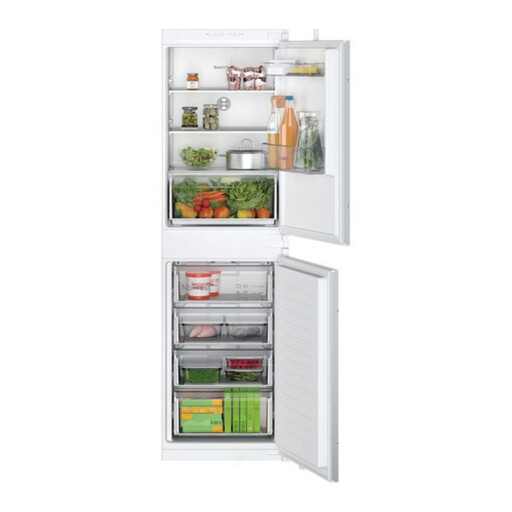
Bosch Series 2 KIN85NSE0G integrated 50/50 fridge-freezer
Consider this model if the shared kitchen has a compatible integrated cabinet and you want a 50/50 split for regular frozen-food storage.
The product name specifies a 177 cm height, sliding hinge, frost-free operation, 249 L total capacity and energy class E. Confirm cabinet and door compatibility, and compare its frozen-compartment volume and annual kWh before buying.
Joybuy
 No image available
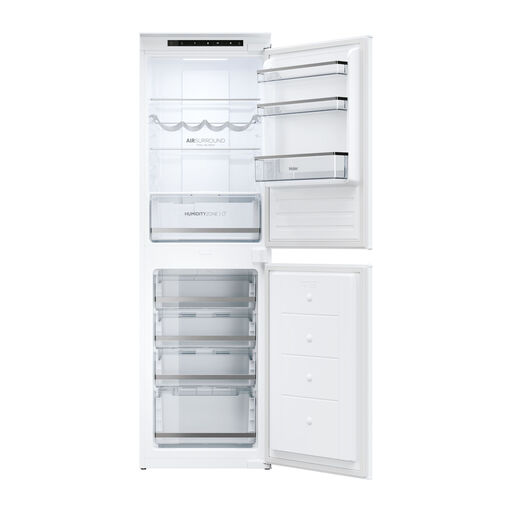
Haier HB50T618FMK Series 4 integrated 50/50 fridge-freezer
This is another 50/50 option to assess when the kitchen calls for an integrated appliance and avoiding manual defrosting matters.
The product name specifies Total No Frost and energy class E. Check the cabinet and hinge arrangement, frozen-compartment litres and exact-model annual energy consumption.
Joybuy
 No image available
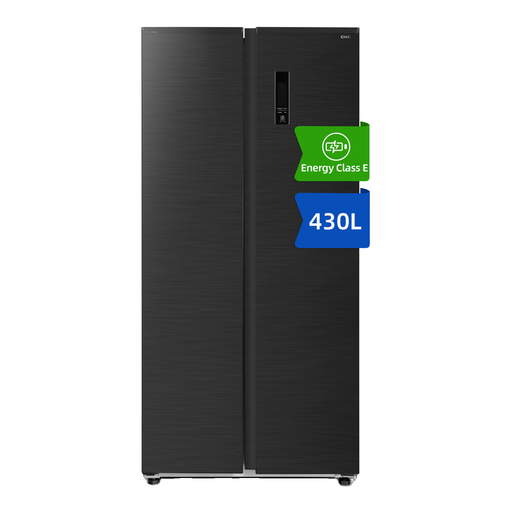
CHiQ JKR433WGE 430 L side-by-side fridge-freezer, black steel
Consider the wider format only if the household needs more overall storage and the kitchen and delivery route can accommodate it.
The product name specifies an 84 cm width, No Frost and energy class E. Confirm the freezer’s own capacity, door-opening clearance and annual kWh for this model.
Joybuy
 No image available
Candy CB50S518EK integrated 50/50 fridge-freezer, white
Consider this 50/50 model where an integrated installation suits the kitchen, but check the freezer layout against the space needed for bread and other food.
The product name specifies static refrigeration and energy class E; do not assume it is frost-free. Confirm its defrost instructions, cabinet and door arrangement, noise figure and annual kWh for the exact model.
Joybuy
 No image available
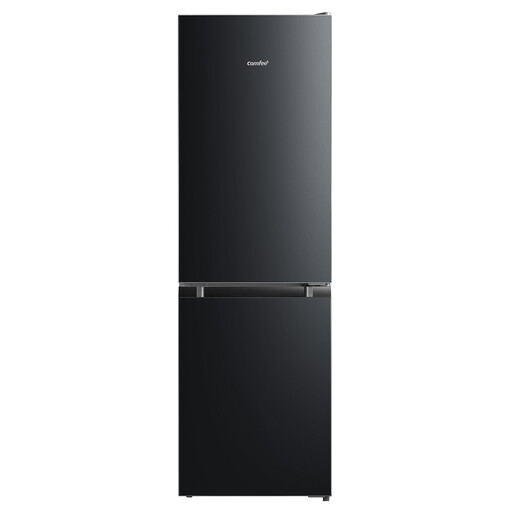
Comfee' RCB169BL2UK(E) 174 L freestanding 70/30 fridge-freezer, black
This narrower 70/30 option may suit a household with modest frozen-food needs, provided its freezer section can hold everyone’s bread and other items.
The product name specifies a 150 cm height, Low Frost, 39 dB noise rating, reversible door and energy class E. Low Frost is not the same specification as frost-free; check the freezer volume, defrost instructions and annual kWh.
Joybuy
Common questions
Is a 50/50 fridge-freezer a good choice for regularly freezing sliced bread?
A 50/50 layout is a useful starting point when frozen food is a regular priority in a shared kitchen. Bosch describes 50/50, 60/40 and 70/30 splits as different allocations of fridge and freezer space, but the actual freezer litres and drawer layout still need checking for each model.
Does a shared household need a frost-free freezer?
Frost-free is worth considering if avoiding manual defrosting matters to the household. Beko describes its CFG4582 range as frost-free, while Bosch specifies Total No Frost for the KGN392WDFG; check the exact variant rather than assuming every appliance from either brand has the same system.
Which energy and noise figures should I compare?
Compare the exact fridge-freezer model’s energy class, annual consumption in kWh and noise emissions in dB(A), alongside its frozen-compartment litres. UK government energy-label guidance and the household refrigeration label fields identify these as model-specific information, so energy class alone does not answer the freezer-space or noise question.


