Flatmates storing next-day soup
If soup is usually eaten soon after cooking, accessible fridge shelves for covered, dated portions matter more than dedicating much of the appliance to freezing.


Choose more fridge space if the household usually eats its leftover soup within 48 hours; look for shelves that fit covered containers and leave room for other shared groceries. If several people regularly freeze portions, a 50/50 fridge-freezer deserves a closer look, but check its usable drawer space. GOV.UK advises keeping a household fridge between 0°C and 5°C: neither the compartment split nor a frost-free label replaces cooling and storing soup properly.
If soup is usually eaten soon after cooking, accessible fridge shelves for covered, dated portions matter more than dedicating much of the appliance to freezing.
Households making a large pot of soup need freezer space that lets them separate and retrieve individual containers. GOV.UK advises eating refrigerated leftovers within 48 hours or freezing them.
When several people use the same shelves, a clear place for covered, ready-to-eat soup and a way to check the fridge temperature help everyone follow the same storage routine. Food Standards Scotland recommends regular thermometer checks.
Choose when: Most soup is kept for near-term meals alongside other chilled groceries.
Trade-off: Compared with a 50/50 split, less of the appliance is allocated to frozen portions; confirm usable space on the particular model.
Choose when: Several users regularly freeze individual portions as well as storing everyday chilled food.
Trade-off: The fridge section may feel cramped if tall soup containers and other ready-to-eat foods must share it.
| Concern | What to check | Who this matters to |
|---|---|---|
| Chilled storage | Check fridge temperature with a separate thermometer and leave room around covered containers. | If I share a crowded fridge, I need to know my cooled soup is staying cold rather than relying on the control dial. Around 36% of consumers put safe chilled storage first. |
| Container fit | Measure a lidded container and compare its height and width with the model’s usable shelf spacing. | When my soup containers vary in size, I need a shelf arrangement that lets me reach each one without moving everyone else’s food. Roughly 29% of consumers prioritise container space and access. |
| Shared upkeep | Check the exact defrost type and whether shelves and drawers are easy to remove for cleaning. | If defrosting tends to get postponed in our kitchen, I would rather choose a maintenance routine everyone can keep up with. About 21% of consumers make low-maintenance use their primary concern. |
| Freezing portions | Compare freezer drawer dimensions with your portion containers and allow enough fridge space for current meals. | When I cook more soup than we can eat within 48 hours, I need space to freeze and find dated portions. Around 14% of consumers put freezer organisation first. |
Overall capacity does not show whether a tall, lidded soup container will fit between shelves or be easy to remove.
Measure the containers you use and compare them with the exact model’s shelf positions and internal layout.
Frost-free operation addresses ice build-up; a dial setting does not by itself tell you the temperature inside the fridge.
Follow GOV.UK’s advice to cool cooked food promptly, refrigerate it within one to two hours, and eat refrigerated leftovers within 48 hours or freeze them. Use a fridge thermometer to check for 0°C to 5°C.
A 50/50 split gives more of the appliance to freezing than a fridge-led layout, which may leave less room for everyday chilled food.
Base the split on how often the household actually freezes portions, then check the fridge shelves and freezer drawers on the model under consideration.
Beko offers fridge-freezer formats relevant to households comparing a 50/50 split and adjustable shelving.
Bosch lists 50/50, 60/40 and 70/30 layouts, giving buyers different balances of chilled and frozen space to examine.
Hotpoint lists fridge-freezer formats including 60/40 and 70/30 models and frost-free options.
Samsung lists conventional bottom-mount fridge-freezers alongside larger French-door and side-by-side formats.
These fridge-freezers offer different installation formats and amounts of stated storage for shared-household use. Compare their actual shelf and drawer fit with your soup containers rather than treating capacity or a frost-free feature as a food-safety assurance.
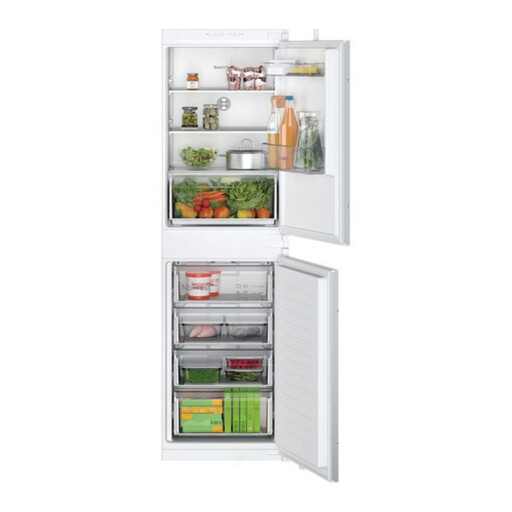 No image available
Consider this built-in format if the shared kitchen has a compatible cabinet and frozen portions matter alongside chilled storage.
The product title specifies a 177 cm sliding-hinge model, Frost Free operation and 249 L total capacity. Check cabinet, hinge and ventilation requirements, as well as usable shelf clearance for your containers.
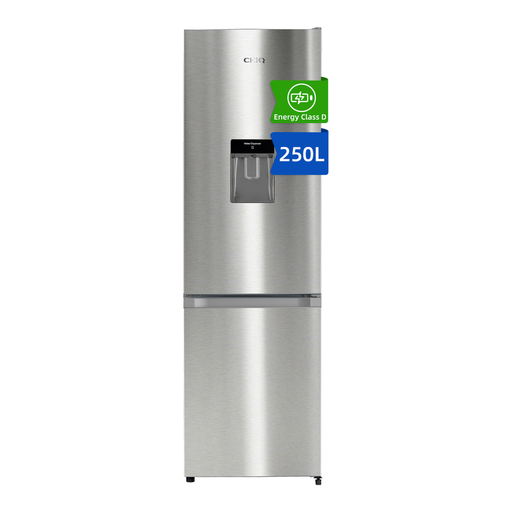 No image available
This is a freestanding option for a shared kitchen where users want to compare container space and defrosting upkeep.
The product title states 54 cm width, 181 cm height, 250 L total capacity and Total No Frost. Measure the installation space and the shelf clearance needed for your lidded containers.
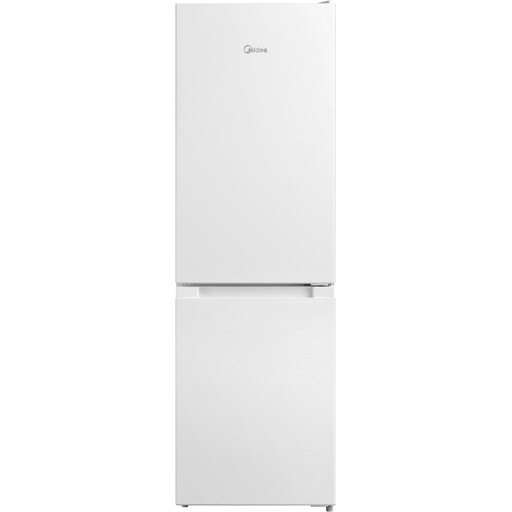 No image available
Consider this model when the kitchen calls for a fridge-freezer with a stated 50 cm appliance width, provided its internal layout suits everyone’s containers.
The product title gives 173 L total capacity. Compare shelf clearance, freezer drawer fit and the space needed around the appliance before choosing it.
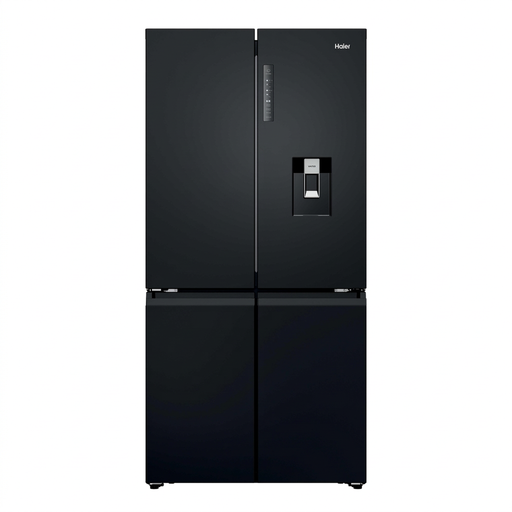 No image available
This larger format is worth considering only if the shared household needs extensive food storage and has room to install it.
The product title states 649 L total capacity. Check delivery access, door-opening space and whether the shelves fit the soup containers you use.
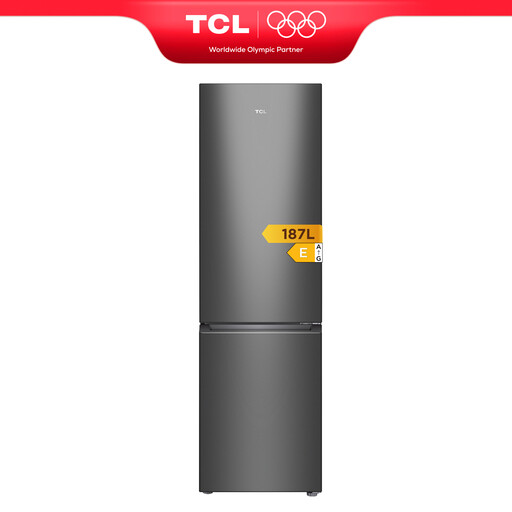 No image available
Consider this freestanding format if the kitchen can accommodate it and reducing manual defrosting work is a priority.
The product title states 55 cm width, 183 cm height, 282 L total capacity and Total No Frost. Check its depth, fridge-freezer split and usable shelf spacing against your kitchen and containers.
Let cooked soup cool promptly and divide a large batch into smaller portions before refrigerating it within one to two hours, as GOV.UK advises. Do not leave the pot standing out for longer to protect the fridge; eat refrigerated leftovers within 48 hours or freeze them.
Keep the fridge between 0°C and 5°C and check it regularly with a thermometer, in line with Food Standards Scotland’s household advice. Do not assume the number on a control dial is a Celsius reading.
No: frost-free features address ice build-up and defrosting work, not how promptly soup was cooled or whether the fridge is at a suitable temperature. Keep soup covered, check the temperature and follow the 48-hour refrigerated-leftover guidance from GOV.UK.
Keep ready-to-eat soup covered and separate from raw food. GOV.UK’s food-business guidance places raw food below ready-to-eat food to prevent drips; arranging a shared household fridge the same way is a practical precaution.
Mark each container with its contents and freezing date so shared users can identify it. Cool the soup promptly, divide it into portions and keep the freezer around −18°C, following GOV.UK’s food-storage guidance.