
24/7 Customer Support

Free returns

Same-day & Next-day Delivery

Quality Guaranteed

Unlock Your Welcome Offers: FREE Delivery | Up to 80% OFF | Free 30-day JoyPlus trial
Download the APP
Choosing a new appliance involves more than comparing litre capacity and appearance. Some fridge freezers look spacious online but offer limited usable storage, while others may not fit through a doorway or open properly beside a wall. Marketing terms such as “smart”, “frost-free” and “energy-saving” also need careful interpretation.
This guide explains the practical checks that matter, common buying traps and a selection of models suited to different UK households.
A large headline capacity does not show how that space is divided. A household that buys fresh food regularly may need more fridge capacity, while batch cooks may prioritise freezer drawers.
Check the separate figures for:
For example, a 344-litre combi model with a 230-litre fridge and 114-litre freezer may suit a couple or small family better than a larger appliance with a narrow fresh-food compartment.
Total No Frost or No Frost fridge freezers generally circulate cold air to reduce ice and frost accumulation, helping avoid manual defrosting. However, low-frost systems such as NanoFrost are not necessarily maintenance-free in the same way.
Read the specification carefully:
An appliance can fit within a stated alcove but still be unsuitable if there is not enough space to open its doors or pull out freezer drawers. Measure the route into the property, including doorways, staircases and turns.
Before ordering, check:
Freestanding fridge freezers are easier to replace or reposition, while integrated fridge freezers sit behind a matching cabinet door for a coordinated kitchen design. Integrated models must match the cabinet opening, hinge system and ventilation arrangement precisely.
Common layouts include:
UK appliances use the A-to-G energy efficiency scale. A rating alone does not show the likely annual cost, so compare the stated annual energy consumption in kWh and multiply it by your electricity tariff.
A larger appliance may use more electricity overall than a smaller one even if both have the same rating. Features such as inverter compressors, holiday modes and adjustable temperature zones can help manage operation, but actual consumption depends on room temperature, loading and usage.
Noise is measured in decibels (dB). A model rated at 35–37dB may be more suitable for an open-plan kitchen than one rated at 41dB, although the noise-emission class should also be considered.
Useful features include:

Why This Fits Their Persona: Its 54cm width and 282-litre capacity suit flats, starter homes and smaller kitchens where floor space is limited.
The stated dimensions make the compact footprint easier to check, while Total No Frost avoids the assumption that a slim model must require frequent manual defrosting.
282-litre capacity, black steel finish, dual freezer drawers, Multi Air Flow and a stated 37dB noise level.
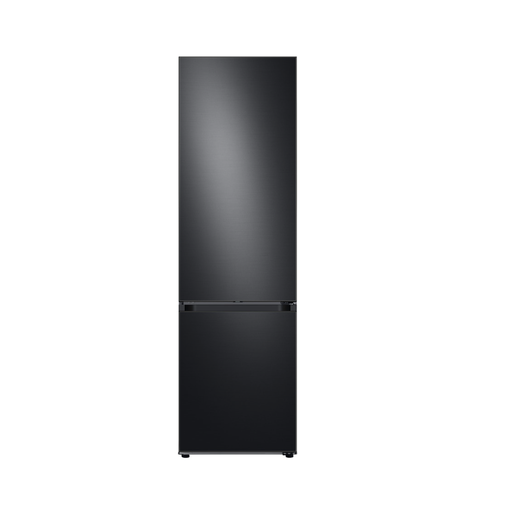
Why This Fits Their Persona: It combines a standard 59.5cm width with Wi-Fi connectivity, a black stainless finish and separate cooling features for households that value convenience and design.
The 387-litre split is stated clearly, helping buyers assess useful space instead of relying on a broad capacity headline.
273-litre fridge, 114-litre freezer, Total No Frost, Wi-Fi through SmartThings and stated B energy class.
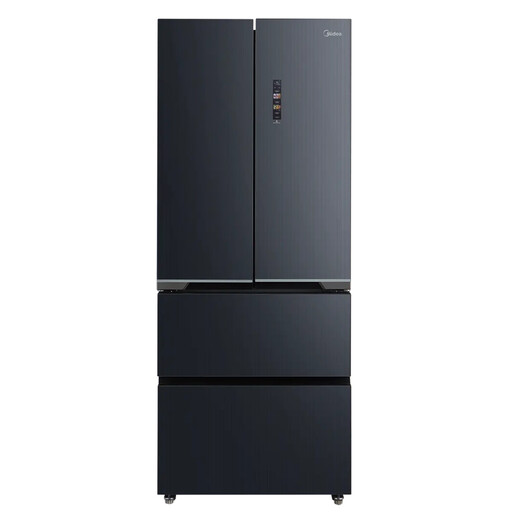
Why This Fits Their Persona: The 435-litre layout suits family shopping, meal preparation and households needing wide fridge access without a conventional 90cm-wide cabinet.
Its 753mm width and 600mm depth are specified, allowing a more realistic kitchen-fit assessment than using the “American-style” label alone.
276-litre fridge, 159-litre freezer, Total No Frost, XL crisper, external display and stated 35dB operation.
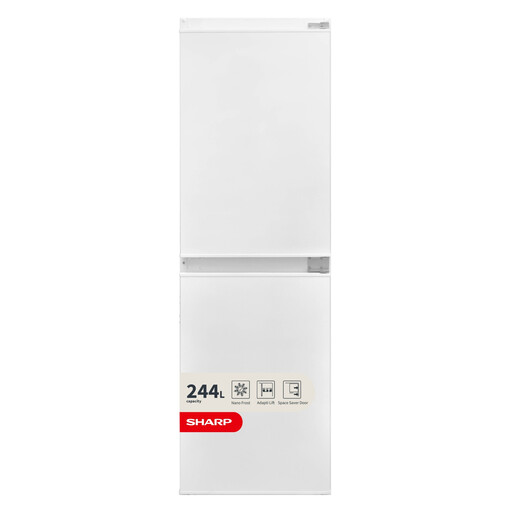
Why This Fits Their Persona: Its 54cm integrated format is designed for a fitted kitchen where a visible freestanding appliance would interrupt the cabinetry.
The 1775 × 540 × 545mm dimensions and sliding-hinge design make cabinet compatibility easier to verify before purchase.
244-litre total capacity, 50/50 fridge-freezer split, NanoFrost, reversible door and 38dB noise level.
We have compiled a complete, real-time list of products that fully satisfy these strict selection criteria and UK safety regulations.
They can reduce routine maintenance by limiting ice accumulation, particularly in the freezer. Compare whether the specification says Total No Frost or only low-frost, and still clean the interior, vents and door seals as advised in the manual.
The required clearance varies by model. Follow the manufacturer’s installation instructions rather than applying a universal measurement. Allow room for ventilation, door movement and drawer access, and check that the appliance is level and connected to a suitable earthed socket.
There is no single capacity for every family. Consider shopping frequency, fresh-food habits and freezer use. Larger households may prefer 400-litre-plus French door, four-door or American fridge freezers, while a 250–350-litre combi can be more practical for a smaller household or compact kitchen.