
24/7 Customer Support

Free returns

Same-day & Next-day Delivery

Quality Guaranteed

Unlock Your Welcome Offers: FREE Delivery | Up to 80% OFF | Free 30-day JoyPlus trial
Download the APP
Buying a fridge freezer is rarely as simple as choosing the capacity and colour. A model can look suitable online but prove awkward to install, expensive to run or inconvenient to organise once it is filled with weekly shopping.
The most common buying mistakes are usually linked to three marketing traps:
The right choice depends on your kitchen measurements, household size, shopping habits and preferred storage layout.
Check height, width and depth, then allow room for ventilation and door opening. Do not measure only the gap between cabinets. Skirting boards, handles, pipes and uneven walls can affect the fit.
For narrow kitchens, slimline fridge freezers measuring around 47–54cm wide may be easier to accommodate than standard 60cm models. However, check whether the doors can open beyond 90 degrees and whether freezer drawers can be pulled out fully.
Freestanding models are easier to replace or reposition. An integrated fridge freezer must match the cabinet dimensions and door-fitting system, so confirm the niche height, furniture door size and hinge arrangement before ordering.
Total litres are only part of the picture. Look separately at fridge and freezer capacity:
A freezer with drawers can make food easier to sort than one large open compartment. French door models provide a wide refrigerated section for platters and large containers, while side-by-side fridge freezers give separate vertical access to chilled and frozen food.
Frost-free fridge freezers circulate cold air to help prevent ice accumulation, reducing the need for manual defrosting. Low frost models reduce ice formation compared with conventional static cooling, but still require occasional defrosting.
When comparing energy-efficient fridge freezers, record both the energy class and annual kWh figure where available. For example, the Midea French door model listed below is rated E and specifies 285 kWh per year. A higher purchase price may not automatically produce lower bills, so compare like-for-like capacity and consumption.
Also check the noise rating if the appliance will sit in an open-plan kitchen. A difference between 35dB and 41dB may be noticeable in a quiet living space, although perceived sound also depends on the room.

Why This Fits Their Persona: Its 47cm width and 144cm height suit students, renters, studio flats and smaller kitchens where a full-height appliance may not fit.
The compact dimensions are stated clearly, while Low Frost technology avoids the maintenance expectations associated with standard static cooling.
157-litre capacity, three freezer drawers, reversible door and 39dB noise level.
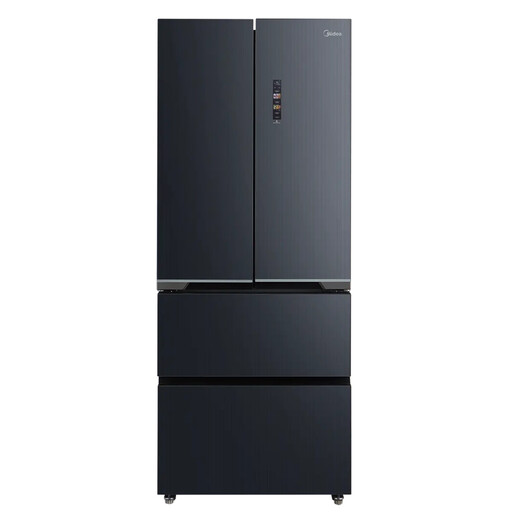
Why This Fits Their Persona: The 60cm depth is designed to sit more naturally with standard kitchen cabinetry, while the French door layout suits households storing wide dishes and fresh ingredients.
Its listed 753mm width and 600mm depth make the space requirement easier to check than assuming every American-style model needs a 90cm gap.
435-litre capacity, Total No Frost, 35dB operation and 285kWh annual consumption.
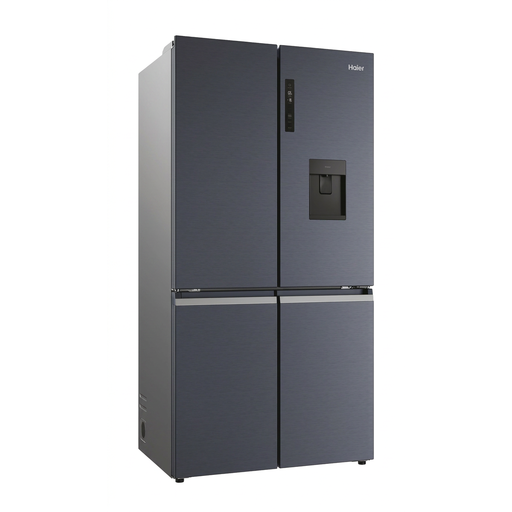
Why This Fits Their Persona: Large households and frequent batch shoppers can use the 528-litre layout for separate fresh, frozen and specialist storage zones.
The specification gives the full 908mm width, 648mm depth and 330kWh annual consumption, helping buyers assess whether the capacity justifies the space and running cost.
528-litre net capacity, Total No Frost, four-door access and an external water supply connection.
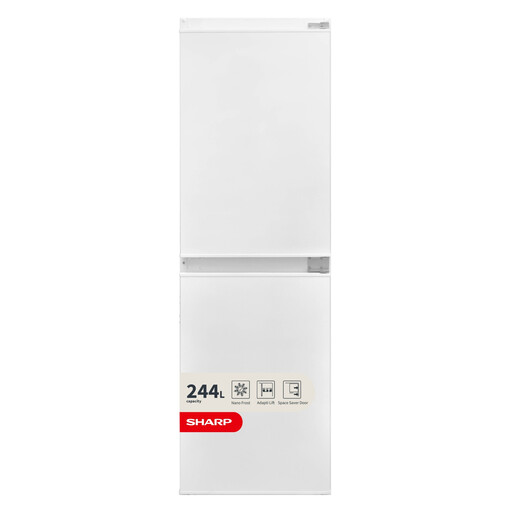
Why This Fits Their Persona: Homeowners planning a coordinated fitted kitchen can place this appliance behind a cabinet door for a consistent appearance.
It is identified as an integrated model with 1775 × 540 × 545mm dimensions, NanoFrost cooling and a sliding hinge, so it should not be confused with a freestanding equivalent.
244-litre net capacity, 50/50 storage split, reversible door and 38dB noise level.
We have compiled a complete, real-time list of products that fully satisfy these strict selection criteria and UK safety regulations.
They can be useful for households that want to reduce manual defrosting. Total No Frost models generally require less freezer maintenance than low frost models, although cleaning and ventilation checks remain necessary.
The correct clearance varies by model, so follow the installation instructions. Avoid blocking ventilation openings and allow enough room for doors, drawers and routine cleaning. Measure the complete installation area rather than relying on the appliance width alone.
Families often prefer larger French door, four-door or side-by-side fridge freezers because they provide more storage and clearer organisation. A conventional freestanding fridge freezer may be more suitable where kitchen width, budget or delivery access is limited.